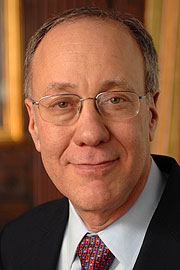

Sveriges Riksbank Prize in Economic Sciences · 2007
Roger B. Myerson
He showed how to write rules that make honesty pay, laying foundations for modern auctions, regulation and fairer institutions.
The Nobel citation: “for having laid the foundations of mechanism design theory”
- Born
- March 29, 1951, Boston, MA, USA
- Shared with
- Leonid Hurwicz, Eric S. Maskin
- Affiliation at the time
- University of Chicago, USA
Economics prize
2007
Shared with 2 other laureates.
Age that year
56years
Born in 1951.
Headline credited impact
$7.8–13.5billion in economic value
Public revenue raised by government spectrum auctions built on modern auction theory. How it was built
Sources cited
19
Fact-checked September 24, 2026.
- In 1972 a Harvard professor told his class that game theory was a field where only limited progress had been made. Myerson took that as his cue, and it became his life's work.
- His father did research and engineering for a family business that made artificial teeth.
- Yahoo! used optimal-auction theory from his 1981 paper to reset minimum ad prices on hundreds of thousands of search keywords, and revenue rose, mainly on popular keywords.
- When Nash, Harsanyi and Selten won the 1994 economics prize for game theory, he opened champagne with his Northwestern colleagues.
- In 2008 he spoke in Jerusalem at a conference President Shimon Peres organized for Israel's 60th anniversary, urging restraint as a path to peace.
The breakthrough
Designing rules that make honesty pay
Game theory studies how people act when their choices affect each other. Mechanism design flips the question: it asks how to write the rules so that people pursuing their own interests still reach a good result, even when each knows things the others do not. Think of the rule that one child cuts the cake and the other chooses: it makes the cutter slice fairly with no one checking. Several economists found a key tool, the revelation principle, at about the same time; Myerson developed it in its most general form. It says that whatever any set of rules can achieve can also be achieved by a simpler system in which everyone privately tells a trusted go-between the truth, and the rules make honesty each person's best move. That let economists search a manageable set of honest systems. In 1981 he used it to find the auction that earns a seller the most money (others reached some of the same results independently). He proved a general form of the rule that, under certain conditions, familiar formats (rising bids, falling prices and sealed bids) bring in the same expected revenue, and that a well-chosen minimum price can raise it. With Mark Satterthwaite he proved a sobering limit: when a buyer and a seller each keep their valuation secret, no bargaining system can guarantee they trade every time a deal would benefit both. With David Baron he showed how a regulator can oversee a monopoly whose true costs it cannot see.[2],[3],[4],[5],[6]
“I understand that the true Laureates are the ideas of incentive analysis and mechanism design”
What it meant for humanity
Myerson's work changes lives indirectly, through the rules that govern markets and public decisions. Before mechanism design, economists mostly asked how well free markets work. The Nobel committee credits the theory with helping economists tell apart situations where markets do well from those where they fail, and with guiding the design of trading systems, regulation and voting procedures.
Auctions are the clearest example. Before 1994 the United States handed out mobile-phone frequencies through "beauty contests" and lotteries, and much of their value went to speculators rather than the public. The auction formats that replaced them were invented by Paul Milgrom, Robert Wilson and Preston McAfee, but they rest on an auction theory whose methods Myerson's 1981 paper helped found. From 1994 to 2022 the Federal Communications Commission completed 100 spectrum auctions with about $259 billion in net winning bids. His theory of minimum prices has also reached online advertising: in a large experiment at Yahoo!, minimum prices guided by it raised search-ad revenue.
His model with David Baron, alongside parallel work by David Sappington, gave regulators a principled way to oversee a monopoly whose true costs they cannot see, and it set off a wave of research on options such as price caps. Since the 2003 invasion of Iraq, which he opposed, he has used game theory to argue that democracy must be built from the ground up, by letting elected local councils earn voters' trust with real budgets. He has pressed this idea for Iraq, Pakistan and Ukraine, where he has sat on the international advisory board of the Kyiv School of Economics since 2014.
- The Nobel committee says mechanism design helps economists see when markets work well and when they do not, and has helped identify efficient trading mechanisms, regulation schemes and voting procedures.[3],[4]
- His 1981 methods became the foundation for later auction theory. From 1994 to 2022 the US held 100 spectrum auctions with about $259 billion in net winning bids, using formats designed by later economists.[5],[14],[15]
- In a large Yahoo! field experiment, minimum ad prices guided by optimal-auction theory raised revenue on frequently searched keywords. The authors call it the first successful practical use of the 1981 results of Myerson and of Riley and Samuelson.[13]
- His 1982 model with David Baron of regulating a monopoly with hidden costs, together with work by David Sappington, set off a surge of research that gives regulators a sound basis for comparing options such as price caps.[5]
- Since the Iraq war he has argued for building democracy from elected local councils upward, writing on Iraq, Pakistan and Ukraine and advising the Kyiv School of Economics since 2014.[2],[7],[12],[19]
Impact in numbers
Most of Myerson's impact runs through ideas rather than products. The revelation principle, revenue equivalence and the Myerson-Satterthwaite limit are now standard tools, and in 2007 he noted that economics textbooks carry chapters built on ideas he helped articulate. Those tools shape auctions, regulation, contracts and the design of electoral systems, but in most of these areas his share cannot be separated from the work of many others. We record one number, with low confidence: public revenue from government spectrum auctions, which rest on the auction theory he helped found. We credit him with only 3 percent, because the formats actually used were invented by later economists, notably Paul Milgrom, Robert Wilson and Preston McAfee, and because the revenue is a transfer from phone companies to taxpayers rather than new wealth. His later work on state-building and local democracy has fed debate on Iraq and Ukraine, but we found no honest way to measure its effect.
EconomyFundamental scienceCommunication
Each number is the laureate’s credited share of a real-world outcome, cumulative to 2025. The whole outcome, the share of credit, and the reasoning are shown so you can check the arithmetic. Outcomes shared with other laureates are counted once on the impact page.
- Low confidenceRippleModeledEconomy
Public revenue raised by government spectrum auctions built on modern auction theory
$7.8–13.5
billion in economic value, credited share
That is 3% of $260–450 billion in economic value since 1994.
How this number was built
Low: net winning bids in the FCC table of 100 completed US spectrum auctions (1994-2022) sum to $259.1B, rounded to $260B, in nominal dollars; some bids went unpaid or to private parties (about $10B to broadcasters in 2017), roughly offset by omitting inflation. High: the Nobel committee (2020) says SMRA raised over $200B worldwide vs over $120B for the FCC in 1994-2014, implying roughly $80B abroad; $260B + $80B = $340B, plus allowances for other non-US sales and conversion to 2024 dollars, rounded to $450B. This is a transfer from firms to the public, not net new wealth. Share 0.03: Myerson's 1981 methods are a foundation of auction theory (Nobel 2007 background), but Vickrey, Milgrom, Wilson, McAfee and others built the formats actually used.[5],[12],[14],[15]
Sources: Federal Communications Commission; NobelPrize.org (Royal Swedish Academy of Sciences); Economic Sciences Prize Committee, Royal Swedish Academy of Sciences, via NobelPrize.org; Econ Journal Watch
The double edge
We found no serious harm traced to Myerson's work, but his tools serve whoever writes the rules. His optimal auction is built to maximize the seller's revenue, not the total good. Its main lever, a minimum or reserve price, means an item can go unsold even when a buyer values it, and it shifts money from buyers to the seller. Online platforms can use the same logic to raise what advertisers pay. The theory also rests on assumptions, such as attentive bidders whose values can be estimated, that do not always hold: in the Yahoo! experiment, theory-guided minimum prices lowered revenue per search for rarely searched keywords, where advertisers paid less attention. We assign no harm figure.
- Minor
Revenue-maximizing auctions favor the seller
Myerson's optimal auction sets a reserve price below which nothing is sold. The Nobel committee's background notes that this can leave an item unsold even when a bidder values it and the seller does not, an inefficient result by classical standards. At Yahoo!, theory-guided reserve prices raised what advertisers paid the platform.[5],[13]
- Minor
Theory can misfire when its assumptions fail
In the Yahoo! experiment, new reserve prices cut revenue per search by 2.5 percent for rarely searched keywords, likely because advertisers set those bids less carefully, and the company softened the theoretical prices for policy reasons. Earlier studies found real-world reserve prices far below the levels theory recommends.[13]
Against the odds
Myerson's path was not blocked by antisemitism, and we found no record that he faced it personally. He grew up in the 1950s and 1960s in Newton, a comfortable Boston suburb with good public schools, in a family that valued reading and science. The barriers that had shaped earlier Jewish lives in America had largely eased by the time he entered Harvard around 1969, where he later earned all three of his degrees. A generation before, Harvard's president Lawrence Lowell had set out to limit Jewish students: his proposed 15 percent quota drew criticism, so the college used other methods, and by 1933 the Jewish share was back down to 15 percent. What weighed on the young Myerson was a different fear. Like many of his generation he worried about nuclear war, and he remembers being troubled by cartoons about the 1956 Suez crisis. He writes that this fed his hope that social science could help leaders keep the peace, a hope that runs through his later work on deterrence and on rebuilding states after war. His story contrasts sharply with that of his co-laureate Leonid Hurwicz, who was in Switzerland when the Nazis invaded Poland in 1939 and reached the United States in 1940, while his father ended up in a labor camp in Russia.
—
Quota
Context, not a barrier he faced: he earned all three degrees at Harvard, which in the 1920s tried to hold down Jewish enrollment. Its president proposed a 15 percent quota, then used other methods, bringing the Jewish share back to 15 percent by 1933. We found no sign such limits touched him.[7],[16]
Jewish background
Myerson was born in Boston in 1951 into a Jewish family and grew up in nearby Newton. The sources we found do not name his parents or trace their origins; he writes that his father worked in a family business that made artificial teeth. In 2007 he told Chicago's Jewish United Fund that he was raised in Reform Judaism and values its stress on each person making informed choices about which Jewish traditions to keep. He has long given to the Chicago Jewish federation, spoke about Iraq at Beth Emet synagogue in Evanston in 2006, and in 2008 addressed a Jerusalem conference marking Israel's 60th anniversary.[2],[8],[9],[10],[11],[18]
Key dates
March 29, 1951
Born in Boston, Massachusetts; grows up in nearby Newton.[1],[8]
1972
Discovers game theory in Howard Raiffa's decision-analysis course at Harvard and begins studying it on his own.[2]
1973
Earns an A.B. summa cum laude and an S.M. in applied mathematics at Harvard.[7]
1976
Completes a Harvard Ph.D. in applied mathematics under Kenneth Arrow, with a thesis on cooperative games.[2],[7]
1976
Joins Northwestern University's decision sciences department, where he does much of his prize-winning work over 25 years.[1],[2],[7],[8]
1979
Publishes his first paper on the revelation principle, in Econometrica.[2],[7]
1981
Publishes "Optimal Auction Design", which works out the auction that maximizes a seller's expected revenue.[5],[7]
1982
Marries Regina (Gina) Weber; their children Daniel and Rebecca are born in 1983 and 1985.[2],[7]
1983
With Mark Satterthwaite, proves that no bargaining system can guarantee every mutually beneficial trade when buyer and seller keep their values private.[4],[5]
1991
Publishes the textbook Game Theory: Analysis of Conflict.[2],[7]
2001
Moves to the University of Chicago's economics department.[2],[7],[17]
October 15, 2007
Awarded the economics prize with Leonid Hurwicz and Eric Maskin for laying the foundations of mechanism design theory.[1],[3]
May 14, 2008
Speaks in Jerusalem on restraint and deterrence at a conference President Shimon Peres organized for Israel's 60th anniversary.[11]
2009
Serves as president of the Econometric Society, is elected to the National Academy of Sciences and receives the Jean-Jacques Laffont Prize.[7]
Sources
- 1.Roger B. Myerson - Facts · NobelPrize.org (Nobel Prize Outreach)
- 2.Roger B. Myerson - Biographical · NobelPrize.org (from Les Prix Nobel 2007), 2007
- 3.The Prize in Economic Sciences 2007 - Press release · NobelPrize.org (Royal Swedish Academy of Sciences), 2007
- 4.Information for the public: Asymmetric information and economic institutions · Royal Swedish Academy of Sciences, via NobelPrize.org, 2007
- 5.Scientific background: Mechanism Design Theory · Economic Sciences Prize Committee, Royal Swedish Academy of Sciences, via NobelPrize.org, 2007
- 6.Perspectives on Mechanism Design in Economic Theory (Prize Lecture, 8 December 2007) · NobelPrize.org, 2007
- 7.Curriculum Vitae: Roger B. Myerson (September 2026) · University of Chicago (Roger Myerson's faculty website), 2026
- 8.Nobel Prize winners have Jewish, Chicago connections · JUF News, Jewish United Fund of Metropolitan Chicago (Wayback Machine copy), 2007
- 9.Roger Myerson · Jewish Virtual Library
- 10.The Challenge of Establishing Democracy in Iraq: notes for a talk at Beth Emet, the Free Synagogue (June 16, 2006) · Roger Myerson, University of Chicago faculty website, 2006
- 11.The Power of Restraint in Strategies of Conflict and Peace (talk in Jerusalem, May 14, 2008) · Roger Myerson, University of Chicago faculty website, 2008
- 12.Roger B. Myerson [Ideological Profiles of the Economics Laureates] (Klein, Daza and Mead), Econ Journal Watch 10(3) · Econ Journal Watch, 2013
- 13.Reserve Prices in Internet Advertising Auctions: A Field Experiment (Ostrovsky and Schwarz), Journal of Political Economy 131(12) · Stanford University (author copy of University of Chicago Press article), 2023
- 14.The Prize in Economic Sciences 2020 - Popular information: Improvements to auction theory and inventions of new auction formats · NobelPrize.org (Royal Swedish Academy of Sciences), 2020
- 15.Auctions Summary: Completed Spectrum Auctions (Wayback Machine copy, November 2025) · Federal Communications Commission, 2025
- 16.Getting In: the social logic of Ivy League admissions (Malcolm Gladwell, on Jerome Karabel's The Chosen) · The New Yorker, 2005
- 17.Roger Myerson (faculty home page) · University of Chicago
- 18.Our Story · Beth Emet The Free Synagogue, Evanston, Illinois
- 19.Perspective & Essays · Roger Myerson, University of Chicago faculty website
Fact-checked on September 24, 2026 by a separate AI fact-checking pass that re-opened the sources, with 11 corrections made. How we check
Suggest a correction