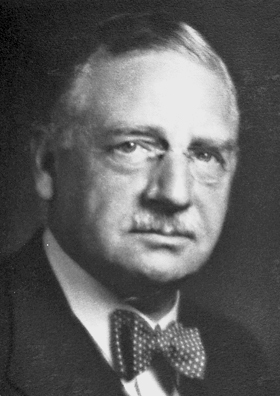

Nobel Prize in Physiology or Medicine · 1936
Otto Loewi
With two frog hearts he proved that nerves signal with chemicals, a basis for many medicines, before the Nazis drove him from Austria.
The Nobel citation: “for their discoveries relating to chemical transmission of nerve impulses”
- Born
- June 3, 1873, Frankfurt-on-the-Main, Germany
- Died
- December 25, 1961, New York, NY, USA
- Shared with
- Sir Henry Dale
- Affiliation at the time
- Graz University, Austria
Medicine prize
1936
Shared with 1 other laureate.
Age that year
63years
Born in 1873.
Headline credited impact
$22–26billion in economic value
Cumulative global sales of drugs that act on G-protein-coupled receptors, 1990-2025 (a proxy for economic activity). How it was built
Sources cited
24
Fact-checked September 24, 2026.
- By his own account, the idea for his Nobel experiment came to him in his sleep. He could not read the notes he scribbled, but the idea returned the next night.
- As Nazi Germany took over Austria in March 1938, he and two of his sons were arrested. He could leave only after being forced to send his Nobel money to a Nazi-controlled bank.
- Arriving in New York in 1940, he saw that a doctor's certificate in his papers called him senile and unable to earn a living. The immigration officer ignored it and let him in.
- He refused to be baptized to help his career, a step many Jewish officials in Austria took, and the Graz medical faculty resisted his appointment in 1909.
- His famous experiment was hard to repeat. One later explanation: the Hungarian frogs he used have hearts with little of the enzyme that destroys the nerve's chemical signal.
The breakthrough
Proof that nerves pass on their signals by releasing chemicals
Nerves carry messages as tiny electrical pulses. But until 1921 nobody knew how a nerve's message crossed the last gap to the organ it controls. Did the electric pulse jump straight across, or did the nerve release a chemical? Loewi settled it with two frog hearts, each kept beating in a small glass tube of salt solution. He stimulated the vagus nerve of the first heart, the nerve that slows the heartbeat, and the heart slowed. Then he moved some of the fluid from inside that heart into a second heart that had been removed without its nerves. The second heart slowed too. The nerve must have released a substance into the fluid, and that substance carried the message. Fluid collected while he stimulated the nerve that speeds the heart made the second heart beat faster. Loewi called the slowing substance Vagusstoff, German for 'vagus substance'. By 1926 he and his co-worker Navratil had shown that it behaves like acetylcholine, a chemical Dale had studied years earlier, and that an enzyme in the heart soon breaks it down unless a plant alkaloid called eserine blocks that enzyme. In 1936 he showed that the speeding substance was adrenaline or something very close to it. Think of a nerve ending not as a wire touching the heart, but as a messenger who drops a written note across the gap, and of the enzyme as a shredder that quickly clears the note away.[1],[2],[3],[4],[5],[7],[21]
“The next night, at three o'clock, the idea returned.”
What it meant for humanity
Loewi's two frog hearts settled an old argument about how the body works: nerves pass their messages on by releasing chemicals. Presenting the 1936 prize, the Nobel speaker called this a revolution in understanding how many substances act on the body, and said it had already greatly influenced pharmacology. Loewi's own lab found the same mechanism in the eye, and he concluded that it applies to all the nerves of the autonomic system, which runs the heartbeat, the gut, the glands and the pupils. Dale's group showed that acetylcholine also carries signals between nerve cells and from nerves to muscles. The idea turned the body's own messengers into targets for medicine. Others, not Loewi, invented the drugs that copy, boost or block these messengers, but they built on the principle he proved. A 2017 survey counted 481 drugs, about a third of all drugs approved in the United States, acting on one large family of cell-surface receptors, and 321 of them act on receptors for amine messengers such as adrenaline and dopamine. Another survey lists all nine adrenaline receptors and all five muscarinic acetylcholine receptors as targets of approved drugs. His finding with Navratil that eserine works by blocking the enzyme that destroys acetylcholine was, as he pointed out, the first time an alkaloid's mode of action had been revealed. Enzyme blockers of this kind brought dramatic relief to people with the muscle-weakness disease myasthenia gravis from the mid-1930s, and three common Alzheimer's drugs, donepezil, galantamine and rivastigmine, work the same way, though a Cochrane review found their benefits small. Years earlier, in 1902, he had shown that animals can build their proteins from amino acids, a key finding for nutrition.
- In 1921 he showed that fluid from a frog heart whose vagus nerve had been stimulated slowed a second heart. It was the first clear proof that nerves act by releasing chemical substances.[1],[4],[7],[21]
- With Navratil in 1926 he showed that the vagus substance behaves like acetylcholine and that eserine protects it by blocking the enzyme that breaks it down. Dale and others then used eserine to detect chemical signalling elsewhere.[3],[4],[7],[15]
- At the 1926 International Congress of Physiology in Stockholm he demonstrated his experiment before colleagues, at a time when others had trouble repeating it.[6],[7]
- About a third of approved drugs act on G-protein-coupled receptors, and two-thirds of those target receptors for amine messengers such as adrenaline, the kind of chemical signalling his experiment first proved.[16],[17]
- Drugs that block acetylcholine's breakdown, the mechanism he explained for eserine, relieved myasthenia gravis from the 1930s. Three common Alzheimer's drugs work the same way, with small benefits.[3],[20],[24]
- In 1902 he showed that animals can make their own proteins from amino acids, the building blocks of protein. The Nobel Foundation calls this an essential discovery for nutrition.[2],[7]
Impact in numbers
Loewi gave medicine a principle rather than a product: nerves act by releasing chemicals. That principle underlies whole families of drugs that copy, boost or block the body's messengers, but other scientists invented those drugs over decades, often by trial and error. We therefore make one small, low-confidence ripple claim on the same outcome used for Robert Lefkowitz: cumulative world sales of drugs acting on G-protein-coupled receptors, about $4.4 to $5.2 trillion from 1990 to 2025. Two-thirds of those drugs act on receptors for amine messengers such as adrenaline, and we credit Loewi with 0.5% of the whole, about $22 to $26 billion. Sales measure spending, not health gained, and we make no lives-saved claim because no study separates his part. We make no harm claim for nerve agents and pesticides that attack the acetylcholine system, since they came from pesticide chemistry, not his work. Much of his legacy cannot be counted, including eserine as a research tool that let others trace chemical signalling through the nervous system.
HealthFundamental scienceEconomy
Each number is the laureate’s credited share of a real-world outcome, cumulative to 2025. The whole outcome, the share of credit, and the reasoning are shown so you can check the arithmetic. Outcomes shared with other laureates are counted once on the impact page.
- Low confidenceRippleModeledEconomy
Cumulative global sales of drugs that act on G-protein-coupled receptors, 1990-2025 (a proxy for economic activity)
$22–26
billion in economic value, credited share
That is 0.5% of $4.4–5.2 trillion in economic value since 1990.
How this number was built
Range reused from the Lefkowitz profile so totals line up. Low case: GPCR drugs ~27% of the drug market (Hauser 2017); high case: 35%, Sriram & Insel's share of approved drugs. Applied to IMS prescription sales of $127.7B (1990) and $282.5B (2000) (WHO 2004, Table 4.2), then ~$178B a year in 2011-15 (Hauser: $890B for the 5 years), held flat or grown 3%/yr to 2025: $4.4T low, $5.2T high, nominal. Share: using drug counts as a stand-in for sales, Hauser counts 321 of 481 approved GPCR drugs (67%) acting on aminergic receptors (adrenaline, dopamine, acetylcholine and similar), the kind of signalling Loewi first proved. Within that class his credit is 0.75%, because Elliott proposed the idea, Dale's school extended it, and others found further transmitters, receptors and the drugs themselves: 0.67 x 0.0075 = 0.005. Sales measure spending, not benefit.[4],[7],[16],[17],[18]
Sources: Nature Reviews Drug Discovery (via PubMed Central); Molecular Pharmacology (via PubMed Central); World Health Organization; NobelPrize.org; Encyclopedia.com (Charles Scribner's Sons / Gale)
The double edge
No harm has been traced to Loewi's own conduct or experiments. The shadow is that the chemical signalling he uncovered can be attacked as well as treated. Nerve agents such as sarin, first made in Germany in 1938 in a search for insecticides, and organophosphate pesticides kill by blocking the enzyme that clears acetylcholine. It is the same enzyme that, as Loewi and Navratil found in 1926, eserine blocks. A 2016 review counts 12 deaths from sarin in the 1995 Tokyo subway attack and puts the toll of a 2013 attack near Damascus at about 1,729, though estimates of that toll vary. These poisons came out of pesticide chemistry, not from his experiments, so this profile does not charge their toll to him. His science also had weak spots. His famous experiment was hard to repeat, he later withdrew an early theory about how insulin works, and he long doubted that chemical signalling operated between nerves and muscles, which Dale's group went on to show.
- Moderate
Nerve agents attack the same chemical signal
Sarin and related nerve agents, and many pesticides, are organophosphates that block acetylcholinesterase, so acetylcholine builds up and breathing can fail. Sarin was first made in Germany in 1938 as a possible insecticide and later developed into a weapon. A 2013 sarin attack near Damascus killed hundreds; one review puts the toll at about 1,729. The poisons did not come from Loewi's work, but they strike the system he helped reveal.[7],[19]
- Minor
An experiment that was hard to repeat
His 1921 result was not always easy to reproduce, and he reportedly often failed himself. Success depended on the frog species and the season. The first paper was more cautious than his later retellings, and the physiologist Leon Asher criticized the work. A 1926 public demonstration in Stockholm and later research confirmed it.[6],[7]
- Minor
Missteps and scepticism
By 1929 he had to disavow some of his results on insulin and his hypothesis about how it works. He also stayed stubbornly doubtful, as Dale recalled, that chemicals carried signals beyond the autonomic nerves. Dale and his colleagues showed that they also work between nerve cells in ganglia and from nerves to muscles.[4],[7]
Against the odds
Loewi built his career in Austria when many Jewish civil servants were baptized to get ahead. He refused, and the Graz medical faculty resisted his appointment in 1909 because he openly identified as Jewish. Graz's Jews lived largely apart from the rest of society, and in the late 1930s the city became a stronghold of Austrian Nazism. When Germany annexed Austria in March 1938, about 192,000 Jews lived in the country. On the night of 11 to 12 March the Nazis arrested Loewi and his sons Viktor and Guido in a sweep of prominent Jews and officials of the old regime. He was shocked that one of the Gestapo men was the son of a university colleague. He was held for about two months and forced out of his post, one of about 17 percent of the university's teachers expelled that year, along with nearly a third of its students. He could leave only after being made to transfer his Nobel Prize money from Stockholm to a Nazi-controlled bank, and he reached England in September 1938 with nothing. In November, on Kristallnacht, the Graz synagogue was dynamited and burned. His wife, Guida, was kept back while the Nazis took her family's property in Italy. She spent three years in crowded lodgings in Vienna, afraid of deportation, before she was allowed out in 1941. Their four children scattered to other countries.
1909
Discrimination
When he was appointed professor of pharmacology in Graz, the medical faculty resisted because he openly identified as Jewish and would not be baptized, as many Jewish civil servants did to secure promotion.[10]
1938
Imprisonment
On the night of 11 to 12 March 1938, as Germany annexed Austria, he and his sons Viktor and Guido were taken into so-called protective custody in Graz. He was held for about two months; his sons were released about three weeks after him.[7],[9],[10]
1938
Dismissal
While he was in custody the university put him on leave, and by the end of May 1938 it had forced him into early retirement, ending the chair of pharmacology he had held since 1909. The university expelled about 17 percent of its teachers and nearly a third of its students in 1938.[9],[10],[11],[14]
1938
Persecution
The Gestapo forced him to transfer his Nobel Prize money from a bank in Stockholm to a bank under Nazi control before he was allowed to emigrate. The regime also took the family's real estate.[2],[7],[9]
1938
Exile
He left Austria for England in September 1938 without money or property, then worked in Brussels and Oxford before taking a research professorship at New York University in 1940.[2],[7],[9],[10]
1938
Antisemitic attack
About 192,000 Jews lived in Austria in 1938. In Graz, home to about 1,600 Jews on Kristallnacht in November, the synagogue was dynamited and burned, and more than 300 Jews were sent to the Dachau concentration camp.[12],[13]
1941
Persecution
His wife, Guida, was held back while the Nazis seized her family's property in Italy. She lived for three years in crowded lodgings in Vienna, afraid of deportation, and was let out in 1941 only as a destitute Jew.[7],[9],[10]
Jewish background
Loewi was born in Frankfurt to Jacob Loewi, a Jewish wine merchant, and Anna Willstätter; the Royal Society describes both parents as Jewish, and the Neue Deutsche Biographie lists his religion as Jewish. The family acknowledged its Jewish identity but was not religious. In Graz the Loewis did not attend synagogue and even had a Christmas tree. Yet he refused to be baptized to advance his career, belonged to the B'nai B'rith lodge and a Jewish academic association, and called himself a German-speaking cosmopolitan of Jewish origin. In 1938 the Nazis jailed him with other Jewish men of Graz, and his wife was allowed to leave only as a destitute Jew.[7],[8],[9],[10],[23]
Key dates
June 3, 1873
Born in Frankfurt am Main, Germany, to Jacob Loewi, a wine merchant, and Anna Willstätter.[1],[2],[9],[23]
1896
Earns his medical doctorate at Strasbourg, with a thesis on a topic suggested by the pharmacologist Oswald Schmiedeberg.[2]
1902
Shows that animals can build proteins from amino acids. Visiting Starling's lab in London, he meets Henry Dale, his lifelong friend.[2],[7]
April 5, 1908
Marries Guida Goldschmiedt in Graz. They have three sons and a daughter.[2],[10]
1909
Appointed to the chair of pharmacology at the University of Graz, despite faculty resistance to a professor who would not be baptized.[2],[10]
1921
Publishes his two-frog-heart experiment, the first proof that nerves act by releasing chemical substances.[1],[7],[21]
1926
With Navratil, shows that the vagus substance behaves like acetylcholine and explains how eserine protects it. Demonstrates his experiment at the physiology congress in Stockholm.[3],[6],[7]
December 10, 1936
Receives the Nobel Prize in Physiology or Medicine with Sir Henry Dale for discoveries on the chemical transmission of nerve impulses.[1],[4]
March 1938
Arrested with two of his sons as Germany annexes Austria. Held about two months and forced out of the chair he had held since 1909.[7],[9],[10],[23]
September 28, 1938
Leaves for England only after transferring his Nobel Prize money to a Nazi-controlled bank, stripped of his property. He later works in Brussels and Oxford.[2],[7],[9],[10],[22],[23]
1940
Moves to the United States as research professor of pharmacology at New York University's College of Medicine.[2],[8]
1941
His wife, Guida, is finally allowed to leave Nazi-ruled Vienna and joins him in the United States.[7],[10]
1946
Becomes a US citizen. In 1954 he is elected a Foreign Member of the Royal Society.[2],[8]
December 25, 1961
Dies in New York at 88. His family later donates his papers to the Royal Society in London, which also holds his Nobel medal.[1],[8]
Sources
- 1.Otto Loewi - Facts · NobelPrize.org (Nobel Prize Outreach)
- 2.Otto Loewi - Biographical (from Nobel Lectures, Physiology or Medicine 1922-1941) · NobelPrize.org (Nobel Foundation), 1965
- 3.The Chemical Transmission of Nerve Action (Nobel Lecture, 12 December 1936) · NobelPrize.org, 1936
- 4.Award ceremony speech by G. Liljestrand, 10 December 1936 · NobelPrize.org, 1936
- 5.Speed read: Crossing the gap (Nobel Prize in Physiology or Medicine 1936), by Sophie Petit-Zeman · NobelPrize.org, 2009
- 6.Otto Loewi - Banquet speech, 10 December 1936 (in German) · NobelPrize.org, 1936
- 7.Loewi, Otto (Complete Dictionary of Scientific Biography, by Gerald L. Geison; page also carries Encyclopedia of World Biography and Encyclopaedia Judaica entries) · Encyclopedia.com (Charles Scribner's Sons / Gale)
- 8.Escape to New York (Eloise Barber on Otto Loewi's detention and exile) · The Royal Society (blog), 2025
- 9.Loewi, Otto - Biography (Gedenken und Erinnern) · German Society of Internal Medicine (DGIM)
- 10.Otto Loewi (Familie Loewi) - Stolpersteine in Graz · Verein für Gedenkkultur in Graz (Stolpersteine Graz)
- 11.Dr. Otto Loewi, Nobel Prize Winner, Dies in New York; Held by Nazis · Jewish Telegraphic Agency (archive), 1961
- 12.Graz, Austria (from Encyclopaedia Judaica, 2007) · Jewish Virtual Library (AICE), 2007
- 13.Austria (Holocaust Encyclopedia) · United States Holocaust Memorial Museum
- 14.History of the Medical University of Graz · Medical University of Graz
- 15.Otto Loewi (Otto Loewi Research Center) · Medical University of Graz
- 16.Trends in GPCR drug discovery: new agents, targets and indications (Hauser AS et al., Nat Rev Drug Discov 16:829-842), author manuscript · Nature Reviews Drug Discovery (via PubMed Central), 2017
- 17.G protein-coupled receptors as targets for approved drugs: how many targets and how many drugs? (Sriram K, Insel PA, Mol Pharmacol 93:251-258) · Molecular Pharmacology (via PubMed Central), 2018
- 18.The World Medicines Situation (WHO/EDM/PAR/2004.5), Table 4.2 · World Health Organization, 2004
- 19.Sarin (GB, O-isopropyl methylphosphonofluoridate) neurotoxicity: critical review (Abou-Donia MB et al., Crit Rev Toxicol 46:845-875), author manuscript · Critical Reviews in Toxicology (via PubMed Central), 2016
- 20.The history of acetylcholinesterase inhibitors in the treatment of myasthenia gravis (Katz NK, Barohn RJ, Neuropharmacology 182:108303) · Neuropharmacology (PubMed record), 2021
- 21.One hundred years from Otto Loewi experiment, a dream that revolutionized our view of neurotransmission (Borges R, García AG, Pflugers Arch 473:977-981) · Pflügers Archiv (PubMed record), 2021
- 22.Otto Loewi (biography by Harro Jenss, Gegen das Vergessen) · German Society for Gastroenterology, Digestive and Metabolic Diseases (DGVS), 2023
- 23.Loewi, Otto (by Michael Engel), Neue Deutsche Biographie 15 (1987), pp. 108-109 · Deutsche Biographie (Historical Commission at the Bavarian Academy of Sciences), 1987
- 24.Cholinesterase inhibitors for Alzheimer's disease (Birks JS, Cochrane Database of Systematic Reviews, CD005593), plain-language summary · Cochrane, 2006
Fact-checked on September 24, 2026 by a separate AI fact-checking pass that re-opened the sources, with 5 corrections made. How we check
Suggest a correction