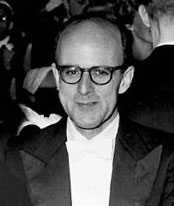

Nobel Prize in Chemistry · 1962
Max F. Perutz
He spent 22 years on the first 3D picture of hemoglobin, then showed how the blood protein picks up and delivers oxygen.
The Nobel citation: “for their studies of the structures of globular proteins”
- Born
- May 19, 1914, Vienna, Austria
- Died
- February 6, 2002, Cambridge, United Kingdom
- Shared with
- John C. Kendrew
- Affiliation at the time
- MRC Laboratory of Molecular Biology, United Kingdom
Chemistry prize
1962
Shared with 1 other laureate.
Age that year
48years
Born in 1914.
Sources cited
29
Fact-checked September 24, 2026.
- Colleagues laughed in 1937 when he said he would solve hemoglobin's structure. The first 3D picture took 22 years and appeared in 1959.
- Interned as an 'enemy alien' in 1940, he was shipped to a camp in Canada, where he set up a camp university taught by fellow internees.
- In World War II he tested pykrete, a frozen mix of ice and wood pulp, for a secret plan to build an aircraft carrier out of ice.
- Watson and Crick found DNA's double helix in the small research unit he led; in 1962 its scientists won two Nobel Prizes.
- At about 80 he turned from hemoglobin to Huntington's disease, studying how long runs of glutamine make proteins clump together.
The breakthrough
Cracking the phase problem and revealing hemoglobin's 3D structure (1953-1970)
Proteins do most of the work in living cells, and each job depends on the protein's shape. In the 1930s nobody could see that shape, because proteins are far too small for any microscope. The best hope was X-ray crystallography: shine X-rays through a protein crystal and they scatter into thousands of spots on film. Turning those spots back into a picture of the atoms needs two facts about each spot, its brightness and its phase, or timing. Film records only the brightness. For hemoglobin, with about 10,000 atoms, the missing half looked impossible to recover. In 1953 Perutz showed that attaching heavy mercury atoms at fixed sites on hemoglobin changed the brightness of the spots by a measurable amount. Comparing crystals with and without heavy atoms let him work out the missing phases, much as one bright landmark lets you orient an otherwise unreadable map. The trick was already used on small molecules, but many experts thought it would fail for proteins. His colleague John Kendrew used it to solve the smaller muscle protein myoglobin first. In 1959 Perutz's team saw hemoglobin, the oxygen carrier in red blood cells, in 3D: four chains, each holding an iron-containing heme group. By 1970 he had atomic models of its oxygen-loaded and oxygen-free forms and showed how the molecule shifts shape to grab oxygen in the lungs and release it in the body's tissues.[3],[4],[5],[6],[7],[8],[18],[19]
“the glaring sunlight of certain knowledge is dull and one feels most exhilarated by the twilight and expectancy of the dawn”
What it meant for humanity
Perutz's work, alongside Kendrew's, proved that the shapes of life's large molecules could be seen, and that seeing them helps explain health and disease. Protein crystallography, the method he and Kendrew pioneered, is now used worldwide. The Protein Data Bank holds more than 227,000 experimentally determined structures of biological molecules, most of them solved by X-ray crystallography, and drug developers lean on them. A 2019 study found that the archive held structures covering 88 percent of the 210 new drugs approved by the US Food and Drug Administration from 2010 to 2016. The archive also includes more than 1,450 crystal structures of the coronavirus enzyme blocked by nirmatrelvir, the active ingredient of the COVID-19 pill Paxlovid. Perutz also brought structure to the clinic. In 1968 he and the Cambridge clinical biochemist Hermann Lehmann placed known mutations onto his hemoglobin model and explained, atom by atom, why some patients made too many red blood cells, others too few, and others had cells that broke apart. Their paper announced a new field, molecular pathology. His 1970 account of how hemoglobin loads and unloads oxygen became a classic example of how proteins change shape to do their jobs. Not every effort paid off: his search for drugs to keep sickle-cell hemoglobin from clumping did not succeed. At about 80 he turned to Huntington's disease and related disorders, showing that proteins with long runs of the amino acid glutamine stick together in clumps linked to the death of nerve cells. As founding chairman of the MRC Laboratory of Molecular Biology, he kept paperwork light and let talented people follow their ideas; the lab counts 12 Nobel Prizes for work by its scientists.
- In 1953 he showed that heavy atoms such as mercury, fixed to a protein, could reveal the missing phases in X-ray data, the step that made protein crystal structures possible.[4],[5],[6],[7]
- In 1968, with Hermann Lehmann, he explained the symptoms of inherited hemoglobin disorders at the atomic level, announcing the field of molecular pathology. He later X-rayed candidate anti-sickling drugs bound to hemoglobin.[5],[8],[17],[29]
- The Protein Data Bank now holds more than 227,000 experimentally determined structures, most solved by X-ray crystallography, the approach he and Kendrew pioneered for proteins.[15],[22],[23]
- Structures in the Protein Data Bank covered 88% of the 210 new drugs the US FDA approved in 2010-2016; more than half of those structures were public over a decade before approval.[21]
- He founded and for 17 years chaired the MRC Laboratory of Molecular Biology in Cambridge, which counts 12 Nobel Prizes for work by its scientists.[5],[14]
- In his last years he showed that long glutamine repeats, like those in Huntington's disease, make proteins stick together in clumps linked to nerve-cell death.[5],[20]
Impact in numbers
Perutz's legacy is a way of seeing. By showing in 1953 that heavy atoms could unlock X-ray data from proteins, and by solving hemoglobin, he and Kendrew proved that the machinery of life could be mapped in three dimensions. That approach produced most of the more than 227,000 structures in a public archive that drug designers use routinely, and his 1968 work with Lehmann was among the first explanations of inherited disease in atomic terms. He also built one of the most productive laboratories in science. We make no quantified claim. Protein crystallography became a tool shared by laboratories worldwide, and the drugs, diagnoses and discoveries built on it passed through so many hands that any share of lives saved credited to Perutz would be guesswork. His own search for a sickle-cell drug did not produce a treatment.
Fundamental scienceHealth
No number is given here on purpose. Some contributions cannot be counted honestly, and we would rather describe them than invent a figure.
The double edge
No harm is known to flow from Perutz's research. The main controversy concerns credit for DNA's double helix. In early 1953 he handed Watson and Crick a report on the King's College London group's work, which included a page of Rosalind Franklin's unpublished results, without first asking the London group. Watson's 1968 memoir, The Double Helix, drew wide attention to the episode. In a 1969 letter to Science, Perutz said the report was not confidential and the data had been presented in talks, but admitted that as a courtesy he should have asked permission; Watson responded with an apology for misrepresenting the incident. Historians who reexamined the record in 2023 agreed that it was not confidential and faulted Watson and Crick for not seeking permission or clearly crediting the data. During the Second World War Perutz also worked on a secret military plan for a floating airfield made of reinforced ice; it was abandoned, and the full-size vessel was never built.
- Moderate
Passing Rosalind Franklin's data to Watson and Crick
In early 1953 Perutz gave Watson and Crick an MRC report on the King's College group's work, including a page from Franklin describing her results, without consulting the London group. In 1969 he wrote in Science that it was not confidential but that he should have asked as a courtesy. A 2023 Nature analysis agreed it was not confidential and said Watson and Crick should have sought permission and credited the data clearly.[5],[13]
- Minor
Secret wartime military project
During the war he worked on Habakkuk, a plan by Britain's Combined Operations command for a giant floating airfield made of pykrete, a frozen mix of ice and wood pulp, to refuel aircraft in the Atlantic. Pykrete was tested and demonstrated to Allied leaders, but the project lost priority and was abandoned; the full-size vessel was never built.[5],[8]
Against the odds
Perutz grew up comfortably in Vienna, a city where Jews were prominent in business, journalism and law but faced widespread prejudice. His biographer says Jews there were effectively shut out of university teaching and government posts unless they converted, one reason his parents had him baptized. As a chemistry student from 1932 to 1936 he wrote of Nazi thugs beating up students on campus, and he avoided the main university campus, fearing attack because he looked Jewish. He moved to Cambridge in 1936 for the science, not to escape. Then in March 1938 Germany annexed Austria. The family textile business was seized, his parents fled through Czechoslovakia and Switzerland, and they reached Britain in early 1939 with almost nothing. Perutz, now classed as a refugee and with his own money gone, had to support them. More than 65,000 of Austria's roughly 185,000 Jews were murdered in the Holocaust. In 1940 Britain interned him as an 'enemy alien' and shipped him to Canada with other internees, most of them Jewish refugees; at sea they learned that another ship carrying internees had been torpedoed, with more than 600 dead. Freed after about eight months, he met antisemitic, anti-Catholic and anti-German prejudice in England and lived from grant to grant for years.
—
Discrimination
As a University of Vienna student (1932-36) he wrote of Nazi thugs beating up students on campus, and he stayed away from the main university campus, fearing he would be attacked because he looked Jewish.[8]
1938
Persecution
After Germany annexed Austria in March 1938 and applied its anti-Jewish laws there, his family's textile business was expropriated and his parents fled via Czechoslovakia and Switzerland, reaching Britain destitute in early 1939. More than 65,000 of Austria's Jews were later murdered.[2],[5],[8],[24],[25],[27]
1938
Exile
Already in Cambridge when Austria fell, he could not go home. He was reclassified as a refugee, became stateless and ran out of money until a Rockefeller grant from January 1939 rescued him; he then had to support his parents in Britain.[2],[8],[12],[27]
1940
Imprisonment
Britain interned him as an enemy alien in 1940 and deported him to a camp in Canada, many of whose inmates were Jewish refugees. Colleagues campaigned for his release, and he was back in Cambridge by January 1941.[5],[9],[26]
—
Discrimination
In wartime England he was often the target of antisemitic, anti-Catholic and anti-German sentiment, and he lived from grant to grant with no permanent post until the MRC laboratory was established.[11],[12]
Jewish background
Perutz was born in Vienna to Hugo Perutz and Dely (Adele) Goldschmidt, both from Jewish families of textile industrialists; his father's family traced its roots to an 18th-century rabbi in Bohemia. His parents were not observant, and he wrote that neither ever entered a synagogue. Believing a Catholic son would have an easier path in Vienna, they had him baptized as a child, after both his grandmothers, who were more attached to Judaism, had died. He grew up nominally Catholic and later rejected religion. Under Nazi racial law he counted as Jewish, and his parents fled Austria in 1938.[5],[8],[9],[10],[12],[28]
Key dates
May 19, 1914
Born in Vienna, the youngest child of textile manufacturer Hugo Perutz and Dely (Adele) Goldschmidt.[1],[2],[11]
September 1936
After chemistry studies at the University of Vienna, becomes a research student under J. D. Bernal at the Cavendish Laboratory in Cambridge.[2],[5]
September 1937
A conversation in Prague with biochemist Felix Haurowitz sets him on the X-ray study of hemoglobin, his life's main work.[2],[5],[6]
1938
Germany annexes Austria; his family's business is expropriated and his parents flee. From January 1939 a Rockefeller grant keeps him in Cambridge and lets him bring his parents to Britain.[2],[5]
1940
Completes his PhD, then is interned as an 'enemy alien' and shipped to a camp in Canada; he returns to Cambridge in January 1941.[5],[9]
1943
Is rapidly naturalized as a British citizen so he can travel to the US for Habakkuk, a secret project to build a floating airfield of reinforced ice.[5],[8]
October 1947
Becomes head of a new Medical Research Council unit for molecular biology at the Cavendish, with John Kendrew as its only other member.[2],[16]
1953
Shows that attaching heavy mercury atoms to hemoglobin can solve the phase problem for protein crystals.[4],[5],[6]
1959
His team obtains the first 3D picture of hemoglobin at 5.5-angstrom resolution, published in Nature in 1960.[8],[16],[19]
1962
Shares the Nobel Prize in Chemistry with John Kendrew and becomes first chairman of the new MRC Laboratory of Molecular Biology.[1],[2],[5]
1968
With Hermann Lehmann, explains inherited hemoglobin diseases in atomic terms, in a paper announcing a new field, molecular pathology.[5],[17]
1970
Publishes his atomic mechanism for how hemoglobin switches shape to load and unload oxygen.[5],[18]
1994
At about 80, proposes that glutamine repeats act as 'polar zippers' and that overly long repeats may cause Huntington's and related brain diseases.[5],[20]
February 6, 2002
Dies of cancer in Cambridge at 87, having just sent off new papers on Huntington's disease.[1],[6],[7]
Sources
- 1.Max F. Perutz - Facts · NobelPrize.org (Nobel Prize Outreach)
- 2.Max F. Perutz - Biographical · NobelPrize.org (Nobel Foundation), 1962
- 3.X-ray analysis of haemoglobin (Nobel Lecture, 11 December 1962) · NobelPrize.org (Nobel Foundation), 1962
- 4.The Nobel Prize in Chemistry 1962 - Presentation speech by Professor G. Hägg · NobelPrize.org (Nobel Foundation), 1962
- 5.Perutz, Max Ferdinand (Complete Dictionary of Scientific Biography, by Soraya de Chadarevian) · Charles Scribner's Sons, via Encyclopedia.com, 2008
- 6.Max Ferdinand Perutz (obituary by Francis Crick) · Physics Today (American Institute of Physics), 2002
- 7.The father of us all (Gregory A. Petsko, Genome Biology 3:comment1004) · Genome Biology, via PubMed Central, 2002
- 8.Max Perutz - father of molecular biology (The Science Show, interview with biographer Georgina Ferry) · ABC Radio National, 2007
- 9.Max Perutz and the secret of life, by Georgina Ferry (review by Richard E. Dickerson, Protein Science 17:377) · Protein Science, via PubMed Central, 2008
- 10.Max Perutz and the secret of life (review by Roy L. Silverstein, J Clin Invest 118:1977) · The Journal of Clinical Investigation, via PubMed Central, 2008
- 11.Getting to Know Max Perutz · Chemical & Engineering News (American Chemical Society), 2008
- 12.The Secret of Max Perutz's Life (Sage Ross, Distillations) · Science History Institute, 2009
- 13.What Rosalind Franklin truly contributed to the discovery of DNA's structure (Matthew Cobb and Nathaniel Comfort) · Nature, 2023
- 14.Nobel Prizes · MRC Laboratory of Molecular Biology
- 15.1962: John Kendrew & Max Perutz · MRC Laboratory of Molecular Biology
- 16.History of the LMB · MRC Laboratory of Molecular Biology
- 17.Molecular pathology of human haemoglobin (Perutz and Lehmann, Nature 219:902-909) · PubMed (National Library of Medicine), 1968
- 18.Stereochemistry of cooperative effects in haemoglobin (Perutz, Nature 228:726-739) · PubMed (National Library of Medicine), 1970
- 19.Structure of haemoglobin: a three-dimensional Fourier synthesis at 5.5-A resolution, obtained by X-ray analysis (Nature 185:416-422) · PubMed (National Library of Medicine), 1960
- 20.Glutamine repeats as polar zippers: their possible role in inherited neurodegenerative diseases (PNAS 91:5355-5358) · PubMed (National Library of Medicine), 1994
- 21.How Structural Biologists and the Protein Data Bank Contributed to Recent FDA New Drug Approvals (Structure 27:211-217) · PubMed (National Library of Medicine), 2019
- 22.Updated resources for exploring experimentally-determined PDB structures and Computed Structure Models at the RCSB Protein Data Bank (Nucleic Acids Res 53:D564-D574) · Nucleic Acids Research, via PubMed Central, 2025
- 23.Methods for Determining Atomic Structures (Guide to Understanding PDB Data) · RCSB Protein Data Bank (PDB-101)
- 24.Jewish Losses during the Holocaust: By Country · United States Holocaust Memorial Museum (Holocaust Encyclopedia)
- 25.Vienna · United States Holocaust Memorial Museum (Holocaust Encyclopedia)
- 26."Enemy Aliens" in Canada · Montreal Holocaust Museum
- 27.Max Perutz (Encyclopedia of World Biography) · Gale, via Encyclopedia.com
- 28.Max Perutz · Wikipedia
- 29.Physiological and x-ray studies of potential antisickling agents (Abraham, Perutz and Phillips, PNAS 80:324-328) · PubMed (National Library of Medicine), 1983
Fact-checked on September 24, 2026 by a separate AI fact-checking pass that re-opened the sources, with 11 corrections made. How we check
Suggest a correction