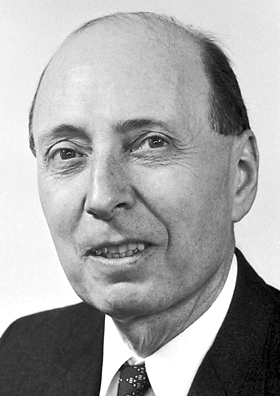

Nobel Prize in Physics · 1963
Eugene Wigner
Used the mathematics of symmetry to decode atoms and nuclei, then led the design of the first large nuclear reactors, for war and peace.
The Nobel citation: “for his contributions to the theory of the atomic nucleus and the elementary particles, particularly through the discovery and application of fundamental symmetry principles”
- Born
- November 17, 1902, Budapest, Austria-Hungary (now Hungary)
- Died
- January 1, 1995, Princeton, NJ, USA
- Shared with
- Maria Goeppert Mayer, J. Hans D. Jensen
- Affiliation at the time
- Princeton University, USA
Physics prize
1963
Shared with 2 other laureates.
Age that year
61years
Born in 1902.
Headline credited impact
18,400–30,600lives saved
Air-pollution deaths prevented by nuclear power replacing fossil fuels. How it was built
Sources cited
28
Fact-checked September 24, 2026.
- He and John von Neumann went to the same Budapest high school a year apart and learned from the same math teacher, László Rátz, whom Wigner thanked in his Nobel banquet speech.
- In July 1939 he and Leo Szilard visited Einstein on Long Island, where Einstein dictated to Wigner a uranium warning that grew into the letter to Roosevelt.
- His team largely designed the giant Hanford plutonium reactors before any reactor had ever run; the formal design report followed in January 1943.
- John Bardeen, later co-inventor of the transistor, was drawn into solid-state physics as Wigner's graduate student at Princeton.
- In 1946 he handed over the first official shipment of a reactor-made radioisotope, carbon-14, bound for a St. Louis cancer hospital.
The breakthrough
Symmetry as a master key to atoms, nuclei and particles
Physicists call something a symmetry if you can change it and the laws of nature stay the same. Turn an experiment around, move it across the room, or run it tomorrow, and it behaves the same way. In the late 1920s Wigner realized that such symmetries are powerful tools in quantum mechanics, the physics of atoms. Using group theory, the branch of mathematics that catalogues symmetries, he derived rules for the patterns of light that atoms give off without solving their very complicated equations. Think of a snowflake: if you know it has six identical arms, you only need to study one arm to understand the whole flake. He also explored mirror symmetry (called parity), which experiments in the 1950s showed some radioactive decays break, and the idea that the laws work the same whether time runs forward or backward. After the neutron was discovered he turned to the atomic nucleus. In 1933 he deduced that the force holding protons and neutrons together is very weak at a distance but, at very close range, about a million times stronger than the electrical forces acting on an atom's outer electrons. He later helped show that this force treats protons and neutrons alike. In 1939 he used the symmetries of Einstein's relativity to classify all the elementary particles then known. The Nobel committee said his methods had become an indispensable guide to the flood of new particles found in experiments.[1],[3],[6],[7],[8]
“In fact, the specification of the explainable may have been the greatest discovery of physics so far.”
What it meant for humanity
Wigner's influence runs along two tracks: ideas that became everyday tools for scientists, and machines that changed the century. His 1931 book made group theory accessible to a wide audience of physicists, and symmetry went on to play a central role in physics in the second half of the 20th century. With his first graduate student, Frederick Seitz, he worked out from quantum principles how a real metal, sodium, holds together, helping open solid-state physics to quantum theory; another student, John Bardeen, went on to co-invent the transistor. His work with Michael Polanyi and Henry Eyring on the rates of chemical reactions was later generalized by Eyring and applied to many problems in chemistry. His statistics for the spacing of energy levels in heavy nuclei became a cornerstone of the quantum theory of chaos. He supervised more than forty PhD students. His National Academy memoir calls him the first nuclear engineer. His wartime team designed the Hanford reactors, the first full-scale production reactors. As research director at Oak Ridge in 1946 and 1947 he set up a reactor training school whose graduates included Hyman Rickover, later head of the Navy's nuclear program, and he led design of the water-cooled Materials Test Reactor, a precursor of commercial power plants; his fuel-element design was used in reactors around the world. He also handed over the first official shipment of a reactor-made radioisotope, bound for a cancer hospital, the start of a program that sent out more than 1,000 isotope shipments in its first year. Nuclear power, which grew in part from this early reactor work, is estimated to have prevented about 1.8 million air-pollution deaths between 1971 and 2009 by displacing fossil fuels.
- His team designed the first full-scale production reactors, at Hanford. After the war he led design of the water-cooled Materials Test Reactor, a precursor of commercial nuclear power plants.[6],[7],[11],[12]
- In 1946 he handed over the first official shipment of a reactor-made radioisotope, carbon-14, bound for a St. Louis cancer hospital. Within a year, over 1,000 isotope shipments had gone out for cancer treatment and for use as tracers in research.[11]
- With Frederick Seitz he worked out from quantum principles how a real metal, sodium, holds together, and John Bardeen, later co-inventor of the transistor, took up solid-state physics as his student.[6],[7],[13]
- The Nobel committee called his symmetry methods an indispensable guide for interpreting the new particles found in experiments; his 1939 paper classified all the elementary particles then known.[3],[6]
- His rule for the spacing of energy levels in heavy nuclei became a cornerstone of the quantum theory of chaos, and he trained more than forty PhD students at Princeton.[6],[7]
Impact in numbers
Wigner's lasting gift is a way of thinking: that the symmetries of nature, handled with the right mathematics, reveal a great deal before any detailed calculation. That idea now runs through atomic, nuclear, particle and solid-state physics and chemistry, and his students helped carry quantum theory into the transistor age. His second legacy is nuclear engineering. He helped turn reactor physics into an engineering discipline, first for plutonium production and then for research reactors, training schools, isotopes for medicine and the precursors of power plants. The same work fueled the Nagasaki bomb and Hanford's long radioactive legacy, and both sides belong in any honest account. Many of his contributions, such as parity, the Wigner-Eckart theorem, random-matrix theory and his essay on the 'unreasonable effectiveness' of mathematics, cannot be priced; the claims below cover only the parts that can be roughly counted.
Fundamental scienceEnergyTechnologyPeace
Each number is the laureate’s credited share of a real-world outcome, cumulative to 2025. The whole outcome, the share of credit, and the reasoning are shown so you can check the arithmetic. Outcomes shared with other laureates are counted once on the impact page.
- Low confidenceRippleModeledEnergy
Air-pollution deaths prevented by nuclear power replacing fossil fuels
18,400–30,600
lives saved, credited share
That is 1% of 1.8–3.1 million lives saved since 1971.
How this number was built
Same range as the Bohr profile. Kharecha and Hansen (2013) calculate that world nuclear power prevented a mean 1.84 million air-pollution deaths in 1971-2009 (low; nothing after 2009 counted), averaging 76,000 a year in 2000-2009. High extends that rate over 2010-2025: 16 x 76,000 = 1.22 million, so 1.84 + 1.22 = about 3.06 million. The total assumes nuclear displaced fossil fuels, mostly coal. Share 0.01: Wigner designed the first large water-cooled production reactors, led design of the Materials Test Reactor (a precursor of commercial plants) whose fuel-element design spread worldwide, set up the training school that taught Hyman Rickover, and co-wrote a 1958 textbook on reactor theory. But power reactors equally rest on fission's discoverers, Fermi's first pile, the Navy's reactor program and decades of industry engineering. Credited: about 18,400-30,600 lives.[6],[7],[11],[12],[22],[23]
Sources: PubMed, US National Library of Medicine; NASA Goddard Institute for Space Studies; National Academy of Sciences; Encyclopedia.com (Gale / Charles Scribner's Sons); Oak Ridge National Laboratory; Oak Ridge National Laboratory
- Low confidenceRippleModeledEconomy
Cumulative world semiconductor sales, a proxy for the quantum-based electronics economy
$42.6–48
billion in economic value, credited share
That is 0.3% of $14.2–16 trillion in economic value since 1955.
How this number was built
Same whole-outcome range as the Bohr, Bloch and Einstein profiles: WSTS worldwide semiconductor billings for 1986-2025 in 2024 dollars (CPI) give $14.2 trillion (low). High ($16T): $14.2T + rough, unsourced allowances of ~$0.5T for pre-1986 chip sales and ~$1T for lasers and other quantum devices outside WSTS = ~$15.7T, rounded up. Sales are only a proxy for value. NIST notes that quantum science underpins transistors and lasers. Share 0.003: with his student Frederick Seitz, Wigner derived a real metal's binding energy essentially from quantum fundamentals (sodium, 1933), helping open solid-state physics to quantum theory, and John Bardeen, co-inventor of the transistor, entered the field as his student. That is less central than Bloch's band theory (0.005), and chips needed many other theorists, materials scientists and engineers. Credited: about $43-48 billion.[6],[7],[13],[24],[25],[26]
Sources: World Semiconductor Trade Statistics; Federal Reserve Bank of Minneapolis; National Institute of Standards and Technology; National Academy of Sciences; Encyclopedia.com (Gale / Charles Scribner's Sons); NobelPrize.org (Nobel Prize Outreach)
- HarmMedium confidenceDirectSourced totalPeace
Deaths within two to four months of the 1945 atomic bombings of Hiroshima and Nagasaki
1,500–2,460
deaths caused, credited share
That is 1% of 150,000–246,000 deaths caused since 1945.
How this number was built
RERF estimates acute deaths within two to four months at 90,000-166,000 in Hiroshima and 60,000-80,000 in Nagasaki, so 150,000-246,000 in total (the same range as the Bohr, Bethe, Segrè and Einstein profiles; later cancers excluded). Share 0.01: Wigner helped start the project, joining Szilard to enlist Einstein's warning in July 1939, and from 1942 led the Chicago group that designed the Hanford reactors whose plutonium went into the Nagasaki bomb. His design role bears mainly on Nagasaki; 0.01 of the total equals about 2.5-3% of Nagasaki's deaths. DuPont engineered and built the reactors, chemists extracted the plutonium, Los Alamos designed the bomb, Hiroshima's uranium came from Oak Ridge, and US leaders chose to use the bombs; he also signed the July 1945 petition against use without warning. Credited: about 1,500-2,460 deaths.[6],[7],[10],[16],[17],[21]
Sources: Radiation Effects Research Foundation; National Academy of Sciences; Encyclopedia.com (Gale / Charles Scribner's Sons); Atomic Heritage Foundation / National Museum of Nuclear Science & History; US Department of Energy, Office of Environmental Management; US Department of Energy, Office of Scientific and Technical Information (OpenNet)
The double edge
Wigner's reactors were built to make bomb fuel. His team designed the Hanford reactors, whose plutonium went into the Trinity test and the bomb that destroyed Nagasaki, where 60,000 to 80,000 people died within two to four months. He had also helped set the project in motion in 1939, when he and Leo Szilard enlisted Einstein to warn the US government. In July 1945 he signed Szilard's petition asking President Truman not to use the bomb unless Japan had first seen and refused surrender terms. His National Academy memoir says he was uneasy that his work helped kill many Japanese civilians, yet late in life he said he did not regret helping to build the bomb and wished it had come sooner, to limit Soviet gains. Hanford went on to make nearly two-thirds of the plutonium in the US stockpile and is now one of the world's most polluted nuclear sites. Wigner also campaigned for decades for civil defense, arguing that the United States could survive and recover from a nuclear attack.
- Major
Plutonium for the Nagasaki bomb
From 1942 Wigner led the Chicago group that designed the Hanford production reactors, and he checked DuPont's blueprints himself. Hanford plutonium fueled the Trinity test and the Nagasaki bomb, which killed an estimated 60,000 to 80,000 people within two to four months. He signed the July 1945 Szilard petition against using the bomb before Japan had seen surrender terms, but later said he did not regret his part.[6],[7],[16],[17],[21],[27]
- Moderate
Hanford's radioactive legacy
Hanford made plutonium for more than 40 years. Its plants released about 739,000 curies of radioactive iodine-131 in 1944-1972, and 177 underground tanks still hold about 56 million gallons of highly radioactive waste; at least 67 are thought to have leaked at some point. A CDC and Fred Hutchinson Cancer Research Center study of 3,440 people exposed as young children found thyroid disease did not rise with dose.[18],[19],[20],[28]
- Minor
Cold War civil-defense advocacy
Wigner spent decades promoting civil defense against nuclear attack. In 1963 he reportedly called for 10% of the defense budget to go to shelters and said a study predicting that a strike would kill 20% of Americans was modest, adding that the country could recover faster than postwar Germany.[6],[7],[27]
Against the odds
Wigner grew up in a well-off Budapest family, but political upheaval shaped his path. In 1919 the family fled Hungary's short-lived communist regime to Austria, and after returning they converted to Lutheranism. In 1920 Hungary's new right-wing, antisemitic government passed the numerus clausus, a law limiting how many Jewish students universities could admit; it was the first anti-Jewish law in Europe after World War I. Hungary had only three physics professorships and his Jewish descent put him at a disadvantage for any academic post, while his father pressed him toward chemical engineering, which he studied in Berlin. His career took off in Germany, but when Hitler came to power in January 1933, Wigner knew his Berlin appointments would be cancelled because of his Jewish background. That April a Nazi law began forcing Jews out of state jobs, including university posts. He was luckier than many: since 1930 he had held a part-time post at Princeton, so he settled in the United States and became a citizen in 1937. In 1939, fearing Hitler's rising power, he persuaded his parents to leave Hungary for America. Later, about 550,000 Jews living in Hungary were murdered in the Holocaust.
1919
Other
When communists seized power in Hungary in 1919, the managerial-class Wigner family fled to Austria for several months, returning after the regime fell.[6],[7],[8]
1920
Quota
Hungary's 1920 numerus clausus law limited university places for Jewish students, the first anti-Jewish law in Europe after World War I. With only three physics professorships in the country, his Jewish descent left him at a disadvantage for an academic career.[7],[14]
1933
Dismissal
After Hitler became chancellor in January 1933, Wigner's appointments at the Technische Hochschule in Berlin were cancelled because of his Jewish background; the April 1933 civil service law barred Jews from state posts, including university jobs.[6],[8],[15]
1933
Exile
Unable to return to his Berlin post, he made the United States his permanent home, working at Princeton and Wisconsin, and became a US citizen on 8 January 1937.[2],[6],[7]
1939
Persecution
Fearing Hitler's rising power after the 1938 Munich agreement, he brought his parents from Hungary to the United States in 1939, as Hungary passed laws in 1938 and 1939 that restricted Jews and defined them in racial terms.[6],[8],[14]
Jewish background
Wigner was born in Budapest to Jewish parents: Antal Wigner, who managed a leather tannery, and Erzsébet (Elisabeth) Einhorn. Judaism was not practiced strictly at home, but as a boy he had religious lessons from a rabbi and prepared for his bar mitzvah. In his late teens, after the family returned from fleeing Hungary's 1919 communist regime, they converted to Lutheranism; he later said the decision was anti-communist rather than religious. In later life he called himself only mildly religious. Nazi Germany still counted his background: his Berlin posts ended in 1933 because he was of Jewish descent.[6],[7],[8],[9],[27]
Key dates
November 17, 1902
Born in Budapest, Austria-Hungary, to Jewish parents Antal and Erzsébet Wigner.[1],[7]
1915
Enters the Lutheran high school in Budapest, where he meets John von Neumann and studies mathematics with László Rátz.[5],[6],[8]
1919
The family flees Hungary's communist regime to Austria, returning after it falls; in his late teens the family converts to Lutheranism.[7],[8]
1925
Earns a doctorate in chemical engineering at the Technische Hochschule Berlin under Michael Polanyi.[7],[8]
1926
Begins applying group theory to quantum mechanics, the work that led to his Nobel Prize; in 1927 he introduces the concept of parity.[6],[8]
1930
Joins Princeton University on a half-time lectureship shared with von Neumann.[6],[8]
1933
His Berlin posts end under Nazi rule because of his Jewish background. With Frederick Seitz he calculates the binding of metallic sodium, and he shows the nuclear force is short-ranged.[1],[6],[8]
January 8, 1937
Becomes a naturalized US citizen.[2]
July 1939
Visits Einstein on Long Island with Leo Szilard; Einstein dictates to Wigner a uranium warning for Belgium's ambassador, the basis of the later letter to Roosevelt.[10]
December 2, 1942
Witnesses the first controlled nuclear chain reaction in Chicago; by then his team has nearly finished designing the Hanford plutonium reactors, reported in January 1943.[6],[7],[9]
July 17, 1945
Signs Leo Szilard's petition urging President Truman not to use the atomic bomb on Japan without first stating surrender terms.[16]
1946
Becomes director of research and development at Clinton Laboratories, now Oak Ridge National Laboratory, focusing on peaceful uses of nuclear energy.[2],[12]
December 10, 1963
Receives half of the Nobel Prize in Physics for symmetry principles in the theory of nuclei and elementary particles.[1],[3],[5]
January 1, 1995
Sources
- 1.Eugene Wigner - Facts · NobelPrize.org (Nobel Prize Outreach)
- 2.Eugene Wigner - Biographical (from Nobel Lectures, Physics 1963-1970) · NobelPrize.org (Nobel Prize Outreach), 1963
- 3.The Nobel Prize in Physics 1963 - Presentation Speech by Professor I. Waller · NobelPrize.org (Nobel Prize Outreach), 1963
- 4.Events, laws of nature, and invariance principles (Nobel Lecture, 12 December 1963) · NobelPrize.org (Nobel Prize Outreach), 1963
- 5.Eugene Wigner - Banquet speech, 10 December 1963 · NobelPrize.org (Nobel Prize Outreach), 1963
- 6.Eugene Paul Wigner, 1902-1995: A Biographical Memoir, by Frederick Seitz, Erich Vogt and Alvin M. Weinberg · National Academy of Sciences, 1998
- 7.Wigner, Eugene Paul (Jenő Pál) (New Dictionary of Scientific Biography and other reference entries) · Encyclopedia.com (Gale / Charles Scribner's Sons)
- 8.Eugene Paul Wigner (1902-1995), by J J O'Connor and E F Robertson · MacTutor History of Mathematics, University of St Andrews
- 9.Eugene Wigner (profile) · Atomic Heritage Foundation / National Museum of Nuclear Science & History
- 10.Einstein Letter - 1939 · Atomic Heritage Foundation / National Museum of Nuclear Science & History
- 11.Oak Ridge National Laboratory 80 Years of Great Science: 1943-2023 (timeline) · Oak Ridge National Laboratory, 2023
- 12.A nuclear lab in peacetime · Oak Ridge National Laboratory, 2023
- 13.John Bardeen - Biographical · NobelPrize.org (Nobel Prize Outreach), 1956
- 14.Hungary before the German Occupation · United States Holocaust Memorial Museum, Holocaust Encyclopedia
- 15.Law for the Restoration of the Professional Civil Service · United States Holocaust Memorial Museum, Holocaust Encyclopedia
- 16.Manhattan Project: Leo Szilard's July 17, 1945 petition to the President · US Department of Energy, Office of Scientific and Technical Information (OpenNet)
- 17.Hanford Field Office (Hanford Site overview) · US Department of Energy, Office of Environmental Management
- 18.Hanford overview · Washington State Department of Ecology
- 19.The Green Run · US National Park Service, 2023
- 20.CDC Releases Hanford Thyroid Disease Study Final Report (press release) · Centers for Disease Control and Prevention, 2002
- 21.Frequently Asked Questions: How many people died as a result of the atomic bombings? · Radiation Effects Research Foundation
- 22.Prevented mortality and greenhouse gas emissions from historical and projected nuclear power (Kharecha PA, Hansen JE, Environmental Science & Technology 47(9):4889-95) · PubMed, US National Library of Medicine, 2013
- 23.Coal and Gas are Far More Harmful than Nuclear Power, by Pushker Kharecha and James Hansen (archived) · NASA Goddard Institute for Space Studies, 2013
- 24.Historical Billings Report (WSTS Blue Book monthly data, 1986 to date) · World Semiconductor Trade Statistics
- 25.Consumer Price Index, 1913- · Federal Reserve Bank of Minneapolis
- 26.A Quantum Leap Forward: How Tiny Particles Can Bring Us Exciting New Tech, by Corey Stambaugh · National Institute of Standards and Technology, 2025
- 27.Eugene Wigner · Wikipedia
- 28.About Hanford Cleanup · US Department of Energy, Hanford Site
Fact-checked on September 24, 2026 by a separate AI fact-checking pass that re-opened the sources, with 10 corrections made. How we check
Suggest a correction