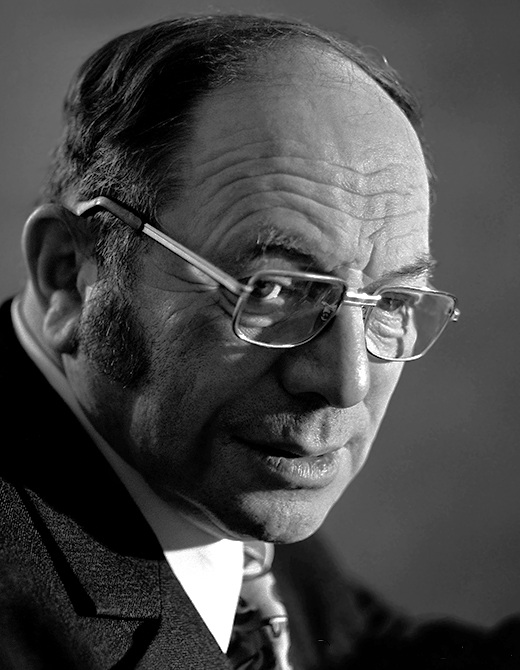

Sveriges Riksbank Prize in Economic Sciences · 1975
Leonid Vitaliyevich Kantorovich
He invented linear programming, the math of getting the most from scarce resources, and fought Soviet dogma to see it used.
The Nobel citation: “for their contributions to the theory of optimum allocation of resources”
- Born
- January 19, 1912, St. Petersburg, Russian Empire (now Russia)
- Died
- April 7, 1986, Moscow, USSR (now Russia)
- Shared with
- Tjalling C. Koopmans
- Affiliation at the time
- Academy of Sciences, Russia
Economics prize
1975
Shared with 1 other laureate.
Age that year
63years
Born in 1912.
Headline credited impact
$4.3–6.9billion in economic value
Benefits reported by Edelman Award finalist operations-research projects, much of it built on linear programming. How it was built
Sources cited
20
Fact-checked September 24, 2026.
- He entered Leningrad University at 14. At 20 he looked so young that students at his first lecture told him to sit down and wait for the professor.
- Linear programming began with a 1938 question from a plywood trust: how to split time on eight lathes among five kinds of plywood to get the most output.
- In 1959 he told the Academy that linear programming was planning crop rotations in Iowa, not in Soviet regions that could have used it a decade earlier.
- In the 1960s his group's modelling led to a new Soviet taxi fare: a fixed charge for taking a cab plus a lower price per kilometer.
- His 1942 note on moving masses is a classic of optimal transport; in 2017 a distance built on that theory helped AI image generators train more reliably.
The breakthrough
Linear programming: calculating the best use of scarce resources
In 1938 a plywood trust in Leningrad brought the young professor a practical puzzle. It had eight lathes and five kinds of plywood, and it wanted to split machine time so that total output was as large as possible in the required mix. Its own laboratory kept finding plans that could still be improved. Problems like this hide a huge number of possible plans, far too many to check one by one. Kantorovich saw that they share one mathematical form: make a simple quantity, such as total output, as large as possible while obeying many simple limits, such as the hours each machine can run. This is now called linear programming.
His key trick was to attach a number to each scarce resource, which he called a resolving multiplier. Think of it as a price tag showing how much extra you could produce with one more hour on a busy machine. By adjusting these tags and shifting work toward resources that were cheap, he could move step by step to the best plan. Economists now call such tags shadow prices. He soon found the same structure in crop planning, cutting materials with less waste and routing freight, and published it all in a 1939 booklet. Later he argued that a planned economy could hand these prices to factories so they could make good decisions on their own.[2],[3],[5],[6]
“But this accidental problem turned out to be very typical.”
What it meant for humanity
Linear programming turned a vague goal, doing the most with what you have, into a problem a computer can solve, and it now runs quietly underneath the modern economy. A 2000 list of the ten most influential algorithms of the twentieth century, reported in SIAM News, included the simplex method for linear programming, developed independently in the United States by George Dantzig, and the article said linear programming dominates industry. Finalists for the Edelman Award, the top prize for applied operations research, have reported more than $431 billion in cumulative benefits; recent finalists used optimization to route trucks, plan delivery networks and reschedule flights and crews.
Kantorovich got there first. Dantzig later acknowledged that his 1939 booklet already covered nearly every use of linear programming that Americans knew by 1960. At home he applied the ideas where officials let him: a team he guided cut steel sheets with less waste at a Leningrad railway-carriage works, his group's models reshaped Soviet taxi fares, and a desk calculating machine he designed was made in Soviet factories for a decade. He trained a school of mathematical economists in Leningrad and Novosibirsk and argued, against official dogma, that prices computed from optimal plans should guide investment and production. His 1942 note on moving masses became a classic of optimal transport, a branch of mathematics whose distance measures are now used in machine learning. Linear programming is now taught in economics and mathematics departments and built into standard software.
- Dantzig later noted that Kantorovich's 1939 booklet already described almost the whole range of linear programming applications known in the United States by 1960.[8],[13]
- A top-ten list of 20th-century algorithms, reported in SIAM News, included the simplex method for linear programming, developed independently by George Dantzig in 1947, and noted that linear programming dominates industry.[16]
- Edelman Award finalist projects in operations research have reported more than $431 billion in cumulative benefits. A 2025 finalist, Lufthansa's system for rescheduling aircraft, passengers and crews, saved its SWISS airline 12 million euros.[14],[15]
- From 1948 to 1950 a team he guided at the Leningrad Carriage-Building Works used linear programming to plan how to cut steel sheets, saving material.[2],[13]
- A duality theorem from optimal transport that bears his name underpins the Wasserstein GAN, a 2017 method that made training image-generating neural networks more stable.[8],[17]
Impact in numbers
Kantorovich's gift was a way of thinking: that the best use of scarce resources can be calculated, and that the calculation also yields prices showing what each resource is worth. That idea now sits inside software that plans production, schedules transport and allocates budgets, and in economics and operations-research courses. Most practical use outside the USSR grew from George Dantzig's independent work, so we credit Kantorovich with only 1 percent of one narrow, documented tally: the benefits reported by Edelman Award finalist projects. His influence inside the USSR is real but hard to count: steel-cutting savings, taxi fares, sector planning models and a generation of mathematical economists. His pure mathematics, from Kantorovich spaces to optimal transport, keeps paying off in mathematics and machine learning in ways no dollar figure captures.
EconomyMathematicsTechnologyFundamental science
Each number is the laureate’s credited share of a real-world outcome, cumulative to 2025. The whole outcome, the share of credit, and the reasoning are shown so you can check the arithmetic. Outcomes shared with other laureates are counted once on the impact page.
- Low confidenceRippleModeledEconomy
Benefits reported by Edelman Award finalist operations-research projects, much of it built on linear programming
$4.3–6.9
billion in economic value, credited share
That is 1% of $431–690 billion in economic value since 1972.
How this number was built
Whole outcome: benefits reported by Franz Edelman Award finalists, the only running tally of applied operations research. INFORMS: over $431B since 1972 (April 2025; $419B earlier). About six projects a year, so a floor. Low $431B as nominal. High ~$690B: same total in 2024 dollars if the average dollar was booked around 2005 (CPI 195.3 vs 313.7, x1.61). Share 0.01 = 0.5 (rough part of finalist value resting on linear programming and its integer and network extensions, not simulation, forecasting or machine learning) x 0.1 (credit to LP's founding ideas vs later algorithms, solvers, computers and project teams) x 0.2 (Kantorovich among founders with Dantzig, Koopmans, von Neumann and Hitchcock; first, but Western practice grew from Dantzig's independent simplex). Attributed: about $4-7B.[2],[8],[14],[15],[16],[20]
Sources: INFORMS; INFORMS; Society for Industrial and Applied Mathematics; Federal Reserve Bank of Minneapolis; NobelPrize.org (from Les Prix Nobel 1975); arXiv
The double edge
Kantorovich's main legacy is a mathematical tool with overwhelmingly peaceful uses, but his career was bound up with the Soviet state. In 1948 a top-secret government order put him in charge of a Leningrad computing group for the Soviet atomic bomb project, where he helped calculate equations describing the explosion; his group took part until 1953. Historians link his 1949 Stalin Prize informally to this military work. His calculations were one small input to a weapons program that fed the nuclear arms race, but we found no way to tie a harm total to his share, so none is quantified. His larger hope, that optimization could make central planning work, was not realized. In his Nobel lecture he admitted many applications were episodic and national planning had found no workable form, and a later effort to run the whole Soviet economy through optimization models largely failed. He was also politically cautious: Tjalling Koopmans felt he was more guarded than necessary, and unlike close friends he did not sign a 1968 letter by 99 mathematicians defending a dissident.
- Moderate
Computations for the Soviet atomic bomb
A 1948 top-secret directive of the USSR Council of Ministers ordered a computing group of up to 15 people formed under Kantorovich in Leningrad for the nuclear weapons project. With other mathematicians he calculated solutions to equations describing the bomb's explosion, and his bureau took part until 1953.[7],[8]
- Minor
Optimal planning did not rescue the Soviet economy
He hoped optimization would put central planning on a scientific footing. In 1975 he conceded that many applications were isolated and that no workable form had been found for national planning. Historians describe the later drive to run the whole economy by optimization models as largely a failure, though he himself reportedly thought its expectations were exaggerated.[3],[7]
- Minor
Political caution under Soviet rule
Koopmans, who visited in 1965, thought Kantorovich's self-imposed caution in writing went beyond what was necessary. Unlike close friends, he did not sign the 1968 Letter of 99 Mathematicians supporting the dissident Alexander Esenin-Volpin.[7]
Against the odds
Kantorovich was born in 1912 to Jewish parents in St Petersburg, then the capital of the Russian Empire. As a small child he lived through the revolutions of 1917 and the civil war, when his family spent a year in Belarus, and his father died when he was ten. He built his career under Stalin. During the terror of the late 1930s he watched a public campaign against the mathematician Nikolai Luzin and, like many colleagues, stopped publishing abroad. His economics was risky in itself. Critics called mathematics in economics a tool of capitalism, at a 1943 planning meeting an economist linked his talk of an optimum to Vilfredo Pareto, whom he called a fascist, and in 1944 the planning agency rejected his proposals. He set them aside, later saying it had been dangerous to go on. In the late 1940s the regime ran an antisemitic campaign against so-called rootless cosmopolitans, and in 1953 the Doctors' Plot falsely accused a mostly Jewish group of physicians of plotting murder. In the early 1950s mathematical economics was branded bourgeois and he was harshly criticized. Historians say he entered the Academy of Sciences in 1958 despite his Jewish background, helped by a new Siberian branch, and a colleague recalls that antisemitism in Soviet science held back his students' degrees and his publications. He stayed, adapted and kept working.
1936
Censorship
During Stalin's Great Purge he witnessed the Luzin affair, a public campaign against a leading mathematician, and kept a low profile; as a student of Fichtenholz he could have been targeted too. Like many colleagues, he stopped publishing abroad and withdrew from the international scene.[7]
1944
Censorship
Critics said mathematics in economics served capitalism. At a 1943 planning meeting an economist linked his idea of an optimum to Pareto, whom he called a fascist, and in 1944 the head of Gosplan's statistics agency ruled any practical use of his proposals impossible. He later said going on had been dangerous and that he fell into depression for a time.[7],[13]
1949
Discrimination
Historians note that his 1949 Stalin Prize came despite the antisemitic campaigns of those years. In 1953 the Doctors' Plot accused a mostly Jewish group of doctors of plotting to kill Soviet leaders. In the early 1950s, when mathematical economics was declared a bourgeois science, he was sharply criticized.[7],[11],[19]
1958
Discrimination
Historians write that he reached the Academy of Sciences as a corresponding member in 1958 despite his Jewish background, because new Siberian posts came with Academy nominations and he was nominated in economics. A 1962 bid for full membership in economics failed; he was elected in mathematics in 1964.[7],[9],[11]
—
Discrimination
His colleague Semen Kutateladze recalls that antisemitism, tacitly encouraged by party officials, pervaded Soviet science: the theses of Kantorovich's students were blocked or failed, and his books, articles and proposals were delayed.[10]
1975
Quota
Discrimination in Soviet higher education outlasted Stalin. In the 1970s Moscow State University's mathematics department gave Jewish applicants specially chosen, extremely hard oral exam problems so that they could be failed.[18]
1960
Other
The journal Kommunist openly attacked him in 1960. Later an Academy vice-president mobilized fourteen economists to write to Pravda against his Lenin Prize, and the award was postponed for a year.[7],[13]
—
Other
Kutateladze counts as his worst blow a short stay in a psychiatric hospital that followed his attack on what Kutateladze calls a pseudoscientific project to decipher Maya script by machine.[10]
Jewish background
Kantorovich was born into a Russian Jewish family in St Petersburg. His father, Vitaly Moiseevich Kantorovich, was a doctor who treated sexually transmitted diseases, and his mother was Paulina Grigoryevna Saks (Zaks). The Shorter Jewish Encyclopedia, which includes him, says both parents were physicians who moved from Vilna shortly before he was born. Historians of Soviet science note that he entered the Academy of Sciences despite his Jewish background. No source we consulted describes religious practice or his own statements about being Jewish.[6],[7],[11],[12]
Key dates
January 19, 1912
Born in St Petersburg to Vitaly Kantorovich, a doctor, and Paulina Saks.[1],[2],[6]
1926
Enters the mathematics department of Leningrad University at age 14.[2],[6]
1934
Becomes a full professor at 22; a doctorate follows in 1935 without a thesis defense.[2],[6],[11]
1938
Consults for a plywood trust on scheduling its lathes and marries Natalya Ilyina, a physician.[2],[6]
July 1939
Publishes Mathematical Methods of Organizing and Planning Production, the founding text of linear programming.[2],[6]
1942
Publishes his note on moving masses, a classic of optimal transport, and sends an economic exposition to Gosplan.[7],[13]
1944
Gosplan rules any practical use of his proposals impossible, and he sets aside his national planning ideas.[7]
1948
A top-secret order puts him in charge of a computing group for the Soviet atomic project.[7],[8]
1949
Receives the Stalin Prize for his work linking functional analysis and applied mathematics.[2],[6]
1958
Elected a corresponding member of the USSR Academy of Sciences, in economics; moves to Novosibirsk by 1960.[2],[7],[13]
1959
Publishes The Best Use of Economic Resources, applying optimization and shadow prices to a whole economy, and tells the Academy of Sciences that Soviet economics is lagging in using these methods.[2],[4],[13]
1965
Shares the Lenin Prize with Nemchinov and Novozhilov, a year after becoming a full academician.[7],[8],[13]
October 14, 1975
Awarded the economics prize with Tjalling Koopmans for the theory of optimum allocation of resources.[1],[4]
April 7, 1986
Dies of cancer in Moscow and is buried at Novodevichy Cemetery.[1],[6],[8]
Sources
- 1.Leonid Vitaliyevich Kantorovich - Facts · NobelPrize.org (Nobel Prize Outreach)
- 2.Leonid Vitaliyevich Kantorovich - Biographical · NobelPrize.org (from Les Prix Nobel 1975), 1975
- 3.Mathematics in Economics: Achievements, Difficulties, Perspectives (Prize Lecture, 11 December 1975) · NobelPrize.org, 1975
- 4.Press release: The Prize in Economic Science 1975 · NobelPrize.org (Royal Swedish Academy of Sciences), 1975
- 5.Award ceremony speech (Ragnar Bentzel), 1975 · NobelPrize.org, 1975
- 6.Leonid Vitalyevich Kantorovich (J J O'Connor and E F Robertson) · MacTutor History of Mathematics Archive, University of St Andrews
- 7.Programming the USSR: Leonid V. Kantorovich in context (Ivan Boldyrev and Till Düppe), British Journal for the History of Science 53(2) · Radboud University repository (Cambridge University Press journal), 2020
- 8.Mathematics and Economics of Leonid Kantorovich (S. S. Kutateladze) · arXiv, 2011
- 9.Linear Programming and Kantorovich Spaces (S. S. Kutateladze) · arXiv, 2007
- 10.My Kantorovich (S. S. Kutateladze) · Sobolev Institute of Mathematics, Novosibirsk, 2021
- 11.Канторович Леонид (Shorter Jewish Encyclopedia, vol. 4) · Electronic Jewish Encyclopedia (World ORT), 1988
- 12.Leonid Kantorovich · Wikipedia
- 13.Академик Леонид Витальевич Канторович (Academician Leonid Vitalyevich Kantorovich), Hall of Fame · Russian Virtual Computer Museum
- 14.USA Cycling Awarded the 2025 INFORMS Edelman Award for Data-Driven Olympic Gold Strategy · INFORMS, 2025
- 15.2025 INFORMS Franz Edelman Award Finalists Announced · INFORMS, 2025
- 16.The Best of the 20th Century: Editors Name Top 10 Algorithms (Barry A. Cipra), SIAM News 33(4) · Society for Industrial and Applied Mathematics, 2000
- 17.Wasserstein GAN (Martin Arjovsky, Soumith Chintala and Léon Bottou) · arXiv, 2017
- 18.Jewish Problems (Tanya Khovanova and Alexey Radul) · arXiv, 2011
- 19.Doctors' plot · Wikipedia
- 20.Consumer Price Index, 1913- · Federal Reserve Bank of Minneapolis
Fact-checked on September 24, 2026 by a separate AI fact-checking pass that re-opened the sources, with 4 corrections made. How we check
Suggest a correction