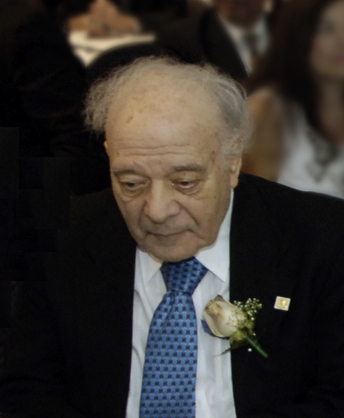

Nobel Prize in Chemistry · 1985
Jerome Karle
He helped write the math that lets X-rays reveal a molecule's shape directly, turning years of crystal puzzle-solving into routine work.
The Nobel citation: “for their outstanding achievements in the development of direct methods for the determination of crystal structures”
- Born
- June 18, 1918, New York, NY, USA
- Died
- June 6, 2013, Annandale, VA, USA
- Shared with
- Herbert A. Hauptman
- Affiliation at the time
- US Naval Research Laboratory, USA
Chemistry prize
1985
Shared with 1 other laureate.
Age that year
67years
Born in 1918.
Sources cited
20
Fact-checked September 24, 2026.
- He learned he had won the Nobel Prize in mid-air: the pilot of his transatlantic flight announced it to the cabin and invited him up to first class.
- When he and Herbert Hauptman announced their method in the early 1950s, many crystallographers refused to believe it, and a hostile review dismissed it as foolishness.
- His wife, Isabella Karle, turned the theory into a working recipe. He felt strongly that she should have shared the Nobel Prize.
- Before crystallography, he devised a test for fluoride in drinking water that became a standard method just as fluoridation was getting under way.
- He started City College at 15 and graduated in 1937 in the same class as Hauptman, the man he would share the Nobel Prize with.
The breakthrough
Direct methods: reading the missing phases straight from X-ray data (1950-1966)
To learn a molecule's shape, chemists grow a crystal of it and shine X-rays through it. The rays scatter into a pattern of spots. Each spot carries two pieces of information: how bright it is, and its phase, meaning how far its wave is shifted compared with the others. Detectors record only the brightness. Without the phases, the pattern cannot be turned back into a map of the atoms. This is the phase problem. Crystallographers had worked around it with heavy atoms or trial and error, and a single structure could take months or years. At the U.S. Naval Research Laboratory, Karle and Herbert Hauptman started from a rule Karle had used in his electron diffraction work: the density of electrons in a crystal can never be negative. A crystal gives far more spots than it has atoms, so the spots must be linked, and that one rule ties their phases together. Between 1950 and 1956 they turned those links into equations and probability formulas that estimate the phases straight from the brightness data. Think of a sudoku: the grid shows only some numbers, but the rules force the rest. Isabella Karle then built a step-by-step procedure, called symbolic addition, that made the method practical, and fast computers did the heavy arithmetic. In 1980 Karle also published the theory behind multiwavelength anomalous diffraction, a technique later widely used for proteins.[1],[2],[3],[4],[5],[9],[18]
“This was especially helpful during the early 1950’s when a large number of fellow-scientists did not believe a word we said.”
What it meant for humanity
Direct methods changed what a chemist could learn in a week. The Nobel committee noted in 1985 that structures which had earned a Nobel Prize in 1964 could now be solved by a clever beginner, and that most of the steep rise in structure determinations over the previous fifteen years had used direct methods. Knowing a molecule's exact shape shows how its bonds form, how it reacts, and how it fits a receptor in the body. Obituaries list uses in research on hormones, antibiotics, heart drugs, painkillers and breast cancer drugs. In 2015 George Sheldrick, author of the widely used SHELX crystallography programs, wrote that small-molecule crystal structures are usually solved by direct methods or, more recently, by newer dual-space methods. The Cambridge Structural Database, a curated archive used across the drug, agrochemical and fine-chemicals industries, now holds more than 1.4 million small-molecule and metal-organic structures. In the Karles' own laboratory, Isabella Karle used the method to solve peptides, steroids, antibiotics and toxins; her studies of frog toxins helped collaborators develop a cheap nerve-blocking agent with possible medical uses. Karle's later theory of multiwavelength anomalous diffraction was put to work by his former colleague Wayne Hendrickson for proteins, and direct methods are now the usual way to find the marker atoms that technique needs. Even his first small invention, a test for fluoride in water, became a standard method as communities began fluoridating drinking water to prevent tooth decay. He spent more than sixty years at a Navy laboratory and argued that defense research and good science could go together.
- Between 1950 and 1956, with Herbert Hauptman, he showed that the missing phases in X-ray data could be estimated directly from measured intensities, using the rule that electron density is never negative.[2],[3],[4]
- By 1985 the Nobel committee said structures that won a 1964 Nobel Prize could be solved by a clever beginner, and most new structure determinations used direct methods.[2],[3]
- Small-molecule crystal structures are usually solved by direct methods or newer dual-space methods; the Cambridge Structural Database, used by drug and chemical companies, holds more than 1.4 million such structures.[15],[16]
- The Karles' 1966 paper laying out the symbolic addition procedure step by step had been cited more than 1,300 times by 1986.[5],[14]
- His 1980 theory of multiwavelength anomalous diffraction was applied by Wayne Hendrickson and colleagues, with synchrotron X-rays, to solve protein structures.[1],[5]
- As a young chemist at the New York State Health Department, he developed a test for fluoride in water that became a standard method.[1],[4]
Impact in numbers
Karle's legacy is a tool. With Hauptman he showed that the phases lost in an X-ray experiment could be recovered by mathematics and probability, and with Isabella Karle's practical procedure and modern computers the approach became a standard way to solve the structures of small molecules, from drugs and hormones to explosives and new materials. More than 1.4 million small-molecule and metal-organic structures now sit in one curated archive used by drug and chemical companies, and his later anomalous-diffraction theory helped protein crystallographers too. We make no quantified benefit claim. Structure determination is one link in long chains of drug discovery and materials research carried out by many thousands of chemists, so any share of lives saved or money earned credited to Karle would be guesswork. We do count a small share of the deaths caused by the atomic bombings, because he worked on plutonium for the Manhattan Project.
Fundamental scienceHealthTechnology
Each number is the laureate’s credited share of a real-world outcome, cumulative to 2025. The whole outcome, the share of credit, and the reasoning are shown so you can check the arithmetic. Outcomes shared with other laureates are counted once on the impact page.
- HarmLow confidenceDirectSourced totalPeace
Deaths from the atomic bombings of Hiroshima and Nagasaki within two to four months
45–74
deaths caused, credited share
That is 0.03% of 150,000–246,000 deaths caused since 1945.
How this number was built
RERF estimates acute deaths within two to four months at 90,000-166,000 in Hiroshima and 60,000-80,000 in Nagasaki, so 150,000-246,000 in total (the range used in the Bethe, Reines and Rotblat profiles; later cancer deaths excluded). Share 0.0003: in 1943-44 Karle was a new PhD chemist in Seaborg's plutonium group at Chicago, where by his own account he found a way to turn plutonium oxide into metal. Plutonium fueled only the Nagasaki bomb, roughly a third of the deaths (60,000-80,000 of 150,000-246,000). A junior role like Reines's (0.001) scaled by about one third gives roughly 0.0003. Tens of thousands of others built the bombs, and US leaders chose to use them. Result: 150,000 x 0.0003 = 45 to 246,000 x 0.0003 = about 74 deaths credited.[4],[8],[17],[19]
Sources: Radiation Effects Research Foundation (RERF); Atomic Heritage Foundation, National Museum of Nuclear Science & History; U.S. Department of Energy, Office of Scientific and Technical Information; Physics Today (AIP)
The double edge
Karle's crystallography has no documented harm of its own, but his career touched weapons work. In 1943-44 he worked on the Manhattan Project in Chicago, where by his own account he found a way to turn plutonium oxide into plutonium metal, the material of the bomb that destroyed Nagasaki. He later said he spent decades disappointed that the United States used the bomb first, then came to accept that decision and argued that nuclear weapons may have deterred war between great powers. At the Naval Research Laboratory, direct methods were also used on explosives and missile propellants, and one of his last papers used quantum mechanics to predict the properties of high-energy explosive molecules. There is also a question of credit: the Nobel committee passed over Isabella Karle, whose practical procedure made the method work. Karle himself felt strongly that she should have shared the prize.
- Moderate
Plutonium chemistry for the atomic bomb
As a new PhD in Glenn Seaborg's plutonium program at Chicago's Metallurgical Laboratory, Karle, by his own account, built a high-temperature apparatus that turned plutonium oxide into plutonium metal. Plutonium fueled the bomb dropped on Nagasaki; the sources do not say whether his method was used to make the bomb's metal. His role was junior, one among many thousands of project workers.[4],[6],[8],[10],[19]
- Minor
Military uses of structure analysis
Obituaries note that the methodology was applied to explosives and missile propellants as well as drugs, and that one of his final papers, published with NRL colleagues after he retired, used quantum mechanics to predict the explosive properties of high-energy molecules.[4],[6],[18]
- Minor
Isabella Karle left out of the prize
Isabella Karle's symbolic addition procedure proved the theory worked and made it usable. The Nobel committee did not include her, a choice many crystallographers questioned. Karle felt strongly that she should have shared the prize.[2],[4],[9]
Against the odds
Karle grew up when many American universities and medical schools quietly limited Jewish enrollment. From the 1920s, and by some evidence into the 1950s, medical schools used unofficial quotas; one medical historian of the time observed that Jewish students rarely exceeded about a tenth of most classes, though Jews made up a far larger share of applicants. Harvard's president in the 1920s openly backed admission quotas, and the University of Michigan rejected many Jewish medical applicants after personal interviews. Karle, the son of an Eastern European immigrant family in Coney Island, went to tuition-free City College during the Depression, hoping to become a medical researcher. Of roughly 150 classmates who tried for medical school, four or five got in; he was not one of them. Harvard Medical School turned him down two years in a row. Karle thought that saying he wanted to do medical research rather than treat patients hurt his chances; when an interviewer later asked about the background to the Harvard rejections, he declined to say more. A 2021 biography of Isabella Karle states that he left Harvard because Harvard had a quota on Jews, and a reference biography reports that at Michigan he was first refused a teaching fellowship because he was Jewish. His adviser, Lawrence Brockway, stepped in, and the next day he had the post. At the Naval Research Laboratory the hurdle was scientific disbelief: in the early 1950s many colleagues rejected his method outright.
1938
Quota
Rejected by Harvard Medical School two years running, and not encouraged to stay in Harvard's biology department despite satisfactory coursework; a 2021 biography says he had to leave Harvard because of its quota on Jews. In a 1987 interview he declined to discuss the background.[7],[9],[10],[13]
1941
Discrimination
At the University of Michigan his application for a teaching fellowship was turned down, according to a reference biography because he was Jewish. His adviser intervened and he received the fellowship the next day.[7],[10]
1953
Other
His 1953 monograph with Hauptman claiming a solution to the phase problem met open disbelief; a hostile review called it foolishness, and it drew fewer than ten citations a year for about a decade.[1],[5],[7],[14]
Jewish background
Karle was born Jerome Karfunkle in New York City to Louis Karfunkle, a Coney Island businessman, and Sadie Helen Kun, a pianist and organist; the family was of Eastern European immigrant origin, and his father's family came from a town near Krakow. City College, a Florida Atlantic University series on American Jewish Nobel laureates, and other biographies describe him and his family as Jewish. He later changed his surname to Karle. Biographers report that he met antisemitic barriers at Harvard and Michigan. We found no published account of his religious practice. In 1942 he married Isabella Lugoski, a daughter of Polish immigrants.[4],[5],[7],[9],[10],[11],[12],[20]
Key dates
June 18, 1918
Born Jerome Karfunkle in Brooklyn, New York City, and raised in Coney Island.[4],[5]
1933
Enters the tuition-free City College of New York at 15.[1],[5]
1937
Graduates from City College in the same class as Herbert Hauptman.[4],[5]
1938
Earns a master's degree in biology at Harvard; later develops a standard test for fluoride in water at the New York State Health Department.[1],[4]
1942
Marries fellow Michigan chemistry student Isabella Lugoski, his lifelong scientific partner.[1],[5]
1943
Joins the Manhattan Project in Chicago, working on plutonium chemistry; his Michigan PhD is awarded in 1944.[1],[4],[8]
1946
Joins the U.S. Naval Research Laboratory in Washington, where he stays until 2009.[1],[5]
1953
With Hauptman, publishes a monograph setting out the probability theory of direct methods; many experts reject it.[4],[5],[14]
1966
Publishes with Isabella Karle the symbolic addition procedure, a step-by-step recipe for solving crystal structures.[5],[14]
1980
Publishes an exact theory for multiwavelength anomalous diffraction, later used to solve protein structures.[1],[5]
1981
Becomes president of the International Union of Crystallography, serving until 1984.[1]
1985
Shares the Nobel Prize in Chemistry with Hauptman for direct methods of crystal structure determination; he hears the news on a transatlantic flight.[2],[4],[5]
2009
Retires from the Naval Research Laboratory with Isabella after decades of combined government service.[5],[6]
June 6, 2013
Dies of liver cancer in Annandale, Virginia, aged 94.[4],[5]
Sources
- 1.Jerome Karle – Biographical (with 1992 addendum) · Nobel Prize Outreach (NobelPrize.org), 1985
- 2.Press release: The 1985 Nobel Prize in Chemistry · Royal Swedish Academy of Sciences / NobelPrize.org, 1985
- 3.Award ceremony speech, Nobel Prize in Chemistry 1985 · Nobel Prize Outreach (NobelPrize.org), 1985
- 4.Jerome Karle (obituary), by Lulu Huang and Lou Massa · Physics Today (AIP), 2014
- 5.Obituary - Jerome Karle (1918-2013), adapted from Wayne Hendrickson's Nature obituary, with colleagues' remembrances · American Crystallographic Association History, 2013
- 6.Jerome Karle dies at 94 (obituary) · Chemical & Engineering News (American Chemical Society), 2013
- 7.Oral history with Isabella and Jerome Karle, interviewed by James J. Bohning and David K. Van Keuren · Science History Institute, 1987
- 8.Jerome Karle's Interview (Voices of the Manhattan Project) · Atomic Heritage Foundation, National Museum of Nuclear Science & History, 2005
- 9.Isabella L. Karle: A Crystallography Pioneer, by Tamar Schlick (DNA and Cell Biology 40:843-847) · Mary Ann Liebert / PubMed Central, 2021
- 10.Jerome Karle (Research Starters biography) · EBSCO
- 11.Jerome Karle Shared the 1985 Nobel Prize in Chemistry With Fellow CCNY Classmate, Herbert Hauptman (archived) · The City College of New York
- 12.Jerome Karle: Nobel Prize, from American Jewish Recipients of the Nobel Prize, by Seymour Brody (archived) · Florida Atlantic University Libraries
- 13.Jewish American Heritage Month: The Forgotten History of Quotas in American Medical School Admissions · Himmelfarb Health Sciences Library, George Washington University, 2023
- 14.The 1985 Nobel Chemistry Prize to Jerome Karle and Herbert A. Hauptman, by Eugene Garfield (Current Contents no. 44) · Institute for Scientific Information / University of Pennsylvania, 1986
- 15.SHELXT - integrated space-group and crystal-structure determination, by George M. Sheldrick (Acta Crystallographica A71:3-8) · International Union of Crystallography / PubMed Central, 2015
- 16.The Cambridge Structural Database (CSD) · Cambridge Crystallographic Data Centre
- 17.Frequently Asked Questions (estimated acute deaths in Hiroshima and Nagasaki) · Radiation Effects Research Foundation (RERF)
- 18.Navy chemist Jerome Karle, who shared Nobel, dies at 94 (Washington Post obituary by Emily Langer, syndicated) · Portland Press Herald, 2013
- 19.Manhattan Project: The Atomic Bombing of Nagasaki, August 9, 1945 · U.S. Department of Energy, Office of Scientific and Technical Information
- 20.Jerome Karle · Wikipedia
Fact-checked on September 24, 2026 by a separate AI fact-checking pass that re-opened the sources, with 9 corrections made. How we check
Suggest a correction