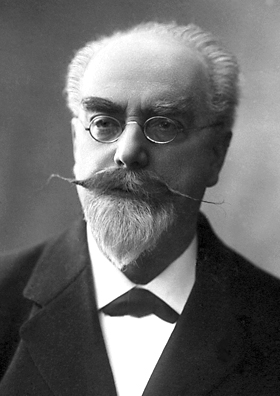

Nobel Prize in Physics · 1908
Gabriel Lippmann
He captured colour by trapping light waves in a photographic plate, and his electrometer recorded the first human electrocardiogram.
The Nobel citation: “for his method of reproducing colours photographically based on the phenomenon of interference”
- Born
- August 16, 1845, Hollerich, Luxembourg
- Died
- July 13, 1921
- Affiliation at the time
- Sorbonne University, France
Physics prize
1908
Awarded alone.
Age that year
63years
Born in 1845.
Sources cited
22
Fact-checked September 24, 2026.
- The colour in his photographs comes from no dye or pigment. Microscopic layers of silver reflect the colours of the light that exposed them, for as long as the plate is intact.
- A 2021 study estimated that his plates typically record 26 to 64 slices of the colour spectrum, against three for most photos: the earliest multispectral imaging method.
- Willem Einthoven named the heartbeat's P, Q, R, S and T waves in 1895 while correcting traces made with a Lippmann capillary electrometer.
- A Luxembourg street once nicknamed the Jews' lane was renamed for him in 1925. Under German occupation from 1940 to 1944 it was given a German name.
- He was nominated for the Nobel Prize 23 times between 1901 and 1908, by Henri Poincaré and Henri Becquerel among others.
The breakthrough
Colour photography that stores light waves in layers of silver
Most colour photography, then and now, splits a scene into red, green and blue and rebuilds it with dyes or pixels. Lippmann instead recorded the pattern made by the light waves themselves. He coated a glass plate with an extremely fine-grained, nearly transparent emulsion and pressed it against a pool of liquid mercury, which acts as a mirror. Light passing through the emulsion bounced off the mercury and ran back into the incoming light. Where the two sets of waves met, they formed a fixed pattern of bright and dark sheets spaced half a wavelength apart: wider for red, tighter for blue. Silver built up in the bright sheets. After developing, each spot on the plate held a microscopic stack of silver layers tuned to the colour that had struck it. Shine white light on it, and the stack sends back only that colour. It is the same effect that colours a soap bubble or mother-of-pearl, which are made of colourless material. Lippmann demonstrated this in his Nobel lecture: when a plate was wetted, the gelatin swelled, the spacing changed and the colours vanished, then returned as it dried, red first. Mixed colours were harder, and he used Fourier's mathematics to show they would work too. Because the colour comes from the silver layers rather than from dyes, it lasts as long as the plate stays intact.[1],[3],[4],[14]
“Life is short and progress is slow.”
What it meant for humanity
Lippmann's colour process never became everyday photography. Exposures were long, plates could not be printed on paper or copied, and three-colour methods won the market; the Nobel Foundation notes that it lived on mainly as a physics experiment. Yet the plates did something no rival method did: they recorded a detailed spectrum of the light, not just three colours. In 2021 researchers at EPFL in Switzerland estimated that his plates typically record between 26 and 64 slices of the spectrum, making the process the earliest multispectral imaging technique. The same standing-wave idea returned in holography. In 1962 the Soviet physicist Yuri Denisyuk combined holography with Lippmann's method, and by 1965 others had made reflection holograms that could be viewed in ordinary white light. His other inventions reached further than his photographs. His capillary electrometer, a hair-thin column of mercury that moves when tiny voltages change, let physiologists record the electrical signal of the human heart. Willem Einthoven named the P, Q, R, S and T waves while working from such traces, before building the string galvanometer that put the electrocardiogram into hospitals. In 1881 Lippmann used thermodynamics to predict that an electric voltage would make certain crystals change shape. This converse piezoelectric effect later powered sonar and medical acoustic devices. His 1908 plan to photograph a scene through a sheet of tiny lenses is an early root of today's light-field cameras and microscopes. He also backed younger scientists: he was Marie Curie's thesis adviser and let her use his laboratory.
- Physiologists used the Lippmann capillary electrometer to record the heart's electrical activity: Augustus Waller in 1887, then Willem Einthoven, who named the P, Q, R, S and T waves before inventing the string galvanometer.[11],[12]
- In 1962 Yuri Denisyuk combined holography with Lippmann's colour method. Dennis Gabor's Nobel lecture calls the result the Lippmann-Denisyuk-Stroke reflection hologram, which can be lit with ordinary white light.[15]
- Using thermodynamics, he predicted in 1881 that voltage would deform certain crystals. The Curie brothers confirmed it. In 1917 Paul Langevin used this converse effect to send ultrasonic pulses through seawater, an early step toward sonar.[13],[21]
- His 1908 'integral photography', which shoots a scene through an array of tiny lenses, is cited as the starting point of light-field imaging, now used in microscopes that record neural activity across whole larval zebrafish brains.[16]
- According to the American Institute of Physics, he was Marie Curie's thesis adviser, let her use his laboratory for her thesis work and helped her find other sources of support.[17]
- About 250 plates made by Lippmann survive; Photo Elysée in Lausanne holds 138, left to it by his heirs in the 1990s. A 2021 study called such plates the first hyperspectral images, though their original spectra cannot be reliably recovered.[14],[20]
Impact in numbers
We make no numerical claim for Lippmann. His prize-winning colour process never reached industrial scale: exposures were long, plates could not be copied, and three-colour methods took the market. Its most lasting public role is as a vivid demonstration of light interference. His wider influence runs through instruments and ideas that others turned into technologies: the capillary electrometer behind the first human heart tracings, the converse piezoelectric effect used in sonar, the standing-wave recording reused in reflection holography, and the lens-array idea behind light-field imaging. Each of these outcomes depended on many later inventors, and we found no published figure that isolates his part, so any number would be invented. His impact is best described as enabling: he gave scientists and doctors new ways to measure faint electrical signals and to record light itself.
Fundamental scienceTechnologyHealthCulture
No number is given here on purpose. Some contributions cannot be counted honestly, and we would rather describe them than invent a figure.
The double edge
We found no documented harms, misuse or serious controversies tied to Lippmann or his inventions.
Against the odds
Lippmann himself met little documented discrimination. His career rose steadily: a Sorbonne professorship in 1883, the Academy of Sciences in 1886 and the Nobel Prize in 1908. His family history, and the world around him, were another matter. His grandfather Jonas, who settled in Luxembourg in 1807, was registered there as a teacher of Hebrew and in 1821 opened the glove works that his son Isaïe later ran. The street leading to the factory was popularly called the Jews' lane. The family moved to Paris around 1848. From 1894 to 1906, while Lippmann taught at the Sorbonne, France was split by the Dreyfus affair. A Jewish army captain was falsely convicted of treason, and Édouard Drumont's paper La Libre Parole presented the case as proof of Jewish treachery. In 1910 and 1911, when Marie Curie, who had worked with his support, stood for the Academy, right-wing papers spread the false rumour that she was Jewish to argue she did not deserve a seat. When Lippmann died in 1921, Luxembourg's Catholic daily, the Luxemburger Wort, did not report it; on the day other papers did, it ran a long antisemitic article drawing on the forged Protocols of the Elders of Zion. A Luxembourg historian asks whether that prejudice explains its silence. Under German occupation from 1940 to 1944, the Luxembourg street named for him was given a German name.
1894
Discrimination
During his years as a Sorbonne professor, the Dreyfus affair (1894-1906) divided France: a Jewish army captain was falsely convicted of treason, probably because he was Jewish, and the right-wing press cast it as proof of Jewish treachery. This was the climate around him, not an attack on him personally.[19]
1911
Discrimination
When Marie Curie, whom he had supported as her thesis adviser, ran for the Academy of Sciences, right-wing papers falsely claimed she was Jewish to argue she was undeserving. She lost by two votes in January 1911. The rumour targeted Curie, not Lippmann, but shows the climate around him.[17],[18]
1921
Discrimination
On 15 July 1921, as other Luxembourg papers reported his death, the Catholic daily Luxemburger Wort ignored it and printed a long antisemitic article based on the forged Protocols of the Elders of Zion. Historian Jos. Massard asks whether that prejudice explains its silence.[8]
1940
Other
Under German occupation from 1940 to 1944, Rue Gabriel-Lippmann in Luxembourg's Bonnevoie district was renamed Eifeler Straße. Massard suggests the occupiers did not want a street named for a Jewish scientist.[8]
Jewish background
Lippmann was born in Luxembourg to French Jewish parents: Isaïe Lippmann, a glove manufacturer born at Ennery near Metz, and Miriam Rose Lévy. His grandfather Jonas was registered in Luxembourg as a teacher of Hebrew, and a Luxembourgish dictionary ties the local 'Jews' lane' to the Jewish Lippmann family. The Jewish Encyclopedia gave him an entry in his lifetime, and a 1953 history of Luxembourg's Jewish community lists him. In 1888 he married the daughter of the novelist Victor Cherbuliez. The sources we found say nothing about his religious practice.[2],[7],[8],[10],[22]
Key dates
August 16, 1845
Born in Bonnevoie, then part of the commune of Hollerich, Luxembourg, to French Jewish parents.[2],[6],[7]
1848
Around 1848-49 his father sells the family glove factory in Luxembourg and moves the family to Paris, where his mother teaches him at home.[2],[7],[8]
1868
Enters the École normale supérieure in Paris. He later fails the teaching exam after neglecting subjects that did not interest him.[2],[6]
1874
On a French government mission to Germany, studies with Kirchhoff and Kühne and earns a Heidelberg doctorate summa cum laude; then works briefly with Helmholtz in Berlin.[2],[7]
July 24, 1875
Defends his Paris thesis on electrocapillarity, the link between electric voltage and the surface tension of mercury.[7],[9]
1881
Uses thermodynamics to predict the converse piezoelectric effect, later confirmed by Pierre and Jacques Curie.[13]
1886
Becomes professor of experimental physics in Paris and director of its physics research laboratory; elected to the Academy of Sciences.[2],[7]
1887
Augustus Waller records the first human electrocardiogram using a Lippmann capillary electrometer.[11],[12]
1888
Marries the daughter of the novelist Victor Cherbuliez.[2]
February 2, 1891
Presents his interference method of colour photography, with a colour photograph of the spectrum, to the Academy of Sciences.[2],[6],[7]
1908
Proposes 'integral photography': recording a scene through an array of tiny lenses, an early root of light-field imaging.[16]
December 10, 1908
After 23 nominations since 1901, receives the unshared Nobel Prize in Physics for reproducing colours photographically using interference.[1],[4],[5]
1912
Serves as president of the French Academy of Sciences.[2]
July 13, 1921
Dies at sea aboard the liner France, returning from a French mission to North America led by Marshal Fayolle.[2],[8]
Sources
- 1.Gabriel Lippmann - Facts · NobelPrize.org (Nobel Prize Outreach)
- 2.Gabriel Lippmann - Biographical · NobelPrize.org (from Nobel Lectures, Physics 1901-1921, Elsevier, 1967), 1967
- 3.Colour Photography (Nobel Lecture, 14 December 1908) · NobelPrize.org, 1908
- 4.Award ceremony speech, Nobel Prize in Physics 1908 (K. B. Hasselberg) · NobelPrize.org, 1908
- 5.Gabriel Lippmann - Nominations · NobelPrize.org (Nobel Prize nomination archive)
- 6.Gabriel Lippmann (1845-1921): Commémoration du 150e anniversaire du savant né au Luxembourg (J.-P. Pier and J. A. Massard, eds.), front matter and 'Repères' chronology · Section des sciences naturelles, physiques et mathématiques de l'Institut grand-ducal de Luxembourg (PDF at massard.info), 1997
- 7.Gabriel Lippmann 1845-1921 (Jacques Bintz), in Pier and Massard (eds.), Gabriel Lippmann, pp. 5-10 · Institut grand-ducal de Luxembourg (PDF at massard.info), 1997
- 8.Gabriel Lippmann et le Luxembourg (Jos. A. Massard), in Pier and Massard (eds.), Gabriel Lippmann, pp. 81-112 · Institut grand-ducal de Luxembourg (PDF at massard.info), 1997
- 9.Gabriel Lippmann, physicien et inventeur à la charnière de deux époques (Jean-Pierre Hansen), in Pier and Massard (eds.), Gabriel Lippmann, pp. 17-24 · Institut grand-ducal de Luxembourg (PDF at massard.info), 1997
- 10.Lippmann, Gabriel (Isidore Singer and Frederick T. Haneman), Jewish Encyclopedia, vol. 8 · Funk and Wagnalls (JewishEncyclopedia.com), 1904
- 11.Award ceremony speech, Nobel Prize in Physiology or Medicine 1924 (Willem Einthoven) · NobelPrize.org, 1924
- 12.A brief review: history to understand fundamentals of electrocardiography (AlGhatrif and Lindsay), Journal of Community Hospital Internal Medicine Perspectives 2(1) · Taylor & Francis (PubMed Central), 2012
- 13.Bio-piezoelectricity: fundamentals and applications in tissue engineering and regenerative medicine (Nagwa Ahmed Kamel), Biophysical Reviews 14(3):717-733 · Springer (PubMed Central), 2022
- 14.Shedding light on 19th century spectra by analyzing Lippmann photography (Baechler, Latty, Pacholska, Vetterli and Scholefield, EPFL), PNAS 118(17):e2008819118 · Proceedings of the National Academy of Sciences (PubMed Central), 2021
- 15.Holography, 1948-1971 (Dennis Gabor, Nobel Lecture, 11 December 1971) · NobelPrize.org, 1971
- 16.A review of light-field imaging in biomedical sciences (Zhao et al.), Med-X 3:25 · Springer (PubMed Central), 2025
- 17.Marie Curie: A Student in Paris (1891-1897) · American Institute of Physics, Center for History of Physics
- 18.Marie Curie: Scandal and Recovery (1910-1913) · American Institute of Physics, Center for History of Physics
- 19.Anti-Semitism: Alfred Dreyfus and 'The Affair' · Jewish Virtual Library (American-Israeli Cooperative Enterprise)
- 20.Les plaques Lippmann, le trésor de Photo Elysée · Photo Elysée, Lausanne, 2022
- 21.Glory of piezoelectric perovskites (Kenji Uchino), Science and Technology of Advanced Materials 16(4):046001 · Taylor & Francis (PubMed Central), 2015
- 22.Gabriel Lippmann · Wikipedia
Fact-checked on September 24, 2026 by a separate AI fact-checking pass that re-opened the sources, with 12 corrections made. How we check
Suggest a correction