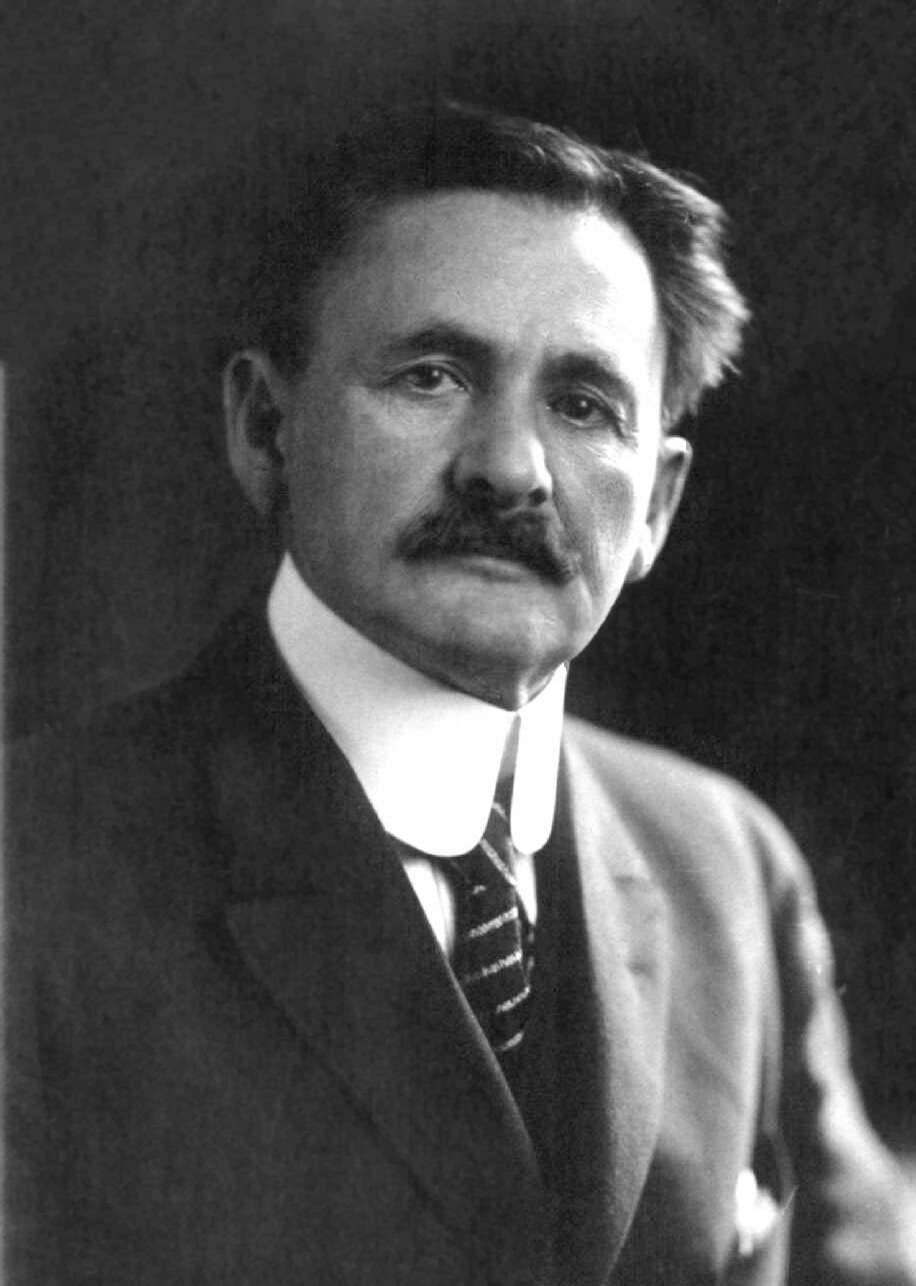

Nobel Prize in Physics · 1907
Albert A. Michelson
An immigrant boy from a gold-rush camp who learned to measure the world with light waves, from the metre to the size of a star.
The Nobel citation: “for his optical precision instruments and the spectroscopic and metrological investigations carried out with their aid”
- Born
- December 19, 1852, Strelno, Prussia (now Strzelno, Poland)
- Died
- May 9, 1931, Pasadena, CA, USA
- Affiliation at the time
- University of Chicago, USA
Physics prize
1907
Awarded alone.
Age that year
55years
Born in 1852.
Headline credited impact
700,000–2 millionpeople benefited
People examined with optical coherence tomography (OCT) eye scans worldwide since 1996. How it was built
Sources cited
16
Fact-checked September 24, 2026.
- As a young Navy instructor, he built the rotating mirror for his first speed-of-light experiment for about ten dollars of his own money.
- Passed over for a Naval Academy place, he took his case to President Grant, who had used up his ten special appointments. Michelson said his career began with an illegal act.
- In 1907 he became the first American to win a science Nobel. The ceremony was cancelled because Sweden's King Oscar II had died two days earlier.
- His 1926 speed-of-light result, 299,796 km per second, was within about 3.5 km per second of today's exact value of 299,792.458.
- The LIGO detectors that first caught gravitational waves in 2015 are giant Michelson interferometers, with arms 4 km long; Michelson and Morley's 1887 arms were about 1.3 m.
The breakthrough
The interferometer: using light waves as a ruler (1881-1893)
Light travels as waves, and when two waves meet they can add up or cancel out. Think of two sets of ripples on a pond: where crest meets crest the water rises higher, and where crest meets trough it goes flat. Michelson turned this into a measuring tool. In his interferometer, first built in 1881, a semi-transparent mirror splits one beam of light in two. The halves travel down separate arms at right angles, bounce off mirrors and recombine, making a pattern of bright and dark stripes called fringes. If one arm changes length by a tiny fraction of a wavelength, the stripes shift. His Nobel presenter said the method could reach about a fiftieth of a wavelength, roughly a hundred-thousandth of a millimetre. In 1892 and 1893, at the request of the international weights-and-measures authorities, he counted how many waves of red light from cadmium fit into the official metre bar: about 1.55 million. From then on, the metre could be rebuilt from light even if the bar were lost. He also showed that many spectral lines, the colored fingerprints of chemical elements, are really clusters of finer lines. And in 1887, with the chemist Edward Morley, he used the device to look for the ether, the invisible substance thought to carry light. They found no trace of it, a famous null result later counted among the experimental supports of Einstein's relativity.[1],[2],[3],[4],[5],[6],[8]
“It is the pitting of one's brains against bits of iron, metals and crystals and making them do what you want them to do.”
What it meant for humanity
Michelson's gift was precision, and precision mattered far beyond his laboratory. His Nobel presentation speech said the interferometer made it possible to check the metre against light waves and, if the metal bar were ever lost, to rebuild it. That idea won out. Since 1960 the metre has been defined by light rather than by a bar: first as a count of krypton light waves, and since 1983 through the speed of light, the constant he spent half a century measuring. Light-wave standards also let metrologists certify the gauge blocks that machinists rely on to about one part in a million. His interferometer design lives on in modern instruments. The LIGO detectors that first recorded gravitational waves from colliding black holes in 2015 are, at their core, Michelson interferometers with arms 4 kilometres long. Optical coherence tomography (OCT), which uses interferometry to image the layers of the retina, grew out of lab set-ups built around a modified Michelson interferometer. By 2016 it was a standard of care in eye medicine, with about 30 million eye scans a year worldwide. His 1920 measurement of the giant star Betelgeuse pioneered stellar interferometry, whose modern successors combine light from telescopes up to hundreds of metres apart. The Michelson-Morley experiment became the classic evidence that no ether could be detected and one of the experimental supports of Einstein's relativity, though its direct influence on Einstein is debated. And as the first head of physics at the University of Chicago, he built a department where Robert Millikan and Arthur Compton, both later Nobel laureates, worked.
- In 1892-93 he measured the international metre bar in waves of red cadmium light. Since 1960 the metre itself has been defined by light, first by krypton waves and since 1983 by the speed of light.[3],[6],[14]
- The LIGO detectors that first observed gravitational waves, on 14 September 2015, are dual-recycled Fabry-Perot Michelson interferometers with 4-km arms; the 1887 Michelson-Morley apparatus had arms of about 1.3 m.[12],[13]
- Optical coherence tomography, first sold in 1996 and built on interferometry, reached about 30 million eye scans a year worldwide by 2016; the first MIT set-ups used a modified Michelson interferometer.[15]
- In 1920 he and Francis Pease measured the diameter of Betelgeuse at Mount Wilson, the first accurate measurement of a star's size. His two-aperture idea is used today at observatories such as VLTI and CHARA.[2],[5],[16]
- The 1887 Michelson-Morley null result became classic evidence against a detectable ether and shaped the theorists who built toward relativity, though historians see its influence on Einstein himself as indirect.[6],[8]
- As first head of physics at the University of Chicago, he built a department where future Nobel laureates Robert Millikan and Arthur Compton taught.[2],[9]
Impact in numbers
Michelson's legacy is a way of measuring: using light waves as a ruler. That idea runs through the modern definition of the metre, the gauge blocks of precision manufacturing, high-resolution spectroscopy, astronomy's multi-telescope interferometers and the LIGO observatories that detected gravitational waves. His ether experiment gave relativity one of its classic experimental footings, and his half-century of speed-of-light measurements set the standard of his era. Almost none of this can be honestly counted in lives or dollars. We record one small, conservative claim: a 1% share of the people examined with optical coherence tomography, an eye-imaging method built on interferometry, reflecting how many later inventors were essential. We do not assign him a share of GPS or other relativity-dependent technologies, because historians regard his experiment's influence on Einstein as indirect.
Fundamental scienceTechnologyHealthSpace
Each number is the laureate’s credited share of a real-world outcome, cumulative to 2025. The whole outcome, the share of credit, and the reasoning are shown so you can check the arithmetic. Outcomes shared with other laureates are counted once on the impact page.
- Low confidenceRippleModeledHealth
People examined with optical coherence tomography (OCT) eye scans worldwide since 1996
700,000–2 million
people benefited, credited share
That is 1% of 70–200 million people benefited since 1996.
How this number was built
Fujimoto & Swanson (IOVS 2016): first commercial OCT 1996; ~20M ophthalmic OCT procedures by 2006; ~30M a year worldwide by 2016. Model: 2007-15 averaging 12-22M/yr x 9 = 108-198M; 2016-25 held at 30M/yr (low) or averaging 40M/yr with growth (high) x 10 = 300-400M. Total ~430-620M procedures. Glaucoma and macular patients are scanned repeatedly, so assume (unsourced) 3-6 scans per person: 430M/6 = ~70M to 620M/3 = ~200M people. Early OCT used a low-coherence light source and an interferometer with a scanning reference arm, and the first MIT set-ups were modified Michelson interferometers. But OCT also rests on earlier interferometry by others, femtosecond optics, fibre-optic telecom parts, the 1991 invention by Huang, Fujimoto, Swanson and colleagues, and clinical work, so Michelson's share is a token 0.01.[15]
Sources: Association for Research in Vision and Ophthalmology, via PubMed Central
The double edge
No serious harm is documented from Michelson's science, which was aimed at measurement rather than weapons. His most direct military work was on optical rangefinders, instruments used to aim naval guns. Between 1891 and 1919 he designed rangefinders, and ear protectors against gunfire noise, for the Navy's Bureau of Ordnance. During World War I, back in uniform at 65, he helped perfect a rangefinder that the US Navy adopted. Colleagues also remembered a hard man in his earlier years. Robert Millikan, who worked in his department for more than two decades, wrote that Michelson had a reputation for being unapproachable and dictatorial, that his early collaborations with staff and students mostly went badly, and that he largely stopped supervising doctoral theses around 1905. Millikan added that he mellowed markedly in later life. His first marriage ended in divorce in 1897. The Naval Academy's archive says he never saw most of that family again, and Millikan reports that before he died he sent his lawyer to ask his first wife's forgiveness.
- Minor
Rangefinders for naval gunnery
From 1891 to 1919 Michelson designed optical rangefinders for the Navy's Bureau of Ordnance, holding five patents on them, as well as ear protectors for use during gunfire. In World War I, as a reserve officer aged 65, he helped perfect a rangefinder adopted as US Navy equipment. No casualty figures can be attributed to this work.[2],[6],[9]
- Minor
A difficult colleague and a broken first marriage
Millikan wrote that in his early years Michelson was seen as unapproachable and dictatorial, that his collaborations often ended badly, and that he dropped most thesis supervision around 1905, though he mellowed later. The AIP calls him aloof and forbidding as a teacher. His first marriage ended in divorce in 1897 and he never saw most of that family again; late in life he asked his first wife's forgiveness.[5],[8],[9]
Against the odds
Michelson faced far less than many laureates on this site, and the sources we found record no antisemitic barrier in his career. His is a story of opportunity found through emigration. He was born in the Prussian province of Posen, a Polish region under Prussian rule. In its capital, Poznan, most Jews were classed under Prussian rules of 1833 as merely tolerated residents rather than citizens, a status that lasted about two decades, and in the 1850s Jews were caught between German and Polish rivalries. His parents, of modest means, left around 1855 because of troubled times in Poland and sailed via Panama to California's gold country, where his father sold dry goods to miners. As a teenager Michelson tied in the exam for Nevada's Naval Academy place, which went to another boy through influence. He carried a congressman's letter to Washington and saw President Ulysses S. Grant, who found him an extra appointment. The same Grant, as a Civil War general in 1862, had issued an order expelling Jews from his military district; Lincoln revoked it within weeks, and as president Grant appointed more Jews to office than any predecessor. Michelson rose to lead physics at the University of Chicago and to preside over the National Academy of Sciences. Even the warm 1938 memorial essay by his friend Robert Millikan used the era's language of race for the family's Jewish background.
1833
Discrimination
In Poznan, capital of the Prussian province where Michelson was born, Prussian rules of 1833 left about 85% of Jews with the status of merely tolerated residents rather than state citizens, a status that was not changed for about 20 years.[10]
1855
Other
Born to parents of modest means, he was taken to America as a small child when the family left Prussian Poland because of troubled times there, travelling via Panama to the California gold-rush camps.[5],[6]
1869
Other
He tied for Nevada's Naval Academy place, but it went to another boy through influence. He took a congressman's letter to President Grant, who had used up his ten at-large appointments yet granted him an eleventh. The same Grant had ordered Jews expelled from his military district in 1862 (Lincoln revoked it); no source links that to Michelson's case.[5],[6],[11]
Jewish background
Michelson was born in Strelno, in Prussian-ruled Poland, to Jewish parents: Samuel Michelson, a dry-goods merchant, and Rosalie Przylubska, a physician's daughter. His sister, the writer Miriam Michelson, wrote that both parents were born of Jewish parents but that the family was not religious. She had no religious training and recalled no religious discussion at home. The biographies we consulted record no Jewish religious practice or communal role in his adult life, and Wikipedia describes him as a lifelong agnostic. The Encyclopaedia Judaica profiles him as the first American to win a Nobel Prize in science.[5],[7],[16]
Key dates
December 19, 1852
Born in Strelno, Prussia (now Strzelno, Poland), to Jewish parents Samuel Michelson, a dry-goods merchant, and Rosalie Przylubska.[1],[5]
1855
Around 1855 the family emigrates via Panama to the gold-rush town of Murphy's Camp, California; his father later moves the business to Virginia City, Nevada.[2],[5],[16]
June 29, 1869
Appointed a cadet midshipman at the US Naval Academy through a special at-large appointment from President Ulysses S. Grant.[2],[5]
1873
Graduates from the Naval Academy; after two years at sea he returns in 1875 to teach physics and chemistry there.[2],[9]
1879
His speed-of-light measurement at Annapolis, grown from a ten-dollar classroom set-up, brings him international notice at 26.[5],[9]
1881
Studying in Europe, he builds his first interferometer in Berlin and tries it at Potsdam to detect Earth's motion through the ether, with a null result.[2],[5],[6]
1887
In Cleveland, where he teaches at the Case School of Applied Science, he and Edward Morley of Western Reserve University run the refined ether-drift experiment and again find no ether wind.[6],[8]
1892
Becomes the first head of physics at the new University of Chicago; in 1892-93 he measures the international metre bar in waves of red cadmium light.[2],[6]
1907
Wins the Nobel Prize in Physics, unshared, as the first American science laureate. The award ceremony is cancelled because King Oscar II died two days earlier.[1],[3],[6],[7]
June 28, 1918
Aged 65, enrols in the US Naval Reserve Force during World War I, advising the Bureau of Ordnance, and helps perfect an optical rangefinder the Navy adopts.[2],[6],[9]
1920
With Francis Pease at Mount Wilson, uses a stellar interferometer to measure the diameter of Betelgeuse, the first accurate measurement of a star's size.[2],[5],[6]
1923
Begins four years as president of the National Academy of Sciences.[2],[6]
1926
Measures the speed of light between Mount Wilson and Mount San Antonio, 22 miles apart, obtaining 299,796 plus or minus 4 km per second.[6],[8],[9]
May 9, 1931
Dies in Pasadena, California, aged 78, while working on a new speed-of-light measurement in a mile-long evacuated pipe.[1],[5],[6]
Sources
- 1.Albert A. Michelson - Facts · NobelPrize.org (Nobel Prize Outreach)
- 2.Albert A. Michelson - Biographical · NobelPrize.org (from Nobel Lectures, Physics 1901-1921, Elsevier, 1967), 1967
- 3.The Nobel Prize in Physics 1907 - Award ceremony speech (K.B. Hasselberg, 10 December 1907) · NobelPrize.org, 1907
- 4.Recent Advances in Spectroscopy - Nobel Lecture, 12 December 1907 · NobelPrize.org, 1907
- 5.Biographical Memoir of Albert Abraham Michelson, 1852-1931 (Robert A. Millikan) · National Academy of Sciences, Biographical Memoirs vol. XIX, 1938
- 6.Michelson, Albert Abraham (Loyd S. Swenson Jr.), Complete Dictionary of Scientific Biography · Charles Scribner's Sons / Gale, via Encyclopedia.com
- 7.Michelson, Albert Abraham (Maurice Goldsmith), Encyclopaedia Judaica · Encyclopaedia Judaica / Gale, via Encyclopedia.com
- 8.Albert A. Michelson (exhibit on the Michelson-Morley experiment) · American Institute of Physics, Center for History of Physics
- 9.Albert A. Michelson: A Virtual Tour of a Life in Science · U.S. Naval Academy, Nimitz Library Special Collections & Archives
- 10.Poznan (Encyclopaedia Judaica) · Encyclopaedia Judaica / Gale, via Encyclopedia.com
- 11.General Order No. 11 (1862) · Wikipedia
- 12.LIGO's Interferometer · LIGO Laboratory (Caltech/MIT)
- 13.Press release: The Nobel Prize in Physics 2017 · NobelPrize.org (Royal Swedish Academy of Sciences), 2017
- 14.Meter · National Institute of Standards and Technology (NIST)
- 15.The Development, Commercialization, and Impact of Optical Coherence Tomography (Fujimoto & Swanson), Invest Ophthalmol Vis Sci 57(9):OCT1-OCT13 · Association for Research in Vision and Ophthalmology, via PubMed Central, 2016
- 16.Albert A. Michelson · Wikipedia
Fact-checked on September 24, 2026 by a separate AI fact-checking pass that re-opened the sources, with 13 corrections made. How we check
Suggest a correction