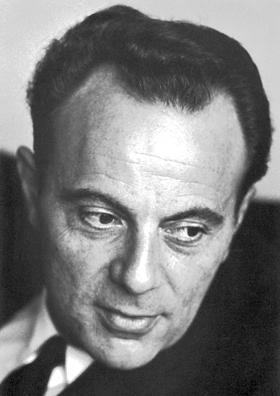

Nobel Prize in Physiology or Medicine · 1965
François Jacob
He showed how cells switch their genes on and off, and helped find messenger RNA, the molecule behind today's mRNA vaccines.
The Nobel citation: “for their discoveries concerning genetic control of enzyme and virus synthesis”
- Born
- June 17, 1920, Nancy, France
- Died
- April 19, 2013, Paris, France
- Shared with
- André Lwoff, Jacques Monod
- Affiliation at the time
- Institut Pasteur, France
Medicine prize
1965
Shared with 2 other laureates.
Age that year
45years
Born in 1920.
Headline credited impact
4,350–44,500lives saved
Deaths averted by mRNA COVID-19 vaccines, credited to the discovery of messenger RNA. How it was built
Sources cited
29
Fact-checked September 24, 2026.
- With Élie Wollman he mapped bacterial genes by pulling mating bacteria apart in a kitchen blender at set times, which showed that the E. coli chromosome is a circle.
- In 1960 he and Sydney Brenner could not detect messenger RNA until, days before leaving Caltech, Brenner leapt up on a beach shouting that the answer was magnesium.
- In August 1944 a German air attack in Normandy riddled him with fragments as he tended a wounded officer. The wounds ended his plan to become a surgeon.
- In July 1958, bored by a film at the cinema, he suddenly saw that his two research systems, a virus dormant in bacteria and the lactose genes, were switched off the same way.
- Before science he spent four years as a Free French army doctor. From 2007 to 2011 he led the Order of Liberation, which honors those who fought to free France.
The breakthrough
How genes are switched on and off, and the messenger that carries their instructions
Every cell in your body carries the same genes, yet a liver cell and a nerve cell behave very differently. In the 1950s nobody knew how a cell decides which genes to use. Working with the gut bacterium E. coli, Jacob and Jacques Monod found an answer in the genes the bacterium uses to digest milk sugar (lactose). A separate regulator gene makes a blocker, the repressor (later shown to be a protein), that sits on a stretch of DNA next to the lactose genes, called the operator, and keeps them silent. When lactose arrives, it pulls the repressor off and the genes switch on. They called a group of genes controlled together in this way an operon. Think of a lamp whose switch is held down by a clip: the lamp (the genes) stays dark until lactose removes the clip (the repressor). To make the model work, they also proposed that genes send out short-lived working copies of themselves, called messenger RNA, to the cell's protein factories, the ribosomes. In 1960, at Caltech with Matthew Meselson, Jacob and Sydney Brenner showed that such messengers exist, while his Pasteur colleague François Gros, working in James Watson's lab at Harvard, found the same. Jacob also saw that a virus hiding inside a bacterium is kept quiet by the same kind of repressor switch. Earlier, with Élie Wollman, he had worked out how bacteria pass genes to one another and shown that their chromosome is a circle.[2],[3],[4],[6],[12],[13]
“I was fortunate enough to arrive at the right place at the right time.”
What it meant for humanity
When the prize was awarded in 1965, the Nobel presenter admitted that this research had not yet produced anything practical, but predicted it would matter for medicine. It did, in three main ways. First, it changed how biologists think. Jacob and Monod showed that genes are not just a list of parts but a network of switches, and in 1961 they suggested that such switches could explain how cells become specialized and how they go wrong in cancer. Research on embryos, stem cells and cancer still builds on that idea. Second, their bacterial switch became a workhorse of biotechnology. The lac promoter, the on-switch of the lactose genes, became a standard part of the tools used to make proteins in bacteria, letting scientists turn on a foreign gene when they choose. The first human insulin made in bacteria, reported in 1979, was produced by joining synthetic insulin genes to the lactose-digesting enzyme gene that Jacob and Monod had studied; the first genetically engineered human insulin went on sale in 1982. Third, messenger RNA, which Jacob helped predict and detect, is the molecule delivered by the mRNA COVID-19 vaccines, of which billions of doses were shipped. As the Institut Pasteur notes, that became possible only after industry found ways to stabilize the fragile molecule. Jacob also wrote widely for the public, criticizing eugenics, sperm banks and racist theories that claimed scientific backing, and his 1977 essay 'Evolution and Tinkering' argued that evolution works like a tinkerer reusing old parts, not an engineer following a blueprint.
- On 13 May 1961 Nature published his paper with Sydney Brenner and Matthew Meselson showing that an unstable RNA carries genes' instructions to the ribosomes, beside a matching report from a Harvard team.[12],[13]
- A 2014 review of protein production in E. coli calls the lac promoter, the switch from the lactose genes Jacob and Monod studied, the staple of bacterial promoter research and a basis of expression vectors.[3],[18]
- The first human insulin made in bacteria (1979) came from synthetic insulin genes fused to the E. coli beta-galactosidase gene, the lactose-system gene at the center of the operon work.[3],[19],[22]
- Turning to mouse embryos in the 1970s, his laboratory identified uvomorulin, a protein now known as E-cadherin, and was a pioneer in switching off chosen genes in mice.[6]
- In Le Monde, in interviews and in his books, he argued against eugenics, sperm banks and racist theories that claimed the backing of science.[10]
Impact in numbers
Most of Jacob's legacy is conceptual and cannot be honestly counted. The ideas that genes are controlled by switches and that they send out short-lived messenger copies underlie modern molecular biology, from how embryos develop to how cancer arises. We make two small numeric claims. First, his lactose-switch work supplied everyday tools of genetic engineering, including the lac promoter used to switch on foreign genes in bacteria and the enzyme gene fused to the first bacterial human insulin; we credit him with half of one percent of the shared recombinant-medicine outcome, alongside Berg, Kornberg, Lederberg and Luria. Second, the mRNA COVID-19 vaccines deliver the very kind of molecule he helped discover; we credit him with half of one percent of the lives they saved, the same share given to Nirenberg for the genetic code, and count the same share of their rare myocarditis cases against him. The slices are small on purpose: Monod, Brenner, Meselson, Gros, Wollman, Lwoff and many later inventors share the credit.
Fundamental scienceHealthEconomy
Each number is the laureate’s credited share of a real-world outcome, cumulative to 2025. The whole outcome, the share of credit, and the reasoning are shown so you can check the arithmetic. Outcomes shared with other laureates are counted once on the impact page.
- Low confidenceRippleModeledHealth
Deaths averted by mRNA COVID-19 vaccines, credited to the discovery of messenger RNA
4,350–44,500
lives saved, credited share
That is 0.5% of 870,000–8.9 million lives saved since 2020.
How this number was built
Range reused from the shared mrna-vaccines outcome. All COVID-19 vaccines: 2.5M deaths averted to Oct 2024 (Ioannidis 2025; 1 per 5,400 doses, so ~13.5B doses) to 19.8M in year one (Watson 2022, excess deaths). mRNA doses: Pfizer-BioNTech 4.3B by Mar 2023 + Moderna ~0.81B in 2021 = ~5.1B (~38%). Low 2.5M x 35% = 0.87M; high 19.8M x 45% = 8.9M. Share 0.005: the vaccines deliver messenger RNA, which Jacob and Monod proposed and Brenner, Jacob and Meselson demonstrated in 1961, in parallel with Gros's team in Watson's lab; many contributed (Cobb 2015). The vaccines also needed the genetic code (Nirenberg 0.005), modified bases (Kariko and Weissman 0.3), lipid delivery, a stabilized spike and industrial work to stabilize mRNA. His slice: 4,350-44,500 lives.[12],[13],[14],[23],[24],[25],[26]
Sources: JAMA Health Forum (PubMed record); The Lancet Infectious Diseases (PubMed record); Pfizer; U.S. Securities and Exchange Commission (EDGAR); Nature; Institut Pasteur; Current Biology (PubMed record)
- Low confidenceRippleModeledEconomy
Cumulative global sales of genetically engineered non-antibody protein medicines (a proxy for economic activity)
$7.5–10
billion in economic value, credited share
That is 0.5% of $1.5–2 trillion in economic value since 1982.
How this number was built
Shared range (as Berg, Kornberg, Lederberg): world sales of recombinant non-antibody protein drugs since Humulin (1982). 2013 antibody sales ~$75B were about half of biopharma, so non-antibody ~$75B (Ecker 2015); 2021 non-antibody originators $53.6B, biosimilars $11.1B (Walsh 2022). Low: quadratic ramp 1982-2013 ($0.81T) + fall to $53.6B in 2014-21 ($0.50T) + flat 2022-25 ($0.21T) = ~$1.5T. High: linear ramp ($1.2T) + same later years + half of biosimilars = ~$2.0T. Nominal sales, not net benefit. Share 0.005 (~$7.5-10B): lac switches are staples of E. coli expression vectors (Rosano 2014); the first bacterial human insulin was a beta-galactosidase fusion (Goeddel 1979). But most novel biologics are made in mammalian cells (Walsh 2022), Monod co-discovered the operon, and Berg (0.05), Kornberg (0.02), Lederberg (0.01), Luria (0.005), Cohen, Boyer and industry did the rest.[3],[18],[19],[20],[21],[22]
Sources: Nature Biotechnology (via PubMed Central); mAbs (via PubMed Central); Journal of Community Hospital Internal Medicine Perspectives (via PubMed Central); Frontiers in Microbiology (via PubMed Central); Proceedings of the National Academy of Sciences (via PubMed Central); NobelPrize.org
- HarmLow confidenceRippleModeledHealth
Myocarditis cases linked to mRNA COVID-19 vaccines, credited to the discovery of messenger RNA
100–350
people harmed, credited share
That is 0.5% of 20,000–70,000 people harmed since 2020.
How this number was built
Range reused from the shared mrna-vaccine-myocarditis outcome. Oster et al. (2022): 1,626 confirmed cases after 354.1M US mRNA doses = 0.46 per 100,000 doses (passive reporting, likely an undercount). Mevorach et al. (2021), Israeli active surveillance: 136 definite or probable cases among ~5.1M two-dose recipients (at least 10.2M doses) = ~1.3 per 100,000 doses. Applied to ~5.1B mRNA doses (Pfizer-BioNTech 4.3B + Moderna 0.81B): 23,000, rounded down to 20,000, to 66,000, rounded up to 70,000. In Israel 95% of cases were mild; one was fatal. Share 0.005, matching the benefit claim: about 100-350 cases.[25],[26],[27],[28]
Sources: JAMA (PubMed record); New England Journal of Medicine (PubMed record); Pfizer; U.S. Securities and Exchange Commission (EDGAR)
The double edge
No direct harm has been traced to Jacob's own experiments. His discoveries are, however, part of the foundations of genetic engineering and of mRNA medicines, which carry their own risks. The mRNA COVID-19 vaccines, for example, can cause rare heart inflammation (myocarditis), mostly in young men, and we count a small slice of those cases against him at the same share as the vaccines' benefit. His science also had limits. In 1961 he and Monod proposed that their bacterial switch might explain gene control in mammals too; later research found that plants and animals also rely on many other layers of control, such as chemical tags on DNA and small RNAs. Finally, credit was widely shared: messenger RNA was pinned down by two teams and many people, and no Nobel Prize was ever given for its discovery.
- Minor
Rare heart inflammation after mRNA vaccines
mRNA COVID-19 vaccines, which deliver messenger RNA, can cause myocarditis, mostly in young males. In US reports, 1,626 cases met the case definition after 354 million doses. In Israel, 95% of 136 definite or probable cases were mild; one was fatal.[27],[28]
- Minor
A bacterial model, generalized early
Their 1961 paper proposed extending the repressor model to mammals, to explain cell specialization and cancer. The core idea of regulatory genes held up, but later work showed that gene control in higher organisms also uses chemical changes to DNA and its packaging proteins, and small RNAs.[6],[8]
- Minor
Many hands behind messenger RNA
Messenger RNA was demonstrated in two back-to-back Nature papers in May 1961, one with Jacob and one led by François Gros in James Watson's Harvard lab. Writing in Current Biology, Matthew Cobb notes that so many people took part that no Nobel Prize was given for the discovery.[12],[14]
Against the odds
Jacob's family was well rooted in France: his grandfather was a general. Yet organized antisemitism was part of the France of his youth: at the Lycée Carnot in Paris he traded blows with young militants of Action française, an antisemitic monarchist movement led by Charles Maurras that named Jews among France's supposed enemies. In early June 1940 his mother died as German armies overran the country. On his 20th birthday, 17 June, he learned on the road south that France was seeking an armistice. Refusing to submit, he slipped aboard a Polish ship at Saint-Jean-de-Luz and joined de Gaulle's Free French in London. Had he stayed, he would have lived under the Vichy regime's Jewish Statutes of 1940 and 1941, which barred Jews from professions including medicine; from June 1942 Jews in occupied France had to wear a yellow star, and some 77,000 Jews living in France died in the Holocaust. He later wrote that his mother had died in time to be spared that horror. He then spent four years as an army doctor. Punished with a posting to a remote outpost in Chad for refusing a job far from the fighting, he later served under fire in Libya and Tunisia, was wounded in 1943 and, in August 1944, gravely wounded in Normandy. Seven months in hospital ended his hope of becoming a surgeon, and he had to start again, entering research at 30.
—
Discrimination
As a teenager at the Lycée Carnot in Paris he traded blows with young militants of Action française, an antisemitic monarchist movement led by Charles Maurras that named Jews among France's supposed enemies.[7],[17]
1940
Exile
Refusing the armistice, he sailed from Saint-Jean-de-Luz on the Polish ship Batory on 21 June 1940 and joined the Free French in London on 1 July. He did not set foot in mainland France again until August 1944.[5],[6],[7]
1940
Persecution
Vichy's Jewish Statutes of October 1940 and June 1941 barred Jews from the free professions, including medicine; from June 1942 Jews in occupied France had to wear a yellow star. Jacob wrote that his mother died in time to be spared the flight from the yellow star.[6],[15],[16]
1942
Other
After refusing an assignment that would have kept him away from combat units, he was sent as punishment to Mao, an isolated post north of Lake Chad, where he was the only doctor for a vast area.[6],[7]
1943
War
Wounded in the arm by mortar fragments at Djebel Garci, Tunisia, on 10 May 1943, he stayed on the firing line until another medical officer could replace him the next morning.[5]
1944
War
On 8 August 1944 in Normandy he was gravely wounded in the arm and leg by aerial bomb fragments while caring for a wounded lieutenant, who died. After about seven months in hospital, his injuries ruled out surgery as a career.[2],[5],[7]
Jewish background
Jacob was born into a French Jewish family, the only child of Simon Jacob and Thérèse Franck, who both came from Jewish families with very different outlooks. His father combined religious practice with Radical-Socialist politics; his mother was agnostic or even atheist. His childhood hero was his maternal grandfather, Albert Franck, a secular Jewish officer described as the first French Jew to become a corps general, who taught him that heaven was empty. Jacob went to synagogue as a boy and had a bar mitzvah, after which he became an atheist. A review of his memoir describes him as proud of his Jewishness; he also wrote that he felt passionately French.[6],[7],[8],[9],[11],[29]
Key dates
June 17, 1920
Born in Nancy, France, the only child of Simon Jacob and Thérèse Franck.[1],[2],[9]
June 2, 1940
His mother dies of Hodgkin's disease as German armies overrun France.[7],[9]
June 21, 1940
Sails from Saint-Jean-de-Luz for England on the Polish ship Batory; joins the Free French in London on 1 July.[5]
August 8, 1944
Gravely wounded in Normandy during a German air attack; spends about seven months in hospital.[2],[5]
November 17, 1945
Named a Companion of the Liberation, holder of the Cross of Liberation, France's highest decoration of the war.[2],[5]
October 1950
After repeated refusals, is accepted into André Lwoff's laboratory at the Institut Pasteur.[2],[6]
1954
Earns his science doctorate on lysogenic bacteria and begins his long partnership with Élie Wollman on bacterial mating.[2]
1958
The PaJaMo experiments with Arthur Pardee and Jacques Monod reveal a repressor that keeps the lactose genes switched off.[6],[8]
May 13, 1961
Nature publishes his paper with Sydney Brenner and Matthew Meselson demonstrating messenger RNA; that year he and Monod publish the operon model.[12],[13]
1964
Becomes professor in a new chair of cell genetics created for him at the Collège de France.[2]
1965
Shares the Nobel Prize in Physiology or Medicine with André Lwoff and Jacques Monod.[1]
1996
2007
Becomes chancellor of the Order of Liberation, serving until 2011.[5]
April 19, 2013
Sources
- 1.François Jacob - Facts · NobelPrize.org (Nobel Prize Outreach)
- 2.François Jacob - Biographical (with 2005 updates by the laureate) · NobelPrize.org (from Nobel Lectures, Physiology or Medicine 1963-1970, Elsevier, 1972), 1972
- 3.Genetics of the Bacterial Cell (Nobel Lecture, 11 December 1965) · NobelPrize.org, 1965
- 4.Award ceremony speech, Nobel Prize in Physiology or Medicine 1965 (presentation by Professor Sven Gard) · NobelPrize.org, 1965
- 5.François Jacob, Compagnon de la Libération (biography) · Ordre de la Libération et son Musée
- 6.Tribute to François Jacob (Christine Petit and Philippe Sansonetti) · Collège de France, 2014
- 7.Discours de réception de M. Marc Lambron (eulogy of François Jacob, seat 38) · Académie française, 2016
- 8.Francois Jacob memorial (Arthur B. Pardee), PNAS 110(25):10053-10054 · Proceedings of the National Academy of Sciences (via PubMed Central), 2013
- 9.Francois Jacob (1920-2013) (Valerie Racine) · Embryo Project Encyclopedia, Arizona State University, 2014
- 10.Mission possible: getting to yes with François Jacob (Jon Beckwith), Research in Microbiology 165(5) · Research in Microbiology (via PubMed Central), 2014
- 11.Review: The Statue Within: An Autobiography by François Jacob · Kirkus Reviews, 1988
- 12.Discovery of messenger RNA in 1961 · Institut Pasteur, 2021
- 13.An unstable intermediate carrying information from genes to ribosomes for protein synthesis (Brenner S, Jacob F, Meselson M), Nature 190:576-581 · Nature, 1961
- 14.Who discovered messenger RNA? (Cobb M), Current Biology 25(13):R526-R532 · Current Biology (PubMed record), 2015
- 15.France (Holocaust Encyclopedia) · United States Holocaust Memorial Museum
- 16.Paris (Holocaust Encyclopedia) · United States Holocaust Memorial Museum
- 17.Action Francaise (Shoah Resource Center glossary entry) · Yad Vashem, International School for Holocaust Studies
- 18.Recombinant protein expression in Escherichia coli: advances and challenges (Rosano GL, Ceccarelli EA), Frontiers in Microbiology 5:172 · Frontiers in Microbiology (via PubMed Central), 2014
- 19.Expression in Escherichia coli of chemically synthesized genes for human insulin (Goeddel DV et al.), PNAS 76(1):106-110 · Proceedings of the National Academy of Sciences (via PubMed Central), 1979
- 20.Biopharmaceutical benchmarks 2022 (Walsh G, Walsh E), Nature Biotechnology 40:1722-1760 · Nature Biotechnology (via PubMed Central), 2022
- 21.The therapeutic monoclonal antibody market (Ecker DM, Jones SD, Levine HL), mAbs 7(1):9-14 · mAbs (via PubMed Central), 2015
- 22.History of insulin (Quianzon CC, Cheikh I), Journal of Community Hospital Internal Medicine Perspectives 2(2) · Journal of Community Hospital Internal Medicine Perspectives (via PubMed Central), 2012
- 23.Global Estimates of Lives and Life-Years Saved by COVID-19 Vaccination During 2020-2024 (Ioannidis JPA et al.), JAMA Health Forum · JAMA Health Forum (PubMed record), 2025
- 24.Global impact of the first year of COVID-19 vaccination: a mathematical modelling study (Watson OJ et al.), Lancet Infectious Diseases · The Lancet Infectious Diseases (PubMed record), 2022
- 25.Pfizer-BioNTech COVID-19 Vaccine: U.S. Manufacturing and Distribution Fact Sheet (March 2023) · Pfizer, 2023
- 26.Moderna, Inc. Form 8-K (January 2022): 2021 COVID-19 vaccine deliveries · U.S. Securities and Exchange Commission (EDGAR), 2022
- 27.Myocarditis Cases Reported After mRNA-Based COVID-19 Vaccination in the US From December 2020 to August 2021 (Oster ME et al.), JAMA · JAMA (PubMed record), 2022
- 28.Myocarditis after BNT162b2 mRNA Vaccine against Covid-19 in Israel (Mevorach D et al.), NEJM · New England Journal of Medicine (PubMed record), 2021
- 29.Francois Jacob (1920 - 2013) · Jewish Virtual Library (American-Israeli Cooperative Enterprise)
Fact-checked on September 24, 2026 by a separate AI fact-checking pass that re-opened the sources, with 6 corrections made. How we check
Suggest a correction