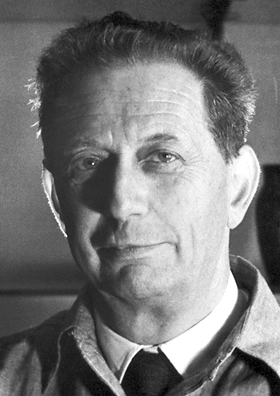

Nobel Prize in Physiology or Medicine · 1965
André Lwoff
He showed that a virus can hide silently inside a cell's genes until a signal wakes it, a key to how genes are switched on and off.
The Nobel citation: “for their discoveries concerning genetic control of enzyme and virus synthesis”
- Born
- May 8, 1902, Ainay-le-Château, France
- Died
- September 30, 1994, Paris, France
- Shared with
- François Jacob, Jacques Monod
- Affiliation at the time
- Institut Pasteur, France
Medicine prize
1965
Shared with 2 other laureates.
Age that year
63years
Born in 1902.
Headline credited impact
$3–4billion in economic value
Cumulative global sales of genetically engineered non-antibody protein medicines (a proxy for economic activity). How it was built
Sources cited
28
Fact-checked September 24, 2026.
- With two colleagues he found that ultraviolet light wakes a virus hidden inside bacteria: about 45 minutes later nearly all the cells burst, each releasing about 100 new viruses.
- He coined the word 'prophage', and his lab's naming committee gave biology other words still in daily use, including virion and capsid.
- In his Nobel lecture he admitted he disliked mathematics and statistics, so he followed a single bacterium through 19 divisions under the microscope instead.
- His mother, a sculptor, was a cousin of the Russian painter Valentin Serov, whose 1895 portrait of her is now held by the Musée d'Orsay in Paris.
- During the German occupation his attic laboratory at the Pasteur Institute was a hub of the Resistance, and he was awarded the Resistance Medal.
The breakthrough
Prophages: how a virus hides inside a cell's genes, and what wakes it
Bacteriophages are viruses that infect bacteria. Most kill their host quickly, but some bacteria, called lysogenic, carry a phage for generations without harm and yet now and then burst open, releasing new viruses. In 1949 the influential new school of American virologists had written lysogeny off. Around 1950 Lwoff decided to watch single bacteria under the microscope. One cell divided 19 times without releasing any virus, yet its offspring kept the ability to make it. Breaking such cells open found no virus inside. So the virus had to survive in a hidden, non-infectious form, which he named the prophage. With Louis Siminovitch and Niels Kjeldgaard he then found a trigger: a dose of ultraviolet light made almost the whole population burst about 45 minutes later, each cell releasing around a hundred new viruses. Further work showed that the prophage is the virus's DNA, fixed at a set spot on the bacterial chromosome and copied along with it, kept silent by a repressor protein until damage to the cell's DNA switches it on. Think of a sleeper agent living quietly in a town for years until a coded message on the radio wakes him. The discovery showed that viral genes can become part of a cell's own heredity, and it fed directly into Jacob and Monod's model of how genes are switched on and off.[1],[2],[3],[4],[8],[17]
“I began my career as a protozoologist. I like to see things, not calculate probabilities.”
What it meant for humanity
Lwoff's discoveries rarely reached patients directly, but they changed how biologists think, and tools built on them are found in labs worldwide. In the 1930s, working with his wife Marguerite, he showed that several vitamins are growth factors that some microbes can no longer make for themselves, and that they work as parts of enzymes. This helped establish that all living things run on the same basic chemistry. His work on lysogeny showed that a virus's genes can join a cell's heredity and lie silent until a signal switches them on. That idea, and the two lines of research he gathered in his attic laboratory, Monod's work on enzyme adaptation and his own on lysogeny, fed straight into the operon model of gene control that won the 1965 prize for all three men. It also offered a way to think about viruses that hide in the body, such as herpes, which he discussed in his Nobel lecture, and about bacterial toxins: the Shiga toxin behind E. coli hemorrhagic colitis is made in quantity mainly after a hidden prophage is switched on. Phage lambda, the classic prophage, played a major part in building the tools of gene cloning, and a very popular bacterial system for producing proteins keeps its key gene on a lambda prophage. Lwoff also helped define viruses by molecular features and pushed for a stable way to classify and name them. Outside the laboratory he presided over France's family-planning movement and directed a cancer research institute that now bears his name.
- With Marguerite Lwoff he showed that several B vitamins are building blocks of enzymes, and that microbes needing them had lost the power to make them: evidence that all life shares one basic chemistry.[6],[7],[8]
- His attic laboratory brought together Monod's work on enzyme adaptation and his own on lysogeny; the merger of these two lines produced the operon model of gene control honored by the 1965 prize.[4],[8]
- Prophage induction helps explain some bacterial disease: the Shiga toxin behind E. coli hemorrhagic colitis is made in quantity mainly after a hidden prophage is switched on and the cell bursts.[17]
- Phage lambda, the classic prophage, played a major part in building gene-cloning tools, and the widely used T7 protein-production system usually keeps its key gene on a lambda prophage called DE3.[17],[18]
- He helped replace older definitions of viruses based on size and growth with molecular ones, such as the kind of nucleic acid they carry, and pushed for a stable system to classify and name viruses.[8]
Impact in numbers
Most of Lwoff's legacy is conceptual. He showed that vitamins work as parts of enzymes in microbes as in other life, that a virus can live inside a cell's genes as a silent prophage, and that outside signals can wake it. These ideas shaped the operon model, the modern definition of a virus and the study of latent infections and toxin-carrying bacteria. We make one small numeric claim. Phage lambda, the classic prophage, became a key vector for gene cloning, and prophage-based switches are still used to make proteins in bacteria, so we credit Lwoff with 0.2% of the shared recombinant-medicine outcome. That is below the 0.5% we give each to Jacob and Luria, because lambda itself was discovered by Esther Lederberg and the cloning tools were built by others. We make no numeric claim for his growth-factor or poliovirus work, where no honest number exists.
Fundamental scienceHealthEconomy
Each number is the laureate’s credited share of a real-world outcome, cumulative to 2025. The whole outcome, the share of credit, and the reasoning are shown so you can check the arithmetic. Outcomes shared with other laureates are counted once on the impact page.
- Low confidenceRippleModeledEconomy
Cumulative global sales of genetically engineered non-antibody protein medicines (a proxy for economic activity)
$3–4
billion in economic value, credited share
That is 0.2% of $1.5–2 trillion in economic value since 1982.
How this number was built
Same outcome and range as the Berg, Kornberg, Lederberg, Luria and Jacob profiles: world sales of recombinant non-antibody protein medicines since Humulin (1982). 2013 antibody sales ~$75B were about half of biopharma (Ecker 2015); 2021 non-antibody originators $53.6B, biosimilars $11.1B (Walsh 2022). Low: quadratic ramp to $75B over 1982-2013 ($0.81T) + fall to $53.6B in 2014-21 ($0.50T) + flat 2022-25 ($0.21T) = ~$1.5T. High: linear ramp ($1.2T) + same later years + half of biosimilars = ~$2.0T. Sales, not net benefit. Share 0.002 (~$3-4B): Lwoff named the prophage and found its induction (1950); lambda, a prophage, became a key cloning vector, and pET/T7 hosts carry a lambda prophage (DE3) while pL vectors use induction as a switch (Casjens 2015; Rosano 2014). But Esther Lederberg found lambda, and Jacob (0.005), Luria (0.005), Berg, Cohen, Boyer and industry did the rest.[3],[17],[18],[19],[20],[21]
Sources: Nature Biotechnology (via PubMed Central); mAbs (via PubMed Central); Journal of Community Hospital Internal Medicine Perspectives (via PubMed Central); Virology (via PubMed Central); Frontiers in Microbiology (via PubMed Central); NobelPrize.org
The double edge
No harm has been traced to Lwoff's own work, and we found no documented misuse of his discoveries. The genetic engineering that prophage research helped make possible carries the general risks of biotechnology, but none that is specific to him. The honest caveats concern limits and credit. He leaned hard toward viruses as the cause of cancer, which later research showed is true for only some cancers. His molecular definition of a virus served for decades before giant viruses prompted calls to rewrite it. And the prize rested partly on work by others who were never rewarded: his wife and lifelong collaborator Marguerite Lwoff, and Eugène and Élisabeth Wollman, whose early ideas on lysogeny he carried forward after they were murdered at Auschwitz.
- Minor
Viruses and cancer: a hope stretched too far
In his 1965 Nobel lecture he described how a virus's genes can turn a cell cancerous and called for war on cancer-causing viruses; a laureate encyclopedia says he and his Pasteur colleagues were convinced cancer was viral. Viruses do cause some cancers, but an IARC study linked about 2.2 million of 2018's 18.1 million new cases, roughly one in eight, to infections, with a bacterium, H. pylori, the largest single cause.[3],[15],[25],[26]
- Minor
A definition of 'virus' later questioned
His molecular definition of viruses guided the field for decades. After giant viruses such as Mimivirus were found, Didier Raoult and Patrick Forterre argued in 2008 that viruses were still defined mostly by what they lack, and proposed a new definition built around the virus's protein shell, the capsid.[8],[24]
- Minor
Credit that others did not receive
Marguerite Lwoff worked beside him for decades, sharing the growth-factor discoveries and later showing how temperature affects each stage of poliovirus growth, but received no share of the prize. Eugène and Élisabeth Wollman, whose lysogeny research he extended, were deported and murdered in December 1943.[6],[7],[11]
Against the odds
Lwoff grew up French, but his family's story began under the tsars. His father left the Russian Empire after being caught up in student unrest at medical school and settled in France, where in the 1890s police watched him as a suspected anarchist, partly because of his Russian origins. André himself faced no documented discrimination early on: he joined the Pasteur Institute at 19 and headed a new department by 36. The Second World War changed everything around him. Vichy France's Jewish Statutes of 1940 and 1941 pushed Jews out of public service and the professions, and some 77,000 Jews living in France died in camps or in detention. At the Pasteur Institute, Eugène and Élisabeth Wollman, the Jewish couple who had treated the Lwoffs almost as family and whose early ideas on lysogeny he later vindicated, were arrested by French police in December 1943 and murdered at Auschwitz. Lwoff, mobilized as an army doctor in 1939, was back at the institute by 1942 and joined Resistance networks. His laboratory became a hub for the Resistance, he gave the underground fighter Jacques Monod a place to work, and by one account he hid downed American airmen in his apartment. He received the Resistance Medal. The sources we found do not say whether the anti-Jewish laws were applied to him personally.
1894
Discrimination
His father, Salomon Lwoff, left Russia after being caught up in student unrest at medical school. In France, as a young asylum doctor, he was placed under police surveillance as a suspected anarchist, which a historian of psychiatry links partly to his Russian origins.[10]
1939
War
At the outbreak of the Second World War he was mobilized as an army medical officer, serving as a lieutenant and then a captain.[5]
1942
War
Back at the Pasteur Institute under German occupation, he joined the Resistance networks Cohors-Asturies and Shelburn, turned his laboratory into a hub for the Resistance and sheltered Jacques Monod's work there. He was awarded the Resistance Medal.[5],[9],[12],[23]
1940
Persecution
Vichy France's anti-Jewish laws of October 1940 and June 1941 pushed Jews out of public life and government jobs and banned them from many professions, medicine among them; some 77,000 Jews living in France died in camps or in detention. We found no record of how these laws touched him personally.[22]
1943
Other
His Pasteur colleagues and mentors Eugène and Élisabeth Wollman, Jewish scientists who had pioneered lysogeny research, were arrested by French police, deported from Drancy and murdered at Auschwitz. He later made it a personal mission to show sceptical American phage researchers that their observations mattered.[8],[11]
1944
War
His 1944 book on how microbes lose biochemical functions over evolution drew little attention from other scientists, which a historian attributes to the circumstances of the time.[8]
Jewish background
Lwoff was born in France to parents who had emigrated from the Russian Empire. His father, the psychiatrist Salomon Lwoff, was born in Kremenchug, in today's Ukraine; his mother, Maria Simonovich, was a painter and sculptor and a cousin of the Russian painter Valentin Serov. Russian, French and English Wikipedia describe the family as Jewish, an Israeli science-education article calls him a Jewish microbiologist, and the Encyclopaedia Judaica carries an entry on him. We found no record of his own religious practice or communal involvement. A historian of his work notes that he opposed antisemitism in all its forms throughout his life.[8],[10],[11],[12],[13],[14],[16],[27],[28]
Key dates
May 8, 1902
Born in Ainay-le-Château, France, where his father, a Russian-born psychiatrist, had set up a family-care colony for mental patients.[1],[10]
1921
Joins the Pasteur Institute at 19, beginning a long collaboration on protozoa with Édouard Chatton.[2],[5]
1925
Marries the microbiologist Marguerite Bourdaleix, who becomes his lifelong research partner.[15]
1932
Earns his doctorate in science (after his MD in 1927) and goes to Otto Meyerhof's laboratory in Heidelberg on a Rockefeller grant.[2]
1936
In David Keilin's Cambridge lab, he and Marguerite identify a bacterial growth factor as the coenzyme cozymase.[2],[6]
1938
Becomes head of a new Department of Microbial Physiology, housed in the attic of a Pasteur Institute building.[5]
1942
Joins the Resistance networks Cohors-Asturies and Shelburn while working at the Pasteur Institute.[5]
December 1943
His Pasteur colleagues Eugène and Élisabeth Wollman are deported from Drancy and murdered at Auschwitz.[11]
1950
With Louis Siminovitch and Niels Kjeldgaard, discovers that ultraviolet light induces a hidden prophage to make viruses.[2],[3]
1954
After a US visit at the invitation of the National Foundation for Infantile Paralysis, and with its funding, turns to poliovirus research.[2],[5]
December 10, 1965
Shares the Nobel Prize in Physiology or Medicine with François Jacob and Jacques Monod.[1],[4]
1968
Becomes director of the CNRS Institute for Scientific Research on Cancer at Villejuif.[5],[9]
1970
Becomes president of the French Movement for Family Planning.[5]
September 30, 1994
Sources
- 1.André Lwoff - Facts · NobelPrize.org (Nobel Prize Outreach)
- 2.André Lwoff - Biographical · NobelPrize.org (from Nobel Lectures, Physiology or Medicine 1963-1970, Elsevier, 1972), 1972
- 3.Interaction among Virus, Cell, and Organism (Nobel Lecture, 11 December 1965) · NobelPrize.org, 1965
- 4.Award ceremony speech, Nobel Prize in Physiology or Medicine 1965 (presentation by Professor Sven Gard) · NobelPrize.org, 1965
- 5.André Lwoff (1902-1994): repères biographiques · Institut Pasteur, Archives
- 6.Marguerite Lwoff (1905-1979): repères biographiques · Institut Pasteur, Archives
- 7.André Lwoff (1902-1994) · Institut Pasteur, 2016
- 8.What history tells us III. André Lwoff: from protozoology to molecular definition of viruses (Morange M), Journal of Biosciences 30(5):591-594 · Indian Academy of Sciences, 2005
- 9.Biography André Lwoff · Institut André Lwoff (Villejuif)
- 10.Salomon Lwoff (Michel Caire) · Histoire de la psychiatrie en France (psychiatrie.histoire.free.fr), 2012
- 11.Worked together in the lab, murdered together in Auschwitz (Davidson Institute of Science Education) · Ynetnews, 2024
- 12.Lwoff, André Michel (Encyclopaedia Judaica) · Encyclopedia.com (Encyclopaedia Judaica, Gale), 2007
- 13.André Michel Lwoff (1902-1994) · Jewish Virtual Library (American-Israeli Cooperative Enterprise)
- 14.Львов, Андре (André Lwoff) · Wikipedia (Russian)
- 15.ЛЬВОВ (Lwoff), Андре, in Лауреаты Нобелевской премии: Энциклопедия (Russian edition of H.W. Wilson's Nobel Prize Winners, 1987) · Nauka i Tekhnika (n-t.ru), from Progress Publishers, 1992, 1992
- 16.Portrait de Mme Lwoff (Valentin Serov, 1895), musée d'Orsay, RF 1980 8 · Ministère de la Culture, POP: Plateforme ouverte du patrimoine (Joconde)
- 17.Bacteriophage lambda: early pioneer and still relevant (Casjens SR, Hendrix RW), Virology 479-480:310-330 · Virology (via PubMed Central), 2015
- 18.Recombinant protein expression in Escherichia coli: advances and challenges (Rosano GL, Ceccarelli EA), Frontiers in Microbiology 5:172 · Frontiers in Microbiology (via PubMed Central), 2014
- 19.Biopharmaceutical benchmarks 2022 (Walsh G, Walsh E), Nature Biotechnology 40:1722-1760 · Nature Biotechnology (via PubMed Central), 2022
- 20.The therapeutic monoclonal antibody market (Ecker DM, Jones SD, Levine HL), mAbs 7(1):9-14 · mAbs (via PubMed Central), 2015
- 21.History of insulin (Quianzon CC, Cheikh I), Journal of Community Hospital Internal Medicine Perspectives 2(2) · Journal of Community Hospital Internal Medicine Perspectives (via PubMed Central), 2012
- 22.France (Holocaust Encyclopedia) · United States Holocaust Memorial Museum
- 23.The Converging Lives of Jacques Monod, Francois Jacob, Andre Lwoff, and Albert Camus in Wartime France (Leonard Norkin) · Leonard Norkin Virology Site, 2017
- 24.Redefining viruses: lessons from Mimivirus (Raoult D, Forterre P), Nature Reviews Microbiology 6:315-319 · Nature Reviews Microbiology (PubMed record), 2008
- 25.Global burden of cancer attributable to infections in 2018: a worldwide incidence analysis (de Martel C et al.), Lancet Global Health 8(2):e180-e190 · The Lancet Global Health (PubMed record), 2020
- 26.Latest global cancer data: Cancer burden rises to 18.1 million new cases and 9.6 million cancer deaths in 2018 (Press release No. 263) · International Agency for Research on Cancer (WHO), 2018
- 27.André Lwoff · Wikipedia (French)
- 28.André Michel Lwoff · Wikipedia (English)
Fact-checked on September 24, 2026 by a separate AI fact-checking pass that re-opened the sources, with 9 corrections made. How we check
Suggest a correction