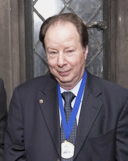

Nobel Prize in Chemistry · 1989
Sidney Altman
He showed that RNA, long seen as a mere messenger, can work as an enzyme, a finding that rewrote textbooks and hinted at how life began.
The Nobel citation: “for their discovery of catalytic properties of RNA”
- Born
- May 7, 1939, Montreal, Canada
- Died
- April 5, 2022, Rockleigh, NJ, USA
- Shared with
- Thomas R. Cech
- Affiliation at the time
- Yale University, USA
Chemistry prize
1989
Shared with 1 other laureate.
Age that year
50years
Born in 1939.
Sources cited
20
Fact-checked September 24, 2026.
- He planned to attend McGill, but a friend invited him along to take the American SAT exam, and both applied to MIT. He got in; his friend did not.
- A stubborn RNA kept showing up in his purified enzyme. He asked a student to get rid of it; the student proved it was essential.
- The decisive 1983 result came from a control experiment: his postdoc Cecilia Guerrier-Takada tested the RNA alone with extra magnesium, and it cut by itself.
- As a teenager he offered book reviews to the Montreal Star. The editor advised him to stick to science while he was young.
- In the year of his Nobel Prize he finished four years as Dean of Yale College, where he led an expansion of science and language requirements.
The breakthrough
RNA that works as an enzyme: the catalytic heart of RNase P (1971-1983)
Cells run on enzymes, molecules that speed up chemical reactions without being used up. For decades, textbooks said every enzyme was a protein, while RNA, DNA's chemical cousin, simply carried genetic messages. Altman's path began with a small puzzle. Transfer RNAs, the adaptors that bring amino acids to the ribosome, are first made as longer drafts that must be trimmed. Around 1970, in Cambridge, England, he isolated one of these drafts, and with colleagues found the enzyme that snips off its front end. They named it ribonuclease P, or RNase P. At Yale, his team kept finding an RNA mixed in with the enzyme. In 1978 they showed that this RNA was essential: destroy it and the enzyme stopped working. Then, in 1983, during joint experiments with Norman Pace's group, his postdoc Cecilia Guerrier-Takada tested the RNA on its own in a solution with more magnesium. It cut its targets by itself, acting as a true catalyst, while the protein part alone did nothing. RNA made in a test tube worked too, ruling out hidden protein. It was like discovering that the paper a recipe is written on can also do the cooking. Working independently, Thomas Cech had found an RNA that splices itself. Together, their findings proved that RNA can be an enzyme.[3],[4],[6],[10],[11]
“The fact that an enzyme had an essential RNA subunit, in itself, seemed heretical enough.”
What it meant for humanity
Altman's discovery changed how scientists understand life rather than handing doctors a new pill. It helped with a chicken-and-egg riddle: DNA needs proteins to be copied, and proteins need DNA's instructions to be built, so which came first? If RNA can both store information and act as an enzyme, an early 'RNA world' could have come before both, and the 1989 Nobel announcement called it very likely that RNA was the first molecule to do both jobs. In 2000, atomic structures showed that the ribosome, the machine that builds every protein, also does its key chemistry with RNA, which many scientists saw as proof that it too is an RNA enzyme. Altman also turned his enzyme into a tool. In 1990 he and Anthony Forster showed that a short 'external guide sequence' could steer RNase P to cut almost any chosen RNA. Later work cut the activity of a target gene in human cells grown in the lab and made drug-resistant bacteria sensitive to antibiotics again in culture. A 2024 journal tribute says this approach foreshadowed later RNA-silencing tools such as RNAi, and that the discovery of RNA catalysis helped spark today's boom in RNA science and medicine. The early hopes for RNA-enzyme medicines have been slower to come true. His influence also runs through people. His Yale lab trained 51 postdoctoral fellows, 15 doctoral students and 22 undergraduates, and foreign scientists often outnumbered Americans in his group. As Dean of Yale College he pushed for science students to learn the humanities and for non-scientists to learn science.
- With Thomas Cech, he overturned the textbook rule that all enzymes are proteins; the Nobel announcement said many textbook chapters would have to be revised.[4],[7]
- Catalytic RNA gave strong support to the idea that early life ran on RNA before DNA and proteins, and in 2000 the ribosome itself was shown to do its key chemistry with RNA.[3],[4],[16]
- In 1990 his lab showed that a short guide RNA can direct RNase P to cut a chosen RNA, a gene-silencing method that a 2024 tribute says foreshadowed RNAi.[7],[12],[13]
- In 1997 his lab used guide RNAs to make drug-resistant E. coli bacteria sensitive to antibiotics again, in laboratory cultures.[14]
- At Yale his lab trained 51 postdoctoral fellows, 15 doctoral students and 22 undergraduates, many of them from abroad.[6]
Impact in numbers
Altman's legacy is knowledge. With Thomas Cech he proved that RNA can be an enzyme, overturning a core assumption of biology and giving strong support to the idea that early life ran on RNA before DNA and proteins. That insight later helped scientists recognize that the ribosome, which builds every protein, is itself an RNA machine. He also showed that short guide RNAs can steer RNase P to destroy chosen RNA molecules, an early gene-silencing method that tributes credit with foreshadowing RNAi and with helping spark the modern wave of RNA research and medicine. We make no quantified claim. No approved drug or therapy can be traced to RNase P or to guide-sequence technology, and the one ribozyme medicine we found tested in patients, Angiozyme, failed. Any count of lives saved would require a causal chain we cannot document. His influence also lives on through the scores of scientists his lab trained and his reforms of Yale's undergraduate curriculum.
Fundamental scienceHealth
No number is given here on purpose. Some contributions cannot be counted honestly, and we would rather describe them than invent a figure.
The double edge
No harm is known to flow from Altman's research. The caveats concern promise and credit. The 1989 prize announcement predicted engineered RNA enzymes, or 'gene shears', that might one day fight viral infections, but ribozyme medicines have been slow to arrive: one ribozyme drug, Angiozyme, was dropped in 2012 after a breast-cancer trial found no tumor responses. The discovery was also the work of a team. Students and postdocs did several of the key experiments, and the decisive 1983 paper was a collaboration with Norman Pace's laboratory. Not every result from his lab held up: the lab itself later found that a 1986 paper on the human enzyme reported an artifact. Finally, the success of catalytic RNA led many to assume every RNase P must use RNA, an idea later disproved.
- Minor
Gene-shear cures have been slow to arrive
The 1989 Nobel press release hoped engineered ribozymes could protect plants and people against viruses. Altman's own guide-RNA method reduced target genes' activity in lab-grown human cells and bacteria. But Angiozyme, a ribozyme drug that works differently from his method and aims at a receptor that helps tumors grow blood vessels, showed no tumor responses in a 2012 phase 2 breast-cancer trial and was not developed further.[4],[13],[14],[15]
- Minor
A discovery built by many hands
Graduate student Ben Stark showed in 1978 that RNase P needs its RNA, overcoming Altman's own initial skepticism. Postdoc Ryszard Kole separated and rejoined the RNA and protein. Postdoc Cecilia Guerrier-Takada found the RNA's catalytic activity, using a gene cloned by student Robin Reed, in joint work with Norman Pace's lab.[3],[6],[11]
- Minor
A result that did not hold up
In the late 1980s his lab found that its own 1986 paper, which reported rebuilding human RNase P activity from human RNA and a bacterial protein, was an artifact: traces of bacterial RNA mixed into the protein had done the work. A former student also recalls that a second 1986 paper from the lab was later shown to be wrong. Catching and correcting such errors is part of normal science.[6]
- Minor
A new dogma that also proved wrong
After Altman's finding, many assumed that every RNase P must contain a catalytic RNA. Later work found protein-only versions of the enzyme in some organisms, including human mitochondria, a reminder that received wisdom cuts both ways.[7]
Against the odds
Altman grew up in a Jewish immigrant family in a country that was often unwelcoming to Jews. His parents came from Eastern Europe about two decades before his birth: his mother from Białystok, then in Poland, and his father from Ukraine, who first had to labor on a farm in Ontario as a condition set by the Jewish agency that sponsored him. From 1930 Canada almost never let Jews in, and during the Nazi era it accepted only about 5,000 Jewish refugees, a record historians rank among the worst of any developed country. In 1930s Montreal, Jews faced informal housing restrictions, quotas in university professional schools and exclusion from elite clubs, beaches and resorts. In 1943 the Germans destroyed the Białystok ghetto in the city his mother had left, sending its Jews to Treblinka and other camps. Altman was the second son of poor immigrants: his mother worked in a textile mill, his father in a grocery, and neither finished high school. The family had to scramble to pay for MIT. We found no record of antisemitic discrimination against him personally. His hardest battle was scientific: for years he struggled to convince colleagues that RNA could be an enzyme, and even late in life he felt he had not been treated fairly.
1930
Discrimination
From 1930 Canada's immigration rules almost never admitted Jews. During the Nazi era (1933-45) the country accepted only about 5,000 Jewish refugees, one of the worst records among developed nations.[17],[19]
—
Discrimination
In 1930s Montreal, where his family lived, Jews faced informal housing restrictions, quotas in university professional schools, and exclusion from elite social clubs, beaches and resorts.[18]
1943
Other
Białystok, his mother's hometown, was occupied by Germany in 1941; about 50,000 Jews were confined in its ghetto, which was destroyed in 1943 with deportations to Treblinka and other camps. No source we found says whether relatives remained there.[6],[20]
—
Poverty
He was the second son of poor immigrants who had not finished high school. His mother worked in a textile mill and his father in a grocery, and the family had to scramble to afford MIT.[2],[6],[8]
—
Other
For years he had great difficulty convincing other scientists that RNA could be an enzyme, and he felt he had not been treated fairly in the late 1970s and early 1980s.[6]
Jewish background
Altman was born in Montreal to Jewish immigrant parents. His mother, Ray Arlin, came from Białystok in Poland and was one of eleven children of a Talmudic scholar; his father, Victor Altman, came from Ukraine. At home the family drew on Yiddish, Russian and English, and he went to Hebrew school on Sundays. Yale described him as proud of his Jewish roots: he took part in establishing Judaic Studies at Yale in the 1980s and long served on the board of Yale's Slifka Center for Jewish Life, later as an honorary trustee. He also co-signed a statement by leading scientists condemning the international boycott of Israeli academics.[5],[6]
Key dates
1930
His father, who had arrived penniless from Ukraine, runs his own grocery in Montreal and has married Ray Arlin, an immigrant from Białystok.[6]
May 7, 1939
Born in Montreal, the second son of poor Jewish immigrants.[1],[2],[6]
1960
Graduates from MIT with a degree in physics, after a senior thesis in nuclear physics with Lee Grodzins.[2],[6]
1967
Earns a PhD in biophysics with Leonard Lerman, begun at the University of Colorado Medical Center and finished at Vanderbilt University, then joins Matthew Meselson's lab at Harvard.[2],[6],[9]
October 1969
Arrives at the MRC Laboratory of Molecular Biology in Cambridge, England, in the group of Sydney Brenner and Francis Crick.[3],[6]
1971
Reports the first pure precursor of a transfer RNA and joins Yale. The enzyme that trims it, RNase P, is described in 1972.[2],[3],[6]
August 1978
His lab shows that RNase P contains an RNA component essential for its activity.[3],[10]
December 1983
With Norman Pace's group, his lab shows that the RNA of RNase P is itself the catalyst, working without its protein.[3],[11]
1985
Becomes Dean of Yale College, serving four years before returning to full-time research on 1 July 1989.[2],[5]
October 12, 1989
Awarded the Nobel Prize in Chemistry with Thomas R. Cech for the discovery of catalytic properties of RNA.[1],[4]
August 17, 1990
With Anthony Forster, shows that guide RNAs can steer RNase P to cut chosen RNA targets, the basis of a gene-silencing method.[12]
April 5, 2022
Dies at 82 in Rockleigh, New Jersey, after a long illness.[1],[5]
Sources
- 1.Sidney Altman - Facts · NobelPrize.org (Nobel Prize Outreach), 1989
- 2.Sidney Altman - Biographical · NobelPrize.org (Nobel Foundation), 1989
- 3.Enzymatic Cleavage of RNA by RNA (Nobel Lecture, 8 December 1989) · NobelPrize.org (Nobel Foundation), 1989
- 4.The Nobel Prize in Chemistry 1989 - Press release · The Royal Swedish Academy of Sciences, 1989
- 5.Sidney Altman, pathbreaking scientist · Yale News (Yale University), 2022
- 6.Tribute to Sidney Altman, including 'Sidney Altman: an exemplary scientist, teacher, and friend (1939-2022)' by Venkat Gopalan · RNA (Cold Spring Harbor Laboratory Press), via PubMed Central, 2022
- 7.A tribute to Sidney Altman, one of the architects of modern RNA biology · Journal of Biological Chemistry, via PubMed Central, 2024
- 8.Sidney Altman: Discovered catalytic RNA, for which he won the Nobel Prize in 1989 · science.ca (GCS Research Society), 2015
- 9.Sidney Altman · The Canadian Encyclopedia (Historica Canada), 2023
- 10.Ribonuclease P: an enzyme with an essential RNA component (PNAS 75:3717-3721) · PubMed (National Library of Medicine), 1978
- 11.The RNA moiety of ribonuclease P is the catalytic subunit of the enzyme (Cell 35:849-857) · PubMed (National Library of Medicine), 1983
- 12.External guide sequences for an RNA enzyme (Science 249:783-786) · PubMed (National Library of Medicine), 1990
- 13.Targeted cleavage of mRNA by human RNase P (PNAS 89:8006-8010) · PubMed (National Library of Medicine), 1992
- 14.Phenotypic conversion of drug-resistant bacteria to drug sensitivity (PNAS 94:8468-8472) · PubMed (National Library of Medicine), 1997
- 15.An open-label, phase 2 trial of RPI.4610 (Angiozyme) in the treatment of metastatic breast cancer (Cancer 118:4098-4104) · PubMed (National Library of Medicine), 2012
- 16.Scientific Background on the Nobel Prize in Chemistry 2009: Structure and Function of the Ribosome · The Royal Swedish Academy of Sciences, 2009
- 17.Jewish Canadians · The Canadian Encyclopedia (Historica Canada)
- 18.Prejudice and Discrimination in Canada · The Canadian Encyclopedia (Historica Canada)
- 19.None Is Too Many · The Canadian Encyclopedia (Historica Canada), 2022
- 20.Bialystok · United States Holocaust Memorial Museum (Holocaust Encyclopedia)
Fact-checked on September 24, 2026 by a separate AI fact-checking pass that re-opened the sources, with 8 corrections made. How we check
Suggest a correction