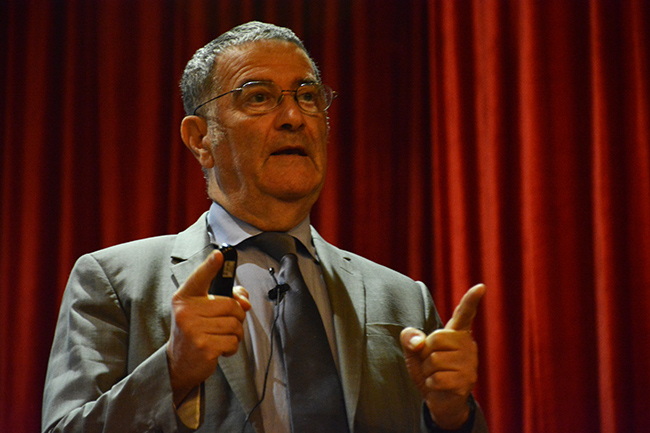

Nobel Prize in Physics · 2012
Serge Haroche
He trapped light in a box of mirrors and counted its photons without destroying them, turning quantum thought experiments into real ones.
The Nobel citation: “for ground-breaking experimental methods that enable measuring and manipulation of individual quantum systems”
- Born
- September 11, 1944, Casablanca, Morocco
- Shared with
- David J. Wineland
- Affiliation at the time
- Collège de France, France; École Normale Supérieure, France
Physics prize
2012
Shared with 1 other laureate.
Age that year
68years
Born in 1944.
Sources cited
15
Fact-checked September 24, 2026.
- His superconducting mirrors held a single microwave photon for about a tenth of a second, long enough to travel some 40,000 km, about once around the Earth.
- His team first recorded the birth and death of a single photon on his 62nd birthday, 11 September 2006, after a postdoc phoned him back to the lab.
- His paternal grandparents met as teachers in the Alliance Israélite Universelle, a network of French-language Jewish schools; his grandfather was an early pupil in Marrakesh.
- In 1963 he ranked first in the entrance exam of France's École Polytechnique, then chose the École Normale Supérieure instead.
- It took his team about 15 years to build a photon box good enough to test ideas they had worked out on paper in the early 1990s.
The breakthrough
Counting trapped photons without destroying them (1983-2011)
Light is made of tiny packets of energy called photons. Normally the only way to detect a photon is to absorb it, as a camera sensor or your eye does, so seeing it destroys it. Haroche's team in Paris found a way to watch photons and leave them alive. They built a 'photon box': two curved mirrors 2.7 cm apart, coated with superconducting niobium and cooled to under one degree above absolute zero. By 2006 the mirrors were so reflective that a microwave photon bounced between them for about 130 milliseconds, travelling some 40,000 km. Through the box they sent giant rubidium atoms, about a thousand times wider than normal atoms, one at a time. Each atom was tuned so it could not absorb the photons. Think of each atom as a tiny stopwatch: the photons do not stop it, but they make it run late, and the delay reveals how many photons are inside. In 2006 and 2007 this let the team watch single photons appear and vanish in sudden 'quantum jumps'. They also put the trapped light into a 'Schrödinger cat' state, two different states at once, and in 2008 filmed how leakage to the outside world destroys that fragile mix, a process called decoherence. In 2011 they used feedback to hold the light at a chosen number of photons. Thought experiments of quantum theory's founders became measurements.[3],[4],[5],[6]
“Time and trust are, I think, worth even more than money.”
What it meant for humanity
Haroche's work has not produced a product anyone can buy. Its main gift so far is understanding. The founders of quantum theory could only imagine experiments on single particles; in 1952 Schrödinger wrote that physicists were not really experimenting on single particles, only studying traces they left behind. Haroche's photon box made several of those imagined experiments real. His team showed, snapshot by snapshot, how a fragile quantum superposition fades into ordinary classical reality, one of the deepest puzzles in physics. The same control opened practical paths. The Nobel committee said the methods of Haroche and David Wineland let their field take its very first steps toward quantum computers. In Paris his team entangled atoms on demand and built simple quantum logic gates in which atoms and photons served as quantum bits. In 2011 they used quantum feedback to hold a light field at a fixed number of photons, correcting the damage done by its surroundings, the kind of error control that quantum machines need. His field, cavity quantum electrodynamics, also inspired circuit QED, in which small superconducting circuits play the part of his atoms. A 2021 review describes circuit QED as central to every current effort to process quantum information with superconducting circuits. Haroche also built people and institutions. Almost a hundred students, postdocs and visitors worked on his experiments, and he taught for decades in Paris and at Yale. He led the Collège de France from 2012 to 2015, taking charge as it opened its buildings to new laboratories in physics, biology and chemistry. He speaks publicly for basic research, and in 2021 he called for more education to counter conspiracy theories and attacks on scientific truth.
- The Nobel committee said the methods of Haroche and Wineland let their field take the very first steps toward a quantum computer.[4],[6]
- His team made and filmed 'Schrödinger cat' states of light, showing step by step how contact with the environment turns a quantum superposition into an ordinary classical mixture.[3],[5],[6]
- Circuit QED, the basis of today's superconducting quantum processors, grew in its early years out of ideas from atomic cavity QED, the field his group helped build. A 2021 review calls it central to all current superconducting approaches.[8],[14]
- In 2011 his team used quantum feedback to stabilize a light field at a chosen photon number, measuring and correcting the effects of decoherence as they happened.[3],[6]
- Almost a hundred students, postdocs and visitors worked on his experiments, and he collaborated for years with Brazilian theorists.[2],[3]
- In 2021 he warned that conspiracy theories were undermining scientific truth and argued that the only remedy was to expand education as far as possible.[11]
Impact in numbers
Haroche's impact is on understanding and on the early foundations of quantum technology, not yet on lives or dollars that can be counted. His photon box turned thought experiments about measurement and Schrödinger's cat into data, and showed decoherence happening step by step. His cavity QED methods, developed alongside the work of Wineland, Kleppner, Walther, Kimble and others, inspired the circuit QED used in superconducting quantum processors, and his quantum feedback experiments anticipated the error control such machines need. We record no quantified claims. Quantum computers have not yet delivered benefits that can be measured, and the chain from his Rydberg atoms to any future machine runs through many other contributors, so any number would be invented. No harm claim is recorded either, because the risk to encryption is still prospective.
Fundamental scienceTechnology
No number is given here on purpose. Some contributions cannot be counted honestly, and we would rather describe them than invent a figure.
The double edge
No documented harm flows from Haroche's work, which is basic research. The main risk lies downstream and in the future. Quantum computers, which his experiments helped prepare in a small way, could one day break the encryption that protects online communication and commerce. In 2012 Haroche himself judged a general-purpose quantum computer to be a distant prospect. NIST reports that some experts expect a code-breaking machine within a decade, and in 2024 it published new encryption standards designed to resist one. Our sources document no controversy about Haroche himself.
- Minor
A future threat to today's encryption
NIST says researchers worldwide are racing to build quantum computers that could break the encryption securing almost everything done online, and that some experts expect such a machine within a decade. In August 2024 it finalized encryption standards designed to resist them. Haroche's contribution to quantum computing is early and indirect, and in 2012 he judged a general-purpose quantum computer to be a distant prospect because decoherence is so hard to overcome.[3],[4],[15]
Against the odds
Haroche himself faced little persecution, but he was born into a community that had just lived through Vichy rule. From October 1940, France's Vichy regime extended its anti-Jewish laws to French Morocco through decrees issued in the sultan's name. Jews were fired from government jobs, Jewish children were expelled from schools, and quotas held Jews to 2 percent of lawyers and doctors. His father became a lawyer at the start of the war; our sources do not say how the quota affected him. Moroccan Jews were not deported to camps, but foreign Jewish refugees were held in labor camps. Allied troops landed in November 1942, yet Vichy influence lasted until mid-1943. In 2011 Germany recognized Moroccan Jews as Holocaust survivors for reparations. Serge was born in September 1944, after those laws had ended. Independence in 1956 briefly brought Jews more equality, but emigration to Israel was banned that May and Zionist activity was outlawed in 1959. Morocco's Jewish population fell from about 222,000 in 1951 to about 42,000 by 1968. The Haroches, raised in French culture, moved to Paris in 1956; he calls it essentially a cultural choice, and the first years there were hard. Our sources document no antisemitic obstacles in his career in France.
1941
Discrimination
Vichy decrees applied in French Morocco from 1940 and 1941 fired Jews from government jobs, expelled Jewish children from schools and capped Jews at 2 percent of lawyers and doctors, just as his father was starting out as a lawyer. Our sources do not say whether the quota touched him.[2],[12],[13]
1956
Other
At Moroccan independence his parents, like many Moroccan Jews, left for France with their sons. He calls the move essentially a cultural choice, and remembers the first years in Paris as difficult and a painful adjustment.[2],[12]
Jewish background
Haroche writes that he was born into a Jewish family of mixed Sephardic and Ashkenazi origins. His father, Albert, came from a Moroccan Jewish family; his paternal grandparents were teachers and later headmasters of Alliance Israélite Universelle schools. His mother, Valentine (née Roubleva), was born in Odessa to Jewish physicians who settled in Morocco in the 1920s, and as a child he often met Casablanca's Russian Jewish émigrés at his grandparents' house. Our sources describe no religious practice. He keeps close ties with Israeli science: the Weizmann Institute calls him a frequent visitor to Israel and a member of its International Board.[2],[7],[9],[10],[11]
Key dates
September 11, 1944
Born in Casablanca, Morocco, to Albert Haroche, a lawyer from a Moroccan Jewish family, and Valentine Haroche, an Odessa-born teacher.[1],[2],[7]
1956
After Moroccan independence the family moves to Paris, where he attends the Lycée Carnot.[2]
1963
Ranks first in the École Polytechnique entrance exam but enters the École Normale Supérieure, where Kastler, Brossel and Cohen-Tannoudji teach him quantum physics.[2]
1971
Earns his doctorate at Paris VI University for thesis work begun in 1967 under Claude Cohen-Tannoudji on the 'dressed atom'.[2],[8]
September 1972
Joins Arthur Schawlow's laser laboratory at Stanford as a postdoctoral fellow and studies quantum beats with pulsed lasers.[2],[8]
1973
Returns to the ENS and starts his own group studying Rydberg atoms, the giant atoms behind nearly all his later experiments.[2],[8]
1983
Using superconducting niobium mirrors, his team shows a cavity speeding up the radiation emitted by single atoms, an early landmark of cavity QED.[3],[6],[8]
1984
Begins nearly a decade as a part-time professor at Yale University while keeping his Paris group.[2]
1996
His team creates a 'Schrödinger cat' superposition of microwave light and measures how quickly it decoheres, one of the first experiments to watch decoherence happen.[3],[6],[7]
2001
Becomes professor at the Collège de France in a new chair of quantum physics.[2]
September 11, 2006
On his 62nd birthday the team records the birth and death of a single photon, counted without being destroyed; results appear in Nature in 2007.[3],[6]
2008
The team reconstructs Schrödinger cat states of light and takes snapshots of their decoherence.[3],[6]
September 2012
Appointed administrator (head) of the Collège de France, a post he holds until 2015.[2]
October 9, 2012
Awarded half of the Nobel Prize in Physics, shared with David J. Wineland, for methods to measure and manipulate individual quantum systems.[1],[4]
Sources
- 1.Serge Haroche - Facts · NobelPrize.org (Nobel Prize Outreach)
- 2.Serge Haroche - Biographical (autobiography, with 2018 addendum) · NobelPrize.org (from The Nobel Prizes 2012, Science History Publications, 2013), 2013
- 3.Controlling Photons in a Box and Exploring the Quantum to Classical Boundary (Nobel Lecture, 8 December 2012) · NobelPrize.org, 2012
- 4.The Nobel Prize in Physics 2012 - Press release · NobelPrize.org (Royal Swedish Academy of Sciences), 2012
- 5.The Nobel Prize in Physics 2012 - Popular information: Particle control in a quantum world · NobelPrize.org (Royal Swedish Academy of Sciences), 2012
- 6.Scientific Background on the Nobel Prize in Physics 2012: Measuring and Manipulating Individual Quantum Systems · NobelPrize.org (Class for Physics, Royal Swedish Academy of Sciences), 2012
- 7.Serge Haroche · Wikipedia
- 8.Serge Haroche (laboratory history) · Laboratoire Kastler Brossel (ENS, Sorbonne Université, CNRS, Collège de France)
- 9.Serge Haroche - Honorary PhD · Weizmann Institute of Science, Scientific Council
- 10.French Jew, American researcher share Nobel Prize in Physics · Jewish Telegraphic Agency, 2012
- 11.Le plaidoyer du physicien Serge Haroche au nom de la vérité scientifique · The Times of Israël (French edition), 2021
- 12.Morocco Virtual Jewish History Tour (sections on World War II and independence, from the Encyclopaedia Judaica) · Jewish Virtual Library (American-Israeli Cooperative Enterprise)
- 13.The unknown story of Moroccan Holocaust survivors, by Julie Masis · The Times of Israel, 2017
- 14.Circuit Quantum Electrodynamics, by A. Blais, A. L. Grimsmo, S. M. Girvin and A. Wallraff (Reviews of Modern Physics 93, 025005, 2021) · arXiv (preprint 2005.12667), 2021
- 15.NIST Releases First 3 Finalized Post-Quantum Encryption Standards · National Institute of Standards and Technology (US Department of Commerce), 2024
Fact-checked on September 24, 2026 by a separate AI fact-checking pass that re-opened the sources, with 6 corrections made. How we check
Suggest a correction