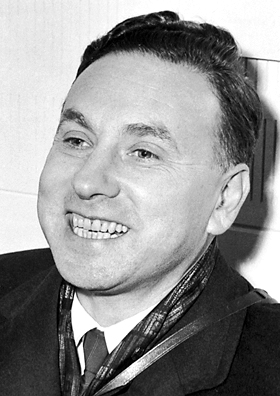

Nobel Prize in Physics · 1961
Robert Hofstadter
He bounced electrons off atomic nuclei to show that protons have size and structure; his crystal detector became nuclear medicine's eye.
The Nobel citation: “for his pioneering studies of electron scattering in atomic nuclei and for his thereby achieved discoveries concerning the structure of the nucleons”
- Born
- February 5, 1915, New York, NY, USA
- Died
- November 17, 1990, Stanford, CA, USA
- Shared with
- Rudolf Mössbauer
- Affiliation at the time
- Stanford University, USA
Physics prize
1961
Shared with 1 other laureate.
Age that year
46years
Born in 1915.
Headline credited impact
11.6–26.6million people benefited
Technetium-99m diagnostic scans, read mainly by gamma cameras built on his sodium iodide crystal. How it was built
Sources cited
21
Fact-checked September 24, 2026.
- To position his first 2.5-ton magnet precisely, he mounted it on a twin 40-mm anti-aircraft gun mount lent by the U.S. Navy.
- His first measurement of the proton's radius, published in 1955, gave 0.74 trillionths of a millimetre. Today's best value, 0.84, lies within his margin of error.
- He said his most important contribution was not his Nobel work but his 1948-50 finding that thallium-doped sodium iodide crystals detect and measure gamma rays superbly.
- In 1954 he suggested Stanford build a far bigger electron accelerator. The idea led to SLAC's two-mile machine, which reached 20 billion electron volts in 1967.
- His son, Douglas Hofstadter, won the 1980 Pulitzer Prize for nonfiction for the book Gödel, Escher, Bach.
The breakthrough
Measuring the size and inner structure of protons and nuclei (1953-1961)
By the 1950s physicists knew that every atom has a tiny nucleus made of protons and neutrons, but no one could see inside one, and many treated the proton as a simple point. Hofstadter found a way to look. At Stanford he aimed beams of very fast electrons from a new linear accelerator at thin targets, from gold to hydrogen. Electrons feel only electric and magnetic forces, which physicists understand well, so the way they bounce off a nucleus reveals how its charge is spread out. Imagine working out the shape of an object hidden in a dark room by throwing thousands of tiny balls at it and noting where they fly. To catch the scattered electrons and measure their angles and energies, he built ever larger magnetic spectrometers, from 2.5 tons to 200 tons. The results showed that the matter in heavier nuclei is spread fairly evenly, thinning out only in a narrow outer layer. In late 1954 his team realized that even the proton is not a point: it has a measurable size, with a charge radius of about 0.74 fermi (a fermi is a trillionth of a millimetre). Today's best value is about 0.84 fermi. Later experiments mapped how charge and magnetism are spread inside protons and neutrons, showing that neither is a simple point. The Nobel committee compared the method to an electron microscope and praised a level of precision rarely achieved before in high-energy physics.[1],[2],[3],[4],[6],[7],[20]
“the search for ever-smaller and ever-more-fundamental particles will go on as long as Man retains the curiosity he has always demonstrated.”
What it meant for humanity
Hofstadter's experiments changed what counts as an elementary particle. Once protons and neutrons were shown to have size and inner structure, physicists had to ask what they were made of. The Nobel presentation speech noted that his results had already helped stimulate the discovery of new particles. About a decade later, experiments at SLAC used electron beams the way he had, at much higher energies, and found the first direct evidence of point-like quarks inside protons and neutrons, work honored with the 1990 Nobel Prize. SLAC itself grew out of his 1954 suggestion that Stanford build a far larger electron accelerator. His detector reached further still. Thallium-activated sodium iodide became the leading way to detect and measure radioactive substances in biology and medicine. Its most important medical use is the gamma camera, developed by Hal Anger in the 1950s: a large sodium iodide crystal behind a lead collimator that images radioactive tracers inside the body. For decades most clinical nuclear medicine cameras have been built on that design. The UN radiation committee estimates about 40 million nuclear medicine scans a year worldwide, and about 80 percent use technetium-99m, whose gamma rays sodium iodide detects almost ideally; heart, bone, kidney and lung scans rely on it. Late in life he turned his detectors to space and the heart. He helped design EGRET, a gamma-ray telescope launched on NASA's Compton Gamma Ray Observatory in April 1991, which mapped the gamma-ray sky in far more detail than before. With Stanford colleagues, including physician Edward Rubenstein, he also worked on a gentler way to image the heart's arteries: iodine dye injected into a vein instead of a catheter threaded to the heart. The first human study took place in 1986, but the method needs a synchrotron and stayed confined to a few research laboratories.
- The UN radiation committee estimates about 40 million nuclear medicine scans worldwide each year, about 80% with technetium-99m. The Anger gamma camera, built around his sodium iodide crystal, has long been the dominant detector for such imaging.[13],[15],[16]
- SLAC's two-mile electron accelerator grew out of his 1954 proposal. There, electron-scattering experiments like his found the first direct evidence of quarks, honored with the 1990 Nobel Prize in Physics.[6]
- The Crystal Ball, a hollow sphere of 672 sodium iodide prisms developed at Stanford and SLAC, measured gamma rays from charmonium and produced new results on mesons made of charm and bottom quarks.[6],[7]
- EGRET, the gamma-ray telescope he helped design, build and test, launched on NASA's Compton Gamma Ray Observatory on 5 April 1991, months after his death, and mapped the gamma-ray sky in far more detail than before.[6],[7],[8]
- In May 1986 a Stanford team including him recorded the first coronary angiogram of a person using synchrotron X-rays and dye injected into a vein. By 2002 about 500 had been made at four laboratories, all without complication.[6],[7],[17]
Impact in numbers
Hofstadter's Nobel work changed understanding rather than daily life. It showed that protons and neutrons, once thought elementary, have size and structure, and it set the pattern for the electron experiments that later revealed quarks. We count that as fundamental science and attach no number. His practical legacy comes from the sodium iodide crystal, which for more than half a century has been the detector at the heart of the gamma camera, used in heart, bone, lung and many other scans. We count it through the same technetium-99m imaging outcome used for Emilio Segrè, whose isotope most of those scans use, and credit Hofstadter with only 2 percent. The camera design, the isotope generator, drug kits and clinical practice were equally essential, and a rival crystal such as caesium iodide might have filled part of the role. The same crystals also serve particle physicists, astronomers and geologists, uses we do not try to count.
Fundamental scienceHealthTechnologySpace
Each number is the laureate’s credited share of a real-world outcome, cumulative to 2025. The whole outcome, the share of credit, and the reasoning are shown so you can check the arithmetic. Outcomes shared with other laureates are counted once on the impact page.
- Low confidenceRippleModeledHealth
Technetium-99m diagnostic scans, read mainly by gamma cameras built on his sodium iodide crystal
11.6–26.6
million people benefited, credited share
That is 2% of 580 million–1.3 billion people benefited since 1961.
How this number was built
Same whole-outcome range as the Segrè profile. UNSCEAR: world diagnostic nuclear medicine ran 24M procedures/yr (1985-90), 32.5M (1991-96), 32.7M (1997-2007), 40M (2009-18). Linear rise from 0 in 1961 to 24M at 1987.5, straight lines between survey midpoints, then 40M/yr to 2025: 318+170+277+418+480 = about 1.66B. Tc-99m share about 80% (UNSCEAR, BNL). High = 0.8 x 1.66B = 1.33B, one person per scan; low = 0.7 x 1.66B x 0.5 (lower early share, two scans per patient) = 580M. Share 0.02: Tc-99m's gamma rays are read mainly by Anger cameras built on his NaI(Tl) crystal, long the dominant SPECT detector. But Anger's camera, the isotope, generator, kits and clinicians were equally essential; CsI(Tl) is a partial substitute and some newer cameras use CZT. Credited: about 12M-27M.[13],[14],[15],[16]
Sources: United Nations Scientific Committee on the Effects of Atomic Radiation; Brookhaven National Laboratory Newsroom; PubMed Central (National Library of Medicine); PubMed Central (National Library of Medicine)
The double edge
No serious harms are documented from Hofstadter's own science, but two points belong on the record. During the Second World War he worked on weapons technology: an optical proximity fuse for anti-aircraft shells at the National Bureau of Standards, which proved less effective than the radio fuse developed elsewhere, and then a radar altimeter at the Norden company, maker of the famous bombsight. In later years he took part in many government studies of technical problems important to the military. Second, the nuclear medicine scans his detectors made practical expose patients to ionizing radiation. UNSCEAR, the United Nations radiation committee, uses an average dose of about 5.1 millisieverts per gamma-camera or SPECT scan; effective dose is a measure tied to the risk of radiation-induced cancer. UNSCEAR's survey does not assess the resulting risks, so we give no number of cancers.
- Minor
Wartime and military research
In the Second World War he worked on an optical proximity fuse, which detonates an anti-aircraft shell near its target, at the National Bureau of Standards, then on a radar altimeter at the Norden company. After the war he took part in numerous government studies of technical problems important to the military.[6],[9]
- Minor
Radiation dose from nuclear medicine scans
Gamma-camera and SPECT scans, which rely on detectors like his, require injecting radioactive tracers. UNSCEAR uses an average effective dose of about 5.1 millisieverts per scan, a quantity linked to the risk of radiation-induced cancer, but its survey does not assess resulting harms or benefits.[15]
Against the odds
Hofstadter was born in New York to immigrant parents and never faced the persecution that drove many European colleagues into exile. No source we found records a specific antisemitic setback in his own career, and it is honest to say so. But he grew up when Jewish students met organized barriers. From about 1920, elite private colleges in the East used character tests, regional preferences and other devices to cut their Jewish enrollment. Columbia's Jewish share fell from 40 to 22 percent in two years, and Princeton's was minuscule. City College of New York, 80 to 90 percent Jewish by 1920 and stigmatized as "the Jewish University of America", was the college of many children of Jewish immigrant workers. Hofstadter entered it in 1931 and graduated with high honors in 1935. His parents were of modest means, and a General Electric fellowship made graduate school at Princeton possible. Attitudes inside universities were a barrier too. In 1939, as Hofstadter was finishing a postdoctoral fellowship at Princeton, physicist Harry Smyth asked whether a promising applicant, Richard Feynman, was Jewish, explaining that the department kept its share of Jews small because they were hard to place in jobs. Princeton hired Hofstadter as an assistant professor in 1946 but did not promote him in 1950, and he left for Stanford. No source we found says why, so we do not assume a reason.
1931
Quota
From about 1920, elite Eastern private colleges limited Jewish enrollment through character tests, regional preferences and other devices. Hofstadter enrolled in 1931 at City College of New York, then 80 to 90 percent Jewish, and graduated in 1935. We do not know whether he applied elsewhere.[1],[18],[21]
1935
Other
His immigrant parents were of modest means; his father was a salesman who owned a cigar store. A Charles A. Coffin Foundation fellowship from General Electric enabled him to attend graduate school at Princeton.[6],[11],[21]
1939
Discrimination
In 1939, while Hofstadter was a postdoctoral fellow at Princeton, physicist Harry Smyth wrote that the physics department kept its share of Jews small because they were hard to place in jobs. The letter concerned Richard Feynman's application, not Hofstadter.[1],[19]
Jewish background
Hofstadter was born in Manhattan, one of four children of Louis Hofstadter, a salesman who owned a cigar store, and Henrietta Koenigsberg. A reference biography describes them as Jewish immigrants of modest means; Stanford's archive calls them Polish immigrants. When he won the Nobel Prize, the Jewish Telegraphic Agency reported it as the award of a New York-born Jewish scientist, and the Encyclopaedia Judaica has an entry on him. He served as a governor of the Technion (Israel Institute of Technology) and of the Weizmann Institute of Science. We found no record of religious observance or of public statements by him about his Jewish identity.[8],[9],[10],[11],[12],[21]
Key dates
February 5, 1915
Born in Manhattan, New York City, to Louis Hofstadter, a salesman and cigar-store owner, and Henrietta Koenigsberg, immigrants from Poland.[1],[6],[8]
1935
Graduates magna cum laude from the City College of New York and wins the Kenyon Prize in mathematics and physics.[1],[6]
1938
Earns his MA and PhD at Princeton at age 23; his thesis on infrared spectra helps clarify the nature of the hydrogen bond.[1],[6]
1942
Works at the National Bureau of Standards in Washington on an optical proximity fuse, then at the Norden company on a radar altimeter until the war ends.[1],[6]
May 9, 1942
Marries Nancy Givan of Baltimore; they later have three children, Douglas, Laura and Mary.[1],[6]
1946
Returns to Princeton as an assistant professor of physics and begins work on gamma-ray detectors.[6]
1948
Discovers that sodium iodide activated with thallium makes an excellent scintillation counter for gamma rays, and files a patent.[1],[6]
1950
With Jack McIntyre shows the crystals can measure gamma-ray energies; moves to Stanford as an associate professor.[1],[6]
1954
In late 1954 his electron-scattering data show the proton has a measurable size; he also suggests building the multi-GeV accelerator that became SLAC.[3],[6]
1958
Elected to the US National Academy of Sciences.[1]
December 10, 1961
Receives half of the Nobel Prize in Physics, shared with Rudolf Mössbauer, for electron-scattering studies of nuclei and nucleons.[2],[4],[5]
May 1986
A Stanford team including him records the first human coronary angiogram made with synchrotron X-rays; the same year he receives the US National Medal of Science.[6],[7],[17]
November 17, 1990
Dies at his home on the Stanford campus, aged 75.[1],[7],[9]
April 5, 1991
EGRET, the gamma-ray telescope he helped design, launches aboard NASA's Compton Gamma Ray Observatory.[6],[7],[8]
Sources
- 1.Robert Hofstadter - Biographical · NobelPrize.org (from Nobel Lectures, Physics 1942-1962, Elsevier, 1964), 1964
- 2.Robert Hofstadter - Facts · NobelPrize.org (Nobel Prize Outreach)
- 3.The electron-scattering method and its application to the structure of nuclei and nucleons (Nobel Lecture, 11 December 1961) · NobelPrize.org, 1961
- 4.The Nobel Prize in Physics 1961 - Presentation Speech by Professor I. Waller · NobelPrize.org, 1961
- 5.Robert Hofstadter - Banquet speech (Stockholm, 10 December 1961) · NobelPrize.org, 1961
- 6.Robert Hofstadter, 1915-1990: A Biographical Memoir, by Jerome I. Friedman and William A. Little (Biographical Memoirs, vol. 79) · National Academy of Sciences, 2001
- 7.Robert Hofstadter · Stanford University, Department of Physics
- 8.Guide to the Robert Hofstadter Papers, 1931-1993 (SC0426), biographical note · Stanford University Libraries, Department of Special Collections, via Online Archive of California
- 9.Dr. Robert Hofstadter Dies at 75; Won Nobel Prize in Physics in '61, by Peter B. Flint (archived copy) · The New York Times, via Internet Archive, 1990
- 10.Dr. Robert Hofstadter, U.S. Jewish Scientist, Wins 1961 Nobel Prize · Jewish Telegraphic Agency, 1961
- 11.Hofstadter, Robert (Encyclopedia of World Biography, Scribner Encyclopedia of American Lives and Encyclopaedia Judaica entries) · Encyclopedia.com
- 12.Robert Hofstadter · Wikipedia
- 13.SPECT detectors: the Anger Camera and beyond, by Todd E. Peterson and Lars R. Furenlid (Physics in Medicine and Biology 56: R145-R182) · PubMed Central (National Library of Medicine), 2011
- 14.Technological Advances in SPECT and SPECT/CT Imaging, by Yassine Bouchareb et al. (Diagnostics 14(13): 1431) · PubMed Central (National Library of Medicine), 2024
- 15.UNSCEAR 2020/2021 Report, Annex A: Evaluation of medical exposure to ionizing radiation · United Nations Scientific Committee on the Effects of Atomic Radiation, 2022
- 16.Celebrating the 60th Anniversary of Technetium-99m · Brookhaven National Laboratory Newsroom, 2018
- 17.SSRL Angiogram (History Bits) · SLAC National Accelerator Laboratory, Archives, History and Records Office
- 18.How Jewish Quotas Began, by Stephen Steinberg · Commentary, 1971
- 19.Richard Feynman (1918-1988), by J J O'Connor and E F Robertson · MacTutor History of Mathematics Archive, University of St Andrews
- 20.CODATA Value: proton rms charge radius (2022 CODATA recommended values) · National Institute of Standards and Technology (NIST), 2024
- 21.Robert Hofstadter (Research Starters), by M. Lee · EBSCO, 2024
Fact-checked on September 24, 2026 by a separate AI fact-checking pass that re-opened the sources, with 12 corrections made. How we check
Suggest a correction