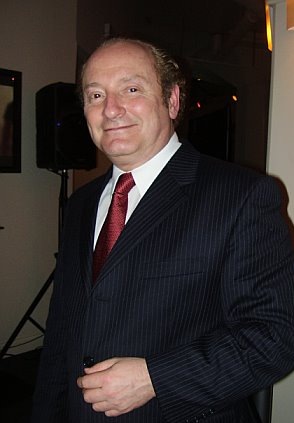

Sveriges Riksbank Prize in Economic Sciences · 1997
Robert C. Merton
He helped crack the pricing of options, giving banks, firms and savers a shared way to value and trade financial risk.
The Nobel citation: “for a new method to determine the value of derivatives”
- Born
- July 31, 1944, New York, NY, USA
- Shared with
- Myron Scholes
- Affiliation at the time
- Harvard University, USA
Economics prize
1997
Shared with 1 other laureate.
Age that year
53years
Born in 1944.
Headline credited impact
$42–147billion in economic value
Extra US economic output from banks' and firms' use of derivatives to manage risk. How it was built
Sources cited
20
Fact-checked September 24, 2026.
- He was the first to call it the "Black-Scholes model," in a 1970 working paper. Today it is often called the Black-Scholes-Merton model.
- He overslept and missed Black and Scholes presenting their option work at a July 1970 conference where he was also giving a paper.
- As a teenager he rebuilt cars, raced hot rods at drag strips and planned to become an automobile engineer.
- His father, sociologist Robert K. Merton, was born Meyer Schkolnick to Jewish immigrants and coined the phrases "self-fulfilling prophecy" and "role model."
- Within two years of the formula's 1973 debut, Chicago options traders were using it to price and hedge. Texas Instruments even sold a handheld calculator programmed to compute it.
The breakthrough
Pricing an option by copying it: the Black-Scholes-Merton method
An option is a contract that gives you the right, but not the duty, to buy or sell something, such as a share of stock, at a set price by a set date. For decades nobody knew how to price one fairly, because the answer seemed to depend on how much each investor disliked risk, which no one can measure. In 1973 Fischer Black and Myron Scholes published a formula that got around the problem, and Merton, working closely with them, found a second, more general way to derive it. He showed that if you can trade nonstop, you can build a mix of the stock and borrowed money that exactly copies what the option will pay, adjusting the mix moment by moment. Think of a cake: if anyone can bake it from flour, eggs and sugar, it cannot sell for more than its ingredients for long, or people would bake and sell it for free money. So the option's price must equal the cost of its ingredients. Merton then stretched the method to cover dividends, changing interest rates, options that can be used early, and stock prices that jump suddenly. He also saw that a company's shares and debts behave like options on the value of the whole firm, which opened the way to pricing loans, guarantees and insurance. Earlier, he had built models of how people should save and invest over a lifetime, and he turned the standard model of risk and return into one that unfolds over time.[3],[4],[5],[6]
“The mathematics of financial models can be applied precisely, but the models are not at all precise in their application to the complex real world.”
What it meant for humanity
Options and other derivatives let a business or investor hand a risk to someone better able to carry it. The Nobel committee gave examples: a copper-mining firm can sell its metal in advance, and a British importer that owes dollars can buy an option that protects it if the pound falls. Before 1973 there was no sound way to price such contracts. The Chicago Board Options Exchange opened that April, and by 1975 its traders were using the Black-Scholes-Merton model to set prices and hedge. The model became so common that Texas Instruments sold a calculator programmed with it. By 1997, the committee said, thousands of traders and investors used the formula every day, and banks relied on the method to build products fitted to their customers' risks.
Merton's version of the method reached well beyond stock options. Because shares, bonds, guarantees and insurance policies all behave like options, the same mathematics can value corporate debt, mortgages, student loans, deposit insurance and the flexibility of a power plant built to burn either of two fuels. Merton argued that derivatives let institutions carry out some financial strategies at a tenth to a twentieth of the cost of trading the underlying securities directly. A 2014 Milken Institute study, funded by the exchange operator CME Group, estimated that US banks' and companies' use of derivatives left the economy 1.1 percent larger in 2012 than it would otherwise have been, with about 530,000 more jobs. In recent years Merton has turned to retirement saving, creating a retirement-funding system for the investment firm Dimensional.
- The Chicago Board Options Exchange opened in April 1973. By 1975 its traders used the model to price and hedge, and it became so widely used that Texas Instruments sold a handheld calculator programmed to compute it.[4]
- In 1997 the Nobel committee noted that thousands of traders and investors used the formula every day and that banks used the method to design instruments tailored to their customers' risks.[3]
- Treating debts, guarantees and insurance as options let the same method value corporate bonds, mortgages, student loans, deposit insurance and flexible investment projects.[1],[2],[3],[4]
- A 2014 Milken Institute study, funded by exchange operator CME Group, estimated that derivatives use lifted US real GDP by 1.1 percent ($149.5 billion) and employment by 530,400 by 2012.[12]
- His current research covers lifecycle investing and retirement funding, and at Dimensional he created Target Retirement Solution, a system for funding retirement.[13]
Impact in numbers
Merton's main legacy is a set of tools: a way to value any contract whose payoff depends on something uncertain, and a way to hedge it. Those tools run through options exchanges, bank risk systems, corporate finance, credit analysis and retirement planning. But their value to society is hard to separate from the harms of derivatives misuse, from the 1998 collapse of his own hedge fund to the 2008 crisis. We record one low-confidence number: extra US economic output linked to banks' and firms' use of derivatives, based on a single industry-funded 2014 study. We credit Merton with only 3 percent, because futures, swaps and forwards do not depend much on option-pricing theory, and he shares credit for that theory with Myron Scholes and the late Fischer Black. We do not subtract crisis losses, which cannot be tied to his work with any precision, so treat the figure as a rough, one-sided indicator.
EconomyTechnology
Each number is the laureate’s credited share of a real-world outcome, cumulative to 2025. The whole outcome, the share of credit, and the reasoning are shown so you can check the arithmetic. Outcomes shared with other laureates are counted once on the impact page.
- Low confidenceRippleModeledEconomy
Extra US economic output from banks' and firms' use of derivatives to manage risk
$42–147
billion in economic value, credited share
That is 3% of $1.4–4.9 trillion in economic value since 1973.
How this number was built
Milken Institute (2014, CME Group-funded): derivatives use by US banks and firms raised real GDP ~$3.7B a quarter in 2003-12 (models range $1.4-8.1B), leaving 2012 GDP 1.1% ($149.5B, chained 2005 $) higher: a yearly level, not a total. 2003-12 ramp: ~$0.75T x 1.538 (GDP deflator 81.56 in 2005, 125.43 in 2024) = $1.15T. 2013-25: OCC bank notionals were $186.5-218.7T in late 2024 vs $223T in 2012, when it tied declines to trade compression, so we assume use and the gain persisted: 2012 gain ($230B in 2024 $) x 0.84 x 13 yr = $2.5T; central $3.6T. High: 1.1% of each year's real GDP (BEA) in 2024 $ = $3.7T; total ~$4.9T (Milken's $8.1B top not used). Low: central x 0.38 (their $1.4B main regression estimate) = $1.4T. Pre-2003, non-US gains omitted; crisis losses not netted. Share 0.03: option pricing gets ~10% (swaps, futures, forwards use it little), split among Merton, Scholes and Black.[3],[5],[12],[17],[18],[19],[20]
Sources: Milken Institute; NobelPrize.org (Royal Swedish Academy of Sciences); NobelPrize.org (Royal Swedish Academy of Sciences); Office of the Comptroller of the Currency; Office of the Comptroller of the Currency; FRED, Federal Reserve Bank of St. Louis (source: US Bureau of Economic Analysis); FRED, Federal Reserve Bank of St. Louis (source: US Bureau of Economic Analysis)
The double edge
Merton's record includes one of the most famous failures in modern finance. He was a founding principal of Long-Term Capital Management, a hedge fund known for its mathematical models and its heavy borrowing. After Russia defaulted in August 1998, the fund lost 44 percent of its value in a single month. Fearing a fire sale that could harm the wider economy, the New York Fed brought together 14 banks and brokers, which put in $3.6 billion so the fund could be wound down in an orderly way. No public money was lent, but the partners, Merton among them, and other investors took heavy losses. More broadly, critics such as the mathematician Ian Stewart argue that faith in Black-Scholes-style models encouraged banks to trade ever more complex derivatives whose risks they did not understand. The US Financial Crisis Inquiry Commission concluded that over-the-counter derivatives, especially credit default swaps, contributed significantly to the 2008 crisis, although those products leaned on other models too. The original formula also assumes smooth price moves, while real markets crash more often than it predicts. Merton himself warned in his Nobel lecture that such models are only approximations.
- Major
The collapse of Long-Term Capital Management
Merton helped found LTCM, which began trading in 1994 and by late 1997 held about $30 of debt for every $1 of capital. After Russia's August 1998 default it lost 44% in one month. The New York Fed convened 14 banks and brokers, which invested $3.6 billion in September 1998 to prevent a disorderly collapse. No Fed money was lent, but partners and investors saw their stake cut to 10%, and the fund lost about $4.6 billion in 1998.[2],[6],[9],[15]
- Moderate
Derivatives and the 2008 financial crisis
The Financial Crisis Inquiry Commission concluded in 2011 that over-the-counter derivatives, notably credit default swaps and synthetic CDOs, contributed significantly to the crisis. Ian Stewart argues that trust in Black-Scholes-style models led banks to trade complex products they could not value reliably. Those crisis products depended on other models as well, so the link to Merton's own work is indirect.[10],[11]
- Moderate
Models that underrate the risk of crashes
The basic formula assumes prices move smoothly, but big swings happen far more often than it predicts: on 19 October 1987 world stock markets lost more than 20% in hours. Merton added sudden jumps to the model in 1976, and in his 1997 Nobel lecture he urged that models be applied only tentatively, with careful attention to their limits.[4],[5],[11]
Against the odds
Merton himself did not face the persecution that shaped many laureates' lives, and his Nobel autobiography mentions no antisemitism. Born in New York in 1944, he grew up in Hastings-on-Hudson, a small village of middle-class and blue-collar families whose public school prepared him for Columbia. His father's road was harder. Robert K. Merton was born Meyer Schkolnick in 1910 to poor Jewish immigrants from eastern Europe in South Philadelphia. As a teenage stage magician he took the name Robert Merton, made it legal at 19, and earned a Harvard doctorate in the mid-1930s, when Harvard was deliberately holding down the number of Jewish students and faculty. He became one of the century's most influential sociologists and the first sociologist to receive the National Medal of Science. The son's own setbacks were ordinary ones. Every economics doctoral program he applied to turned him down except MIT, which took a chance on him after a statistician on the faculty recognized the mathematicians who had recommended him. MIT's economics department was unusually open to hiring Jewish faculty at a time when Ivy League universities were only beginning to do so. His teacher Paul Samuelson had moved there in 1940 after Harvard made no effort to keep him, possibly because he was Jewish.
1910
Poverty
His father, Robert K. Merton, was born Meyer R. Schkolnick in 1910 to poor, working-class Jewish immigrants from eastern Europe in South Philadelphia. He adopted the name Robert Merton as a teenage stage magician and changed it legally at 19.[7],[8]
—
Quota
His father studied at Harvard in the 1930s, when the university was deliberately limiting the number of Jewish students and faculty. Merton's own teacher at MIT, Paul Samuelson, left Harvard in 1940 after it made no effort to keep him, possibly because he was Jewish.[8],[14]
Jewish background
Merton's father, the sociologist Robert K. Merton, was born Meyer R. Schkolnick in Philadelphia in 1910 to working-class Jewish immigrants from eastern Europe. He took the name Merton as a teenage stage magician and made it legal at 19. Merton's mother, Suzanne Carhart, came from a multigenerational Methodist and Quaker family in southern New Jersey. Merton therefore meets the site's standard through his father. His Nobel autobiography notes his father's immigrant parentage but says nothing about religion, and no source consulted describes him practicing Judaism or speaking about a Jewish identity.[2],[7],[8],[15],[16]
Key dates
July 31, 1944
Born in New York City to sociologist Robert K. Merton and Suzanne Carhart; grows up in Hastings-on-Hudson, New York.[1],[2],[8]
1966
Earns a BS in engineering mathematics at Columbia and marries June Rose a week after graduating.[2],[6]
1967
Completes an MS in applied mathematics at Caltech, then leaves mathematics to study economics at MIT on a full fellowship.[2],[6]
1968
Becomes Paul Samuelson's research assistant; that summer they start joint work on the pricing of warrants.[2]
August 1969
Publishes his paper on lifetime consumption and portfolio choice under uncertainty, the start of his continuous-time finance.[2],[5]
1970
Receives his PhD in economics from MIT and begins teaching finance at MIT's Sloan School of Management.[2],[3]
1973
Publishes Theory of Rational Option Pricing, proving and extending the Black-Scholes formula; the Chicago Board Options Exchange opens in April.[3],[4],[5]
February 1976
An option-based mutual fund he designed with Myron Scholes to limit losses in falling markets begins operating; it was not a commercial success.[2]
1988
Moves from MIT to Harvard Business School as George Fisher Baker Professor of Business Administration.[2],[13]
February 1994
Long-Term Capital Management, the hedge fund he helped found with John Meriwether and others, begins trading.[2],[9]
October 14, 1997
Awarded the Nobel Memorial Prize in Economic Sciences with Myron Scholes for a new method to value derivatives; Fischer Black had died in 1995.[1],[3]
September 23, 1998
Fourteen banks and brokers, brought together by the New York Fed, invest $3.6 billion to wind down the failing LTCM.[9]
2010
Becomes professor emeritus at Harvard and returns to MIT Sloan as School of Management Distinguished Professor of Finance.[6],[13],[15]
Sources
- 1.Robert C. Merton - Facts · NobelPrize.org (Nobel Prize Outreach)
- 2.Robert C. Merton - Biographical · NobelPrize.org (from Les Prix Nobel 1997), 1997
- 3.The Prize in Economic Sciences 1997 - Press release · NobelPrize.org (Royal Swedish Academy of Sciences), 1997
- 4.Applications of Option-Pricing Theory: Twenty-Five Years Later (Nobel Lecture, 9 December 1997) · NobelPrize.org, 1997
- 5.Additional background material on the Bank of Sweden Prize in Economic Sciences in Memory of Alfred Nobel 1997 (Advanced information) · NobelPrize.org (Royal Swedish Academy of Sciences), 1997
- 6.Robert C. Merton · Encyclopaedia Britannica
- 7.Robert K. Merton · Encyclopaedia Britannica
- 8.Merton, Robert King (Warren Schmaus, Complete Dictionary of Scientific Biography) and Merton, Robert K. (Craig Calhoun, International Encyclopedia of the Social Sciences) · Encyclopedia.com (Gale / Charles Scribner's Sons), 2008
- 9.Near Failure of Long-Term Capital Management (Michael Fleming and Weiling Liu) · Federal Reserve History (Federal Reserve System)
- 10.Conclusions of the Financial Crisis Inquiry Commission (The Financial Crisis Inquiry Report) · Financial Crisis Inquiry Commission (copy hosted by Stanford Law School), 2011
- 11.The mathematical equation that caused the banks to crash (Ian Stewart) · The Observer / The Guardian, 2012
- 12.Deriving the Economic Impact of Derivatives: Growth Through Risk Management (Prabha, Savard and Wickramarachi) · Milken Institute, 2014
- 13.Robert C. Merton - Faculty directory · MIT Sloan School of Management
- 14.Long before Hillel, Jews found a home at MIT (Simson Garfinkel) · MIT Technology Review, 2023
- 15.Robert C. Merton · Wikipedia
- 16.List of Jewish Nobel laureates · Wikipedia
- 17.Quarterly Report on Bank Trading and Derivatives Activities, Fourth Quarter 2024 · Office of the Comptroller of the Currency, 2025
- 18.OCC Reports Fourth Quarter 2012 Trading Revenue of $4.4 Billion (news release 2013-48) · Office of the Comptroller of the Currency, 2013
- 19.Real Gross Domestic Product (GDPCA), annual, chained 2017 dollars · FRED, Federal Reserve Bank of St. Louis (source: US Bureau of Economic Analysis)
- 20.Gross Domestic Product: Implicit Price Deflator (A191RD3A086NBEA), annual, 2017=100 · FRED, Federal Reserve Bank of St. Louis (source: US Bureau of Economic Analysis)
Fact-checked on September 24, 2026 by a separate AI fact-checking pass that re-opened the sources, with 6 corrections made. How we check
Suggest a correction