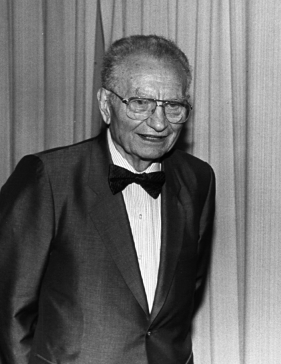

Sveriges Riksbank Prize in Economic Sciences · 1970
Paul A. Samuelson
He rebuilt economics on mathematics, taught it to generations of students, and helped spark the low-cost index fund.
The Nobel citation: “for the scientific work through which he has developed static and dynamic economic theory and actively contributed to raising the level of analysis in economic science”
- Born
- May 15, 1915, Gary, IN, USA
- Died
- December 13, 2009, Belmont, MA, USA
- Affiliation at the time
- Massachusetts Institute of Technology (MIT), USA
Economics prize
1970
Awarded alone.
Age that year
55years
Born in 1915.
Headline credited impact
$17.4–22.8billion in economic value
Fees saved by US investors holding index funds instead of higher-cost actively managed funds. How it was built
Sources cited
21
Fact-checked September 24, 2026.
- The Nobel Memorial Prize in economics was only in its second year in 1970 when he became the first American to receive it.
- His 1948 textbook Economics became the best-selling economics textbook ever, with about 4 million copies sold in some 40 languages.
- Harvard did nothing to keep him in 1940. His MIT colleague Robert Solow later said being smart, Jewish or Keynesian could cost you a job there.
- His 1974 plea for someone to start an index fund helped push Jack Bogle to launch the first index mutual fund in 1976.
- At the Nobel banquet he joked that winning was easy: have great teachers, colleagues and students, read the great masters, and, finally, be lucky.
The breakthrough
Putting economic theory on a mathematical foundation
Before Samuelson, much of economics was argued in words, and experts could talk past each other for decades. In his Harvard doctoral thesis, published in 1947 as Foundations of Economic Analysis, he showed that a small set of ideas could be written as mathematics and used to settle such arguments. The first idea is that households and firms try to do the best they can with what they have, like a shopper stretching a budget or a company seeking the most profit. The second is that markets tend to settle into balance and return to it after a shock. He borrowed a trick from physics: a ball rolling down a slope moves as if it were minimizing a certain quantity, and in the same way economic behavior can be described as if people were maximizing something. From these rules he derived predictions that could be checked against data, such as how a tax or a price change ripples through the economy. He also judged people's tastes by what they actually buy, an idea called revealed preference. And he showed how foreign trade can raise a nation's income overall while lowering some workers' wages. His MIT colleague Robert Solow said a huge share of the standard mental tools economists use traces back to him.[2],[3],[4],[6],[7],[12]
“I don't care who writes a nation's laws — or crafts its advanced treatises — if I can write its economics textbooks.”
What it meant for humanity
Samuelson came of age as the Great Depression shut down businesses in Chicago, and much of his career turned on how to stop that from happening again. His answers reached people mainly through teaching. For decades, future economists, officials and business leaders met economics for the first time in his textbook, which explained how government spending, taxes and interest rates can soften a slump. Advice built on those ideas reached the White House: after the 1960 election he urged President-elect Kennedy to cut taxes to head off a recession, a plan Lyndon Johnson later carried out. When the world economy crashed in 2008, the New York Times noted, most rich countries avoided the Depression-era mistakes of tight budgets and trade barriers, having absorbed the Keynesian teaching of Samuelson and his followers.
His theories also became working tools. His study of public goods explains why things like national defense need collective funding. His mathematics of stock prices helped lay the ground for the Nobel-winning option-pricing work of his student Robert Merton and of Myron Scholes. His argument that few professional investors can reliably beat the market helped inspire the first index mutual fund, which let ordinary savers own the whole market at low cost. At MIT he helped build an economics department that welcomed Jewish scholars when many elite universities did not, and that drew or trained a long line of future Nobel laureates.
- His textbook Economics, first written for MIT's required economics course and published in 1948, sold about 4 million copies in some 40 languages and shaped how generations first learned the subject.[6],[12]
- As an adviser to Presidents Kennedy and Johnson he pressed for tax cuts to fight recession and supported the war on poverty.[6],[7]
- Jack Bogle said Samuelson's 1974 article played a major role in creating the first index mutual fund. By the end of 2024, US index mutual funds and index ETFs held $16.2 trillion.[13],[14]
- MIT's economics department rose from what Samuelson called a mediocre service department to the top of the rankings, and it hired Jewish economists when elite schools largely did not.[6],[10]
- His mathematics of stock-price movements became a basis for the Nobel-winning option-pricing research of his student Robert Merton and of Myron Scholes.[7]
Impact in numbers
Samuelson's main contribution was to change how economics is done and taught, and that cannot honestly be counted in dollars or lives. The mathematical methods of Foundations became standard training for economists, and his textbook gave millions of students, including future officials and business leaders, a shared language for thinking about recessions, inflation, trade and public spending. We record one number, with low confidence: fees saved by US investors who hold low-cost index funds, an industry that Jack Bogle said Samuelson's 1974 challenge helped launch. We credit Samuelson with only 3 percent, because Bogle built the fund and other economists and investors developed and promoted the idea. His tax-cut advice in the 1960s, his public-goods theory, his trade theorems and the MIT department he helped build all mattered too, but their effects are too tangled with other causes to measure.
EconomyEducationFundamental science
Each number is the laureate’s credited share of a real-world outcome, cumulative to 2025. The whole outcome, the share of credit, and the reasoning are shown so you can check the arithmetic. Outcomes shared with other laureates are counted once on the impact page.
- Low confidenceRippleModeledEconomy
Fees saved by US investors holding index funds instead of higher-cost actively managed funds
$17.4–22.8
billion in economic value, credited share
That is 3% of $580–760 billion in economic value since 1976.
How this number was built
US fees only, nominal dollars. ICI: index mutual funds plus index ETFs held $1.9T (2010), $4.2T (2015), $9.9T (2020), $16.2T (2024) and $19.1T (2025); interpolating gives $112-120T of asset-years for 2011-25. Fee gap from ICI asset-weighted expense ratios, assuming 70-85% of index assets are equity: in 2025 active equity funds 0.64% vs index 0.05% (mutual funds) or 0.14% (ETFs); active bond 0.44% vs 0.05%/0.09%: a blended gap of 0.48-0.51 points, wider earlier (active equity 0.96% in 2010). Low: 0.48 points in every year x $112T = $0.54T, plus 2006-10 (index mutual funds $0.62T in 2005, all index $1.9T in 2010) = $0.58T. High: year-specific gaps averaging ~0.57 x $120T = $0.68T, plus ~$0.08T for 1976-2010 = $0.76T. Trading-cost savings excluded. Share 0.03: his 1974 challenge helped spur the first index fund (per Bogle); Bogle built it, and Malkiel, Ellis and others share the idea.[12],[13],[14],[15],[16],[21]
Sources: John C. Bogle (johncbogle.com); Investment Company Institute; Yahoo Finance; Yahoo Finance; Aeon; Investment Company Institute
The double edge
Samuelson's record has real blemishes, mostly errors of judgment rather than harms he intended. His best-selling textbook repeatedly overrated the Soviet economy: from 1961 it projected that Soviet output could overtake America's within a few decades, and later editions kept pushing the date back instead of admitting the forecast was failing. His 1960 paper with Robert Solow presented a short-run menu of choices between inflation and unemployment. Some economists argue it encouraged the 1960s policies that fed the high inflation of the 1970s; others reply that the authors warned the trade-off could shift and that the charge is largely a later myth. More broadly, critics say the mathematical style he championed can make economics abstract and blind to messy real-world factors, a complaint that resurfaced after the crises of the 1970s and 2008. We found no documented physical harm tied to his work, so no harm is quantified here.
- Moderate
Overrated the Soviet economy in his textbook
The 1961 edition said Soviet output, about half of America's but growing faster, could overtake US output between 1984 and 1997. Later editions repeated the analysis with ever later dates (2002 to 2012 by 1980) and little acknowledgment of the miss, as economists David Levy and Sandra Peart documented. A rival best-seller, McConnell's Economics, made a similar error.[17]
- Moderate
The Phillips-curve menu and the Great Inflation
Samuelson and Solow's 1960 paper suggested policymakers could pick among short-run combinations of inflation and unemployment. Economists Hall and Hart (2012) argue this gave 1960s US policy an inflationary tilt; historian of economics Kevin Hoover replies that the authors warned the curve could shift and that its direct influence on policy is largely a myth.[18]
- Minor
Critiques of abstract, mathematical economics
Critics argue that the mathematical approach he spread can make economics abstract and cut off from the real world, a charge renewed after the crises of the 1970s and 2008. His biographer notes that Samuelson knew models were simplified and could miss important factors, and that his popular work rested on data and plain reasoning.[12]
Against the odds
Samuelson was born in the United States and did not face the violence that European Jews endured during his lifetime. The barriers he met were quieter. In the 1920s and 1930s, elite American universities openly limited Jewish students: Harvard, where Jews had made up more than a fifth of the freshman class in 1922, used interviews and judgments of character to cut the Jewish share to about 15 percent by 1933, and before the Second World War Jews were rarely hired as professors. His immigrant family lost much of its money in the 1920s, and he studied through the Great Depression, when looking for summer work seemed pointless and hungry people came to the door asking for food. At Harvard, where he became a star graduate student, the economics department was led by Harold Burbank, whose dislike of Jews, and of mathematical and Keynesian economics, was well known. In 1940 Harvard offered him only an instructorship and made no effort to keep him when MIT offered a tenure-track post. His biographer Roger Backhouse finds that attitudes toward Jewish economists were one of several reasons for the move, and Samuelson later blamed Burbank and other senior professors for antisemitism in the department. MIT, far more open to Jewish scholars, became his academic home for the rest of his life.
1940
Discrimination
Harvard's economics chair, Harold Burbank, was known to dislike Jews as well as the mathematical and Keynesian economics Samuelson practiced. Harvard made no effort to keep him when MIT offered a tenure-track job in October 1940. He later blamed Burbank and other senior professors for antisemitism in the department.[7],[9],[10],[11],[19]
—
Quota
He entered higher education when elite American universities restricted Jews. Harvard used interviews and character assessments to cut the Jewish share of its students to about 15 percent by 1933, and before the Second World War Jewish professors were rare on American campuses.[10],[20]
1932
Other
His family lost much of its money in the 1920s. He began college in January 1932, in the depths of the Great Depression, when he judged it pointless to look for summer work and hungry people came to the family's door asking for food.[7],[12]
Jewish background
Samuelson was born in Gary, Indiana, to Frank Samuelson, a pharmacist, and Ella Lipton. He described his family as upwardly mobile Jewish immigrants from Poland, and his biographer traces them to Suwałki, near the old border with East Prussia. The family later settled in Hyde Park, then a largely Jewish part of Chicago. Historians count him among the Jewish economists whom Harvard discouraged, and MIT's openness to Jewish scholars shaped his career. No source consulted describes his religious practice. His brother Robert Summers became a Penn economics professor, and his nephew Lawrence Summers became US Treasury Secretary.[1],[7],[10],[11],[12]
Key dates
May 15, 1915
Born in Gary, Indiana, to a family of Jewish immigrants from Poland.[1],[7]
1923
The family moves to Chicago, later settling in the Hyde Park neighborhood.[1],[12]
January 2, 1932
Enters the University of Chicago at 16; a lecture on Thomas Malthus that first day hooks him on economics.[7],[8]
1935
Graduates from Chicago and begins graduate study in economics at Harvard.[2],[12]
1938
Marries fellow economics student Marion Crawford; they later have six children, including triplet sons.[7]
October 1940
Leaves Harvard, which made no effort to keep him, for an assistant professorship at MIT.[9],[11]
1941
Receives his Harvard PhD, winning the David A. Wells Prize for his dissertation.[2],[6]
1944
Joins MIT's wartime Radiation Laboratory, working on computers for tracking aircraft.[2],[7]
1947
Publishes Foundations of Economic Analysis and receives the first John Bates Clark Medal.[2],[8]
1948
Publishes the textbook Economics: An Introductory Analysis.[2],[6]
January 5, 1961
Delivers his report on the state of the American economy to President-elect John F. Kennedy.[2]
1970
Awarded the Nobel Memorial Prize in Economic Sciences, the first American to receive it.[1],[5],[6]
August 31, 1976
Vanguard's First Index Investment Trust, inspired in part by his 1974 challenge, completes its public offering.[13]
1996
Receives the National Medal of Science.[6]
December 13, 2009
Sources
- 1.Paul A. Samuelson - Facts · NobelPrize.org (Nobel Prize Outreach)
- 2.Paul A. Samuelson - Biographical · NobelPrize.org (from Les Prix Nobel 1970), 1970
- 3.Maximum Principles in Analytical Economics (Nobel Memorial Lecture, 11 December 1970) · NobelPrize.org, 1970
- 4.The Prize in Economics 1970 - Presentation Speech (Assar Lindbeck) · NobelPrize.org, 1970
- 5.Paul A. Samuelson - Banquet speech · NobelPrize.org, 1970
- 6.Nobel-winning economist Paul A. Samuelson dies at age 94 (Greg Frost) · MIT News, 2009
- 7.Paul A. Samuelson, Economist, Dies at 94 (Michael M. Weinstein), copy hosted by Stanford · The New York Times, 2009
- 8.Paul Samuelson, Nobel Prize-winning economist, 1915-2009 · University of Chicago News, 2009
- 9.Paul A. Samuelson's move to MIT (Roger Backhouse), History of Political Economy 46 (suppl.) · University of Birmingham research portal (Duke University Press journal), 2014
- 10.MIT's Openness to Jewish Economists (E. Roy Weintraub), CHOPE Working Paper 2013-05 · Center for the History of Political Economy, Duke University, 2013
- 11.Long before Hillel, Jews found a home at MIT · MIT Technology Review, 2023
- 12.Paul Samuelson brought mathematical economics to the masses (Roger Backhouse) · Aeon, 2020
- 13.The Professor, the Student, and the Index Fund (John C. Bogle) · John C. Bogle (johncbogle.com), 2011
- 14.2025 Investment Company Fact Book (Figures 2.5, 6.4, 6.5) · Investment Company Institute, 2025
- 15.Jack Bogle will soon have saved investors over $1 trillion (Ethan Wolff-Mann) · Yahoo Finance, 2019
- 16.Index Funds Celebrate Their 50th Birthday (Quinn Waller, The Daily Upside) · Yahoo Finance, 2026
- 17.Soviet Growth & American Textbooks (Alex Tabarrok, on Levy and Peart) · Marginal Revolution, 2010
- 18.The Genesis of Samuelson and Solow's Price-Inflation Phillips Curve (Kevin D. Hoover), History of Economics Review 61 · Duke University (author's copy), 2015
- 19.Paul Samuelson · Wikipedia
- 20.Getting In: the social logic of Ivy League admissions (Malcolm Gladwell, on Jerome Karabel's The Chosen) · The New Yorker, 2005
- 21.2026 Investment Company Fact Book (Figures 2.5, 6.4, 6.5) · Investment Company Institute, 2026
Fact-checked on September 24, 2026 by a separate AI fact-checking pass that re-opened the sources, with 10 corrections made. How we check
Suggest a correction