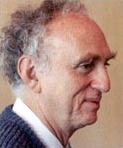

Nobel Prize in Physics · 1995
Martin L. Perl
A chemical engineer turned physicist, he found the tau, the first evidence that matter's building blocks come in three families.
The Nobel citation: “for the discovery of the tau lepton”
- Born
- June 24, 1927, New York, NY, USA
- Died
- September 30, 2014, Palo Alto, CA, USA
- Shared with
- Frederick Reines
- Affiliation at the time
- Stanford University, USA
Physics prize
1995
Shared with 1 other laureate.
Age that year
68years
Born in 1927.
Sources cited
18
Fact-checked September 24, 2026.
- He trained as a chemical engineer and worked on TV picture tubes at General Electric. At 23, after a teacher told him that what he loved was called physics, he switched.
- The tau lepton weighs about 3,477 times as much as its cousin the electron, yet it lasts only about 0.3 trillionths of a second.
- Until he was sure what he had found, Perl called the new particle 'U' for unknown. In 1977 he named it tau, from the Greek word for 'third'.
- His Michigan graduate student Samuel Ting shared the 1976 physics Nobel for the J/psi, which the SLAC team Perl belonged to found at the same time.
- In 1969 he co-founded Scientists and Engineers for Social and Political Action, the activist group that became Science for the People.
The breakthrough
Discovering the tau lepton, first member of a third family of matter (1974-1977)
By the 1960s physicists knew two charged leptons, light particles that ignore the strong nuclear force: the electron and the muon. The muon acts just like an electron but is about 207 times heavier, and nobody knew why. No theory called for a third one, but Perl wondered whether heavier cousins existed. At Stanford's new SLAC laboratory he searched for years without luck. His chance came in 1973 with SPEAR, a ring where beams of electrons and positrons, their antimatter twins, smash head-on. When the two annihilate, their energy can turn into a pair of new particles. Perl reasoned that a pair of heavy leptons would decay almost at once, within a fraction of a millimetre, leaving an electron on one side, a muon of opposite charge on the other, and invisible neutrinos carrying energy away. So he hunted for exactly that: collisions showing one electron, one muon, missing energy and nothing else. It was detective work by bookkeeping, like an accountant who keeps finding the same sum missing and concludes there must be a hidden account. By the end of 1974 his team had 24 such events that no known particle could explain. Colleagues were skeptical, so he called the particle 'U' for unknown. More data and, in 1977, confirmations from the DESY laboratory in Germany showed it was a lepton about 3,500 times heavier than the electron. He named it tau, for 'third'.[3],[4],[5],[11],[12],[18]
“Of course, my ultimate good fortune was that the tau existed.”
What it meant for humanity
The tau lepton did not cure a disease or power a machine. Its gift was understanding. Perl's discovery was the first experimental evidence that the basic particles of matter come in three families, not two. The bottom quark followed soon after at Fermilab, the top quark in 1995, and in 2000 a Fermilab team directly detected the tau neutrino, completing the set. That three-family pattern matters. In 1972 Makoto Kobayashi and Toshihide Maskawa showed that a third family of quarks would let the Standard Model include a subtle broken symmetry between matter and antimatter. A symmetry-breaking of this general kind is thought to be why matter outlasted antimatter after the Big Bang, though exactly how remains unexplained. In 2001 the BaBar detector at Stanford, which Perl's group helped build, and Japan's Belle experiment confirmed their prediction, and Kobayashi and Maskawa shared in the 2008 Nobel Prize. Today the tau is a working tool. In 2017 the CMS experiment at CERN reported the first single-experiment observation of the Higgs boson decaying into tau pairs, at a rate consistent with theory. The SLAC-Berkeley detector team Perl belonged to also co-discovered the J/psi particle in 1974 and showed that quarks reveal themselves as jets of particles, a method used in collider experiments ever since. Beyond physics, he fought for the public good as he saw it. He co-founded an activist scientists' group in 1969, helped push the American Physical Society to create forums on physics and society, and argued for more women and minorities in the physical sciences. He was also candid about what his discovery left open: at the Nobel banquet he said it raised more questions than it answered. Why nature has exactly three families remains unsolved.
- The tau was the first evidence for a third family of matter particles. The bottom quark, the top quark (1995) and the tau neutrino (2000) completed that family, giving the Standard Model its three-generation shape.[3],[5],[16]
- Kobayashi and Maskawa, who shared in the 2008 Nobel, showed that three quark families allow a broken symmetry between matter and antimatter. BaBar at Stanford, which Perl's group helped build, and Japan's Belle confirmed it in 2001.[5],[8],[14]
- In 2017 the CMS experiment at CERN reported the first observation by a single experiment of the Higgs boson decaying into pairs of tau leptons, at a rate consistent with the Standard Model's prediction.[15]
- The SLAC-Berkeley Mark I team, with Perl's group taking part, co-discovered the J/psi particle in 1974 and showed that quarks appear as jets of particles, a method used in collider experiments ever since.[5],[8],[13]
- In 1969 he co-founded Scientists and Engineers for Social and Political Action, later Science for the People, and then helped press the American Physical Society to create forums, serving as first editor of its physics-and-society newsletter.[5]
- From the early 1990s into the 2000s, he hunted for free quarks with an automated, inkjet-style version of Millikan's oil-drop experiment. One early run checked 40 million drops; a later one tested meteorite dust. None held a fractional charge.[5],[8]
Impact in numbers
Perl's discovery has no practical application, and we make no numerical claims for it; any figure would be invented. Its value is knowledge. The tau was the first evidence that matter's basic particles come in three families, a pattern that the bottom quark, top quark and tau neutrino later completed. That third family lets the Standard Model include the broken symmetry between matter and antimatter that Kobayashi and Maskawa described, confirmed in 2001 at Stanford's BaBar, which his group helped build, and at Japan's Belle. The tau is now a precision tool, used for example to measure how the Higgs boson couples to matter. Perl also shaped people: he trained experimenters, including the future Nobel laureate Samuel Ting, pushed for small, independent experiments, and helped build the American Physical Society's forum on physics and society.
Fundamental science
No number is given here on purpose. Some contributions cannot be counted honestly, and we would rather describe them than invent a figure.
The double edge
We found no documented harms tied to the tau discovery, which has no military or commercial use, or to Perl's conduct. One fair caveat concerns credit. The discovery came from the Mark I collaboration of about 30 physicists, but the Nobel Prize named Perl alone. He publicly credited colleagues such as Gary Feldman and Paul Tsai, and noted that Italian teams had searched for heavy leptons first, at lower masses.
Against the odds
Perl grew up in the United States, not under Nazi or Soviet rule, and we found no record of antisemitism aimed at him personally. His family's story began with flight. Around 1900 his parents came to New York as children from the Polish lands of the Russian Empire; he wrote that their Jewish families left to escape poverty and antisemitism. They grew up in poor areas of New York, his father on Manhattan's East Side and his mother in Brownsville, Brooklyn, and their schooling ended with high school. His father built a small printing firm that sometimes struggled to meet its Friday payroll but kept the family in the middle class through the Depression. The America of his youth still limited Jews. From about 1920 many private colleges capped Jewish admissions, and Columbia's Jewish enrollment fell from 40 to 22 percent in two years; such barriers eased only after World War II. Perl wrote that choosing engineering in the early 1940s was unusual for a Jewish boy because antisemitism was still common in engineering companies. His studies were interrupted by wartime service in the Merchant Marine and the Army, and the G.I. Bill helped him finish his degree in 1948. He switched to physics at 23 and, married with a young child, got through Columbia's doctoral program although he had taken only two physics courses before starting.
—
Exile
Around 1900 his parents came to the United States as children from the Polish area of the Russian Empire. Perl wrote that, as Jews, their families left to escape poverty and antisemitism.[1],[5]
—
Quota
Context, not a documented personal barrier: from about 1920 many private colleges limited Jewish admissions, and Columbia's Jewish enrollment fell from 40 to 22 percent in two years. Such barriers eased after World War II.[17]
1942
Discrimination
Perl wrote that choosing engineering was an unusual path for a Jewish boy in the early 1940s because antisemitism was still common in engineering companies. He enrolled in chemical engineering at the Polytechnic Institute of Brooklyn.[1]
Jewish background
Perl's parents, Oscar Perl and Fay Rosenthal, came to the United States as children around 1900 from the Polish area of the Russian Empire; he wrote that, as Jews, their families left to escape poverty and antisemitism. The Nobel Foundation calls him of Russian-Jewish descent, and his biographers say his parents were not very religious. He recalled Brooklyn's Jewish middle class expecting boys to become doctors, dentists, lawyers or accountants. The Encyclopaedia Judaica says he strongly supported Israel and Jewish life in the US and practiced Reconstructionist Judaism; his own writings do not discuss his religious life.[1],[2],[5],[9]
Key dates
June 24, 1927
Born in New York City and raised in Brooklyn, the son of Jewish immigrants Oscar Perl and Fay Rosenthal.[1],[2]
1942
Graduates from James Madison High School in Brooklyn at 16, winning the physics medal, and starts chemical engineering at the Polytechnic Institute of Brooklyn.[1],[5]
1944
Leaves college to become an engineering cadet in the US Merchant Marine; after the war he is drafted and serves a year in the Army.[1],[5]
1948
Earns a chemical engineering degree summa cum laude, marries Teri Hoch, and joins General Electric, later working on electron tubes in Schenectady.[1],[5]
1950
Encouraged by physics professor Vladimir Rojansky at Union College, he leaves engineering at 23 and enters Columbia University's physics doctoral program.[1],[5]
1955
Completes his PhD under I. I. Rabi and joins the University of Michigan, where he moves into particle physics.[1],[5]
1963
Moves to the new Stanford Linear Accelerator Center (SLAC) to lead its experimental Group E and begins hunting for new leptons.[4],[5],[8]
1969
Co-founds Scientists and Engineers for Social and Political Action, later Science for the People, at an American Physical Society meeting in New York.[5]
1974
At SLAC's SPEAR collider, the SLAC-Berkeley team he belongs to co-discovers the J/psi particle; by year's end he has 24 unexplained electron-muon events.[4],[5],[13]
December 1975
The Mark I team publishes 'Evidence for Anomalous Lepton Production', the first paper on the new particle.[4],[5]
1977
Perl names the particle tau in March; experiments at Germany's DESY laboratory confirm it within months.[4],[5]
1982
Receives the Wolf Prize in Physics for the tau discovery, a year after election to the US National Academy of Sciences.[5],[7]
October 11, 1995
Awarded half of the Nobel Prize in Physics for the discovery of the tau lepton; the other half goes to Frederick Reines for detecting the neutrino.[2],[3],[10]
September 30, 2014
Dies at Stanford Hospital in Palo Alto at 87, still coming to SLAC in his last years to work on the nature of dark energy.[6],[7]
Sources
- 1.Martin L. Perl - Biographical · NobelPrize.org (from Les Prix Nobel 1995, Nobel Foundation, 1996), 1995
- 2.Martin L. Perl - Facts · NobelPrize.org (Nobel Prize Outreach)
- 3.The Nobel Prize in Physics 1995 - Press release (11 October 1995) · Royal Swedish Academy of Sciences / NobelPrize.org, 1995
- 4.Reflections on the Discovery of the Tau Lepton (Nobel Lecture, 8 December 1995) · NobelPrize.org, 1995
- 5.Martin L. Perl, 1927-2014: A Biographical Memoir, by Gary Feldman, John Jaros and Rafe H. Schindler · National Academy of Sciences, 2016
- 6.Nobel laureate Martin Perl dies at 87 · Physics World (IOP Publishing), 2014
- 7.Martin L. Perl, Winner of 1995 Nobel Prize for Discovery of Tau Lepton, Dead at 87 · SLAC National Accelerator Laboratory, 2014
- 8.Martin Perl, 1927-2014 (faculty and staff biographies) · SLAC Archives, History & Records Office
- 9.Perl, Martin Lewis (Encyclopaedia Judaica, 2nd ed., entry by Michael Denman) · Encyclopedia.com (Gale), 2007
- 10.Martin L. Perl - Banquet speech (Stockholm, 10 December 1995) · NobelPrize.org, 1995
- 11.The Nobel Prize in Physics 1995 - Award ceremony speech by Professor Carl Nordling · NobelPrize.org, 1995
- 12.Review of Particle Physics 2025 update: Leptons summary table · Particle Data Group (Lawrence Berkeley National Laboratory), 2025
- 13.The Nobel Prize in Physics 1976 - Press release (18 October 1976) · Royal Swedish Academy of Sciences / NobelPrize.org, 1976
- 14.The Nobel Prize in Physics 2008 - Press release · Royal Swedish Academy of Sciences / NobelPrize.org, 2008
- 15.Observation of the Higgs boson decay to a pair of tau leptons with the CMS detector (arXiv:1708.00373) · CMS Collaboration (published in Physics Letters B, 2018), 2017
- 16.Physicists find first direct evidence for tau neutrino at Fermilab · Fermi National Accelerator Laboratory, 2000
- 17.How Jewish Quotas Began, by Stephen Steinberg · Commentary, 1971
- 18.The Discovery of the Tau and Its Major Properties: 1970-1985 (SLAC-PUB-5388), by Martin L. Perl · Stanford Linear Accelerator Center, 1990
Fact-checked on September 24, 2026 by a separate AI fact-checking pass that re-opened the sources, with 5 corrections made. How we check
Suggest a correction