
Nobel Prize in Physics · 1987
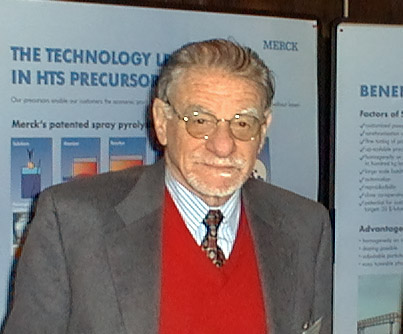
K. Alex Müller
He bet that humble ceramics could carry current with zero resistance, and opened the era of high-temperature superconductors.
The Nobel citation: “for their important break-through in the discovery of superconductivity in ceramic materials”
- Born
- April 20, 1927, Basel, Switzerland
- Died
- January 9, 2023, Zurich, Switzerland
- Shared with
- J. Georg Bednorz
- Affiliation at the time
- IBM Zurich Research Laboratory, Switzerland
Physics prize
1987
Shared with 1 other laureate.
Age that year
60years
Born in 1927.
Sources cited
14
Fact-checked September 24, 2026.
- He and Georg Bednorz reported their discovery in April 1986; the Nobel Prize was announced in October 1987, only about 18 months later.
- The record for the warmest superconductor had been stuck at 23 degrees above absolute zero since 1973. Their ceramic beat it by 12 degrees.
- The search nearly died in 1985 after about two years of failed samples. The winning material was first measured in January 1986.
- Their discovery set off the 1987 'Woodstock of Physics', a New York session where about 50 speakers talked until after 3 a.m.
- His first-year physics class at ETH Zurich was more than three times the usual size. Students called it the 'atom bomb semester'.
The breakthrough
Superconductivity in copper-oxide ceramics (1986)
Some materials, cooled far enough, lose all electrical resistance. Current then flows with no energy lost as heat. This is superconductivity, found in 1911. The catch was the cold. Every known superconductor had to be chilled with liquid helium, at about -269°C, which is costly and hard to handle. For 75 years, researchers raised the highest working temperature only slowly, and from 1973 the record sat at 23 degrees above absolute zero. Müller had spent two decades at IBM's Zurich lab studying oxides, crystals built from metal and oxygen atoms. Most of them conduct electricity poorly. Looking for a superconductor among them was a bit like scouting for a star sprinter in a chess club. But Müller had a theory. He thought certain metal atoms that twist the crystal around them could bind electrons in pairs more tightly. In 1983 he and Georg Bednorz began testing samples. Nickel compounds failed, and so did the first copper ones. Then, in January 1986, the resistance of a barium-lanthanum-copper oxide dropped suddenly as it cooled. Within two weeks they pushed the effect up to about 35 degrees above absolute zero (about -238°C), a jump of 12 degrees over the old record. Labs around the world rushed in. By early 1987, related copper oxides worked above 90 degrees above absolute zero. That is warm enough to use liquid nitrogen, which is cheap and easy to handle.[2],[3],[5],[6]
What it meant for humanity
Before 1986, anything superconducting needed liquid helium. The copper oxides that Müller and Bednorz opened up can work in liquid nitrogen, which the Royal Swedish Academy of Sciences called considerably cheaper and easier to handle than liquid helium. That changed what engineers could try. Turning brittle ceramics into long, bendable wire took decades. It has now been done, and companies sell high-temperature superconducting wire and cable. In the German city of Essen, a one-kilometre superconducting cable went into service in 2014. It links two substations in the city centre and carries about five times as much power as a conventional cable, with almost no losses. Superconducting fault-current limiters, which protect power grids from surges, are sold commercially. Thin superconducting films are used as filters in mobile-phone base stations. Superconducting sensors called SQUIDs, some now made from the new materials, can pick up the faint magnetic fields made by the heart and brain. The most closely watched use is fusion energy. In 2021, MIT and Commonwealth Fusion Systems tested a magnet built from high-temperature superconducting tape, which reached 20 tesla, a record for a magnet of its kind. The designers say such magnets match the performance of conventional superconducting magnets 40 times larger in volume. One supplier made more than 300 kilometres of wire from YBCO, one of the copper oxides that followed the 1986 discovery, and delivered most of it to Commonwealth Fusion Systems. None of this is yet a mass technology. Hospital MRI scanners still use the older niobium-titanium superconductors. But the materials Müller found are central to fusion research today.
- Copper-oxide superconductors work above the boiling point of liquid nitrogen (-196°C), so they can be cooled far more cheaply than earlier superconductors, which needed liquid helium.[2],[10]
- Since 2014, a 1-kilometre superconducting cable in Essen, Germany, has linked two city-centre substations, carrying about five times as much power as a conventional cable.[10]
- In 2021, an MIT and Commonwealth Fusion Systems magnet made of high-temperature superconducting tape reached 20 tesla, a record for its kind and a key step toward smaller fusion power plants.[12]
- One wire maker made more than 300 km of YBCO wire in nine months, mostly for fusion magnets. It called this the largest completed order in the industry's history.[11]
- Thin high-temperature superconducting films serve as filters in mobile-phone base stations. The new materials are also used in SQUIDs, sensors sensitive enough to detect magnetic fields from the heart and brain.[10]
Impact in numbers
We record no numbers for Müller. His discovery started a new branch of materials science, but its uses are still young and scattered. We found no published total of people helped, dollars earned or emissions avoided. Here is what can be said plainly. Before 1986, practical superconductivity meant liquid helium; afterwards, copper oxides working in liquid nitrogen became possible. Decades of engineering turned those brittle ceramics into commercial wire, cables, fault-current limiters, filters and sensors. Their biggest test is now under way in fusion energy, where magnets made from copper-oxide tape could make reactors much smaller. The scientific impact is easier to see. Hundreds of laboratories took up the work within months, and physicists still argue over why these materials superconduct. Müller himself backed an explanation based on electrons that distort the crystal around them.
Fundamental scienceTechnologyEnergy
No number is given here on purpose. Some contributions cannot be counted honestly, and we would rather describe them than invent a figure.
The double edge
We found no documented harm from Müller's discovery. It has no weapons use and is linked to no disaster. What went wrong was expectation. In May 1987 superconductors made the cover of Time magazine, and predictions of new technology ran far ahead of the materials. The ceramics proved brittle and hard to make into wire. In 2021, engineers who make high-temperature superconducting wire wrote that development took more time and effort than many had expected, and that for most commercial uses the wire was still too expensive.
Against the odds
Müller grew up in Switzerland, which stayed neutral in the Second World War. We found no record of him facing antisemitism himself. The Swiss historical dictionary lists him as Reformed Protestant, and his mother, the Jewish parent, died in 1938 when he was 11. He then spent the war years, 1938 to 1945, at an evangelical boarding school in the mountains of eastern Switzerland. There, he later wrote, the students followed the war through discussion groups in class. Switzerland was a hard place for Jews trying to escape Nazi Europe. In 1938 the Swiss government approved a 'J' stamp for Jewish passports, a step the historians later said applied Nazi Germany's racist thinking to Swiss immigration policy. An independent commission of historians later found that from 1940 to 1945 Switzerland turned away about 24,000 refugees, many of them Jewish. The commission found that widespread antisemitism, not food shortages or military pressure, was why Switzerland closed its borders in 1942. By the summer of 1942, Swiss officials knew that refugees turned back faced deportation and death. Müller's own struggle was scientific. Experts expected oxides to make poor superconductors. He later said this was exactly why he wanted to try, because he felt like swimming against the current.
1938
Other
His mother died when he was 11, and he was sent to a boarding school in Schiers, where he stayed through the Second World War.[1],[5]
1942
Discrimination
Wider context: in 1942 Switzerland closed its borders to most refugees. A commission of historians later blamed widespread antisemitism, and found that about 24,000 people, many of them Jews, were turned away from 1940 to 1945. We found no record that Müller or his family were affected.[13]
1986
Other
Not a Jewish barrier: oxides were thought to be unlikely superconductors, and there had been many false reports of 'high-temperature' superconductivity. Other scientists at first met the discovery with skepticism.[3],[6],[8]
Jewish background
Müller's mother was Irma Müller, born Irma Feigenbaum; his father, Paul Rudolf Müller, was a businessman and musician. Jinfo.org lists him as having a Jewish mother. It says this rests on what Müller himself said on a 2006 visit to Israel, when Bar-Ilan University gave him an honorary doctorate. We could not find that statement in a second source. After his mother died when he was 11, he went to an evangelical boarding school, and the Swiss historical dictionary records his religion as Reformed (Protestant). We found no sign that he practised Judaism.[1],[4],[5],[7]
Key dates
April 20, 1927
Born in Basel, Switzerland. His early years were spent in Salzburg, Austria, where his father studied music, and then in Dornach and Lugano.[1],[4]
1938
His mother dies when he is 11. He enters the Evangelical College in Schiers, where he stays until the end of the Second World War.[1],[5]
1946
Begins physics studies at ETH Zurich, taught by Paul Scherrer and Wolfgang Pauli.[1],[6]
1958
Earns his doctorate at ETH Zurich for work on magnetic resonance in strontium titanate, then joins the Battelle Memorial Institute in Geneva.[1],[4]
1963
Joins the IBM Zurich Research Laboratory in Rüschlikon, where he spends about 15 years studying perovskite oxides.[1],[4]
1982
Named an IBM Fellow, giving him freedom to choose his own research.[1],[4]
1983
In late summer, begins the search for high-temperature superconductivity in oxides with Georg Bednorz.[3]
1986
Bednorz and Müller find superconductivity near 35 K in a barium-lanthanum-copper oxide and report it in April, 12 degrees above the old record.[2],[3]
March 18, 1987
Thousands of physicists pack the 'Woodstock of Physics' session on the new superconductors at the American Physical Society meeting in New York.[9]
October 14, 1987
The Nobel Prize in Physics is announced for Müller and Georg Bednorz, for the discovery of superconductivity in ceramic materials.[2]
1987
Becomes a full professor at the University of Zurich, where he teaches until 1994.[4],[6]
January 9, 2023
Sources
- 1.K. Alex Müller – Biographical · NobelPrize.org (Nobel Prize Outreach), 1987
- 2.Press release: The Nobel Prize in Physics 1987 · The Royal Swedish Academy of Sciences / NobelPrize.org, 1987
- 3.Perovskite-Type Oxides – The New Approach to High-Tc Superconductivity (Nobel lecture by J. Georg Bednorz and K. Alex Müller) · NobelPrize.org (Nobel Prize Outreach), 1987
- 4.Müller, Karl Alexander (Hugo Keller) · Historisches Lexikon der Schweiz (HLS), 2023
- 5.In Memoriam Karl Alexander Müller · Swiss Physical Society, 2023
- 6.Gegen den Strom schwimmen · University of Zurich (UZH News), 2023
- 7.Jewish Nobel Prize Winners in Physics · JINFO.ORG
- 8.Karl Alexander Müller (Encyclopedia of World Biography) · Encyclopedia.com / Gale, 2018
- 9.Experience the 1987 "Woodstock of Physics" Online (archived copy) · American Physical Society, APS News, 2016
- 10.High-temperature superconductors: underlying physics and applications (A. Bussmann-Holder and H. Keller, Zeitschrift für Naturforschung B 75, 3–14) · De Gruyter / arXiv, 2020
- 11.Development and large volume production of extremely high current density YBa2Cu3O7 superconducting wires for fusion (Molodyk et al., Scientific Reports 11, 2084) · Nature Portfolio, Scientific Reports, 2021
- 12.MIT-designed project achieves major advance toward fusion energy · MIT News, 2021
- 13.Bergier report: Thousands of Jews turned back, "widespread anti-semitism" · swissinfo.ch, 1999
- 14.TIME Magazine Cover: Superconductors, May 11, 1987 · TIME, 1987
Fact-checked on September 24, 2026 by a separate AI fact-checking pass that re-opened the sources, with 7 corrections made. How we check
Suggest a correction