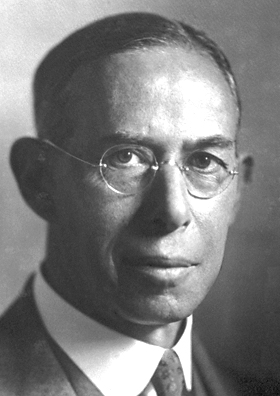

Nobel Prize in Physiology or Medicine · 1944
Joseph Erlanger
He timed signals racing along nerves and found thick fibers fast and thin ones slow, a key to how we feel touch and pain.
The Nobel citation: “for their discoveries relating to the highly differentiated functions of single nerve fibres”
- Born
- January 5, 1874, San Francisco, CA, USA
- Died
- December 5, 1965, St. Louis, MO, USA
- Shared with
- Herbert S. Gasser
- Affiliation at the time
- Washington University, USA
Medicine prize
1944
Shared with 1 other laureate.
Age that year
70years
Born in 1874.
Sources cited
28
Fact-checked September 24, 2026.
- When Western Electric refused to sell them a cathode-ray tube in 1921, he and Herbert Gasser built their own, using a laboratory distillation flask as the tube.
- He was nominated for the Nobel Prize 17 times from 1935 to 1944. Later he nominated his St. Louis colleagues Carl and Gerty Cori, who won in 1947.
- As a student he learned to box from the celebrated fighter Jim Corbett, and in later life he tuned in to televised boxing every Wednesday night.
- When an antivivisectionist freed his laboratory dogs from their cages, all of them found their own way back to the lab by nightfall.
- His father came from Buchau in Württemberg, the small German town that was also the ancestral home of Albert Einstein's family.
The breakthrough
Timing nerve signals with a homemade oscilloscope: thick fibers fast, thin fibers slow
A nerve is not a single wire. It is a cable holding many fibers, each one a long extension of a nerve cell. When a fiber fires, a tiny electrical pulse runs along it. The pulse is over in a flash, and the smallest are only a few millionths of a volt. In 1921 the recording instruments of the day were too sluggish to draw such fast signals accurately. Erlanger and his former student Herbert Gasser, working in St. Louis, paired a strong amplifier with a cathode-ray tube, the ancestor of the old television screen. Its beam of electrons has no moving parts to slow it down. They even had to build their first tube themselves. When they stimulated a nerve and recorded the signal farther along it, the signal arrived not as one bump but as several waves. Think of a marathon: fast and slow runners start together but reach the finish line in separate bunches. Each bunch was a group of fibers with its own speed, and the speed matched the fiber's thickness. Others had guessed at this link between size and speed; Erlanger and Gasser proved it. The thickest fibers, called A fibers, carried signals at 5 to 100 meters per second. The thinnest, C fibers, managed less than 2. Pain travels largely on thin, slow fibers, while touch, muscle sense and the commands that move muscles use thick, fast ones.[1],[2],[3],[4],[6],[7]
“fraught with a series of fortunate circumstances and fortunate decisions”
What it meant for humanity
Erlanger's work changed medicine in three areas. The first was the heart. Around 1905 he designed a clamp that could squeeze the thin bundle of tissue, the bundle of His, that carries each heartbeat's signal from the upper to the lower chambers. By tightening it step by step in dogs, he produced every degree of heart block and showed that failed conduction there causes Stokes-Adams attacks, in which the pulse slows and the patient faints. Writing in the 1970s, one biographer called these experiments the basis of what was then known about how signals travel inside the heart. The second was blood pressure. In 1904 he built his own blood-pressure instrument, which a New York firm later manufactured, and he worked out what produces the tapping sounds doctors hear through a stethoscope when they measure blood pressure. During World War I he and Gasser proposed a glucose and gum acacia infusion for wounded soldiers in shock. The third, and most lasting, was the nervous system. Their sorting of nerve fibers by thickness and speed became a standard way to classify nerves, and it helped show that pain travels largely on thin, slow fibers. In 1929 they were the first to show that it takes less local anesthetic to silence a thin nerve fiber than a thick one of the same kind, a finding regional-anesthesia teaching still cites. Today doctors use tests that time how fast signals travel along nerves to help diagnose carpal tunnel syndrome, diabetic nerve damage and Guillain-Barré syndrome, and a clinical review of these tests lists Erlanger and Gasser among their pioneers. Rockefeller University notes that faulty nerve conduction figures in conditions from multiple sclerosis to leprosy.
- His clamp experiments in dogs showed that the heartbeat's signal crosses from the upper to the lower chambers only through the bundle of His, and that blocking it there underlies Stokes-Adams fainting attacks.[6],[7],[10],[25]
- With Gasser he made the first use of the cathode-ray oscilloscope in biology. Nerve researchers soon came to see it as the only instrument good enough to record nerve signals.[3],[6]
- Their A, B and C fiber groups, from 5-100 meters per second down to under 2, became a standard way to classify nerve fibers and helped link pain largely to thin, slow fibers.[4],[11],[12],[16]
- In 1929 Gasser and Erlanger were the first to show that it takes less local anesthetic to silence a thin nerve fiber than a thick one of the same kind, a finding still cited in regional-anesthesia teaching.[13]
- Nerve conduction tests, which time signals along nerves, help diagnose carpal tunnel syndrome, diabetic neuropathy and Guillain-Barré syndrome. A clinical review of the field lists Erlanger and Gasser among its pioneers.[14],[15]
- In World War I he and Gasser proposed a glucose and gum acacia infusion to treat wounded soldiers in shock. One biographer says the US Army used it in France.[7],[18]
Impact in numbers
Erlanger's impact is broad but hard to count. His heart-block experiments helped establish how the heartbeat's electrical signal crosses from the upper to the lower chambers. His nerve work with Gasser gave physiology a new instrument and a new map. The cathode-ray oscilloscope became the standard way to record nerve signals, and sorting fibers by thickness and speed still frames how scientists and doctors think about touch, pain and local anesthesia. Nerve conduction tests, used to diagnose conditions such as carpal tunnel syndrome and diabetic neuropathy, measure the very property he and Gasser studied. But each of these benefits passed through many later scientists, instruments and clinical inventions, and no published source estimates how many patients his work helped. We therefore make no numerical claim. His legacy also includes an institution: he led Washington University's physiology department for more than three decades, and by 1947 the university counted four Nobel laureates on its faculty, a record for an American university at the time.
HealthFundamental science
No number is given here on purpose. Some contributions cannot be counted honestly, and we would rather describe them than invent a figure.
The double edge
No large-scale harm is tied to Erlanger's discoveries, but his record has limits. His heart and nerve research relied on experiments on animals, including heart surgery on living dogs and studies of frog nerves, and he publicly defended animal research, including in a 1910 pamphlet for the American Medical Association. His biographer stresses that he demanded careful treatment of laboratory animals and sharply rebuked a student who performed a drastic procedure on frogs without consulting him. His World War I shock remedy used gum acacia. A later history of wartime resuscitation notes that gum acacia infusions in that war caused harmful reactions and swelling, though it does not single out his formula; experts judged whole blood the better treatment, and in World War II blood and plasma became the mainstays. Finally, the neat link between a fiber's thickness and its job proved too simple. His own biographer wrote that only broad matches between fiber type and function hold up, and recent research shows that some slow C fibers carry touch while some fast, thick fibers signal pain.
- Minor
Research on animals
His heart-block studies involved surgery on living dogs, and his later single-fiber studies used frog nerves. He defended animal research in a 1910 American Medical Association pamphlet. His biographer records that he insisted on good care and respect for laboratory animals, but the experiments still meant major surgery on living animals.[3],[6]
- Minor
A wartime shock remedy that did not last
In 1919 he and Gasser proposed a hypertonic gum acacia and glucose solution for wound shock. A history of fluid resuscitation reports that gum acacia infusions used in World War I caused harmful reactions and swelling, that postwar reviews judged whole blood the best treatment, and that blood and plasma dominated in World War II. It does not single out his formula.[7],[18],[19]
- Minor
A classification that proved too tidy
The idea that a fiber's size and speed reveal its job holds only broadly. A 2024 review notes that some slow C fibers carry touch and some fast, thick fibers signal pain, and it suggests a new way of classifying nerve fibers.[6],[12]
Against the odds
The sources we found record little antisemitism in Erlanger's own life. His father left Buchau, in the German kingdom of Württemberg, arrived in New York without money, and reached San Francisco in the 1849 Gold Rush. The new city was unusually open to Jews. One local history notes that Jews there won public office and entered the city's social elite at a time when New York society was shutting Jews out. Prejudice never vanished, though: in 1855 the speaker of the California Assembly called for a special tax on Jews. Erlanger's own obstacles were mostly about money. His parents had only an elementary education, he was the only one of seven children to finish college, and as a medical student he could not afford to travel home for vacations. Later, while he led a department in St. Louis, many American medical schools restricted Jewish applicants: in 1933-34 about 26 percent of Jewish applicants won a place, against 46 percent of others. The sources we found do not show that he was personally held back. The community his father left, which was also the ancestral home of Albert Einstein's family, was destroyed. Buchau's synagogue was burned in November 1938, its last Jews were deported in 1942-43, and at least 56 of the 162 Jews living there in 1933 died as a result of Nazi persecution. When he received his prize at a New York dinner in December 1944, the Jewish press counted him among three Jewish winners.
—
Other
He came from a family of modest means: his immigrant parents had only an elementary education, and he was the only one of seven children to complete college. As a medical student he spent vacations doing research because he could not afford the trip home.[6],[7],[10]
1855
Discrimination
Gold Rush San Francisco was unusually welcoming to Jews, who won public office and joined the city's upper class. Prejudice still surfaced: in 1855, about two decades before his birth, the speaker of the California Assembly called for a special tax on Jews. The idea went nowhere.[21],[22],[27]
—
Quota
During his career many US medical schools limited Jewish admissions. In 1933-34, about 26% of Jewish applicants got a place versus 46% of others. We found no evidence that the quotas affected him personally; he was already a department head.[20]
1938
Persecution
Buchau, his father's hometown, lost its Jewish community to Nazi persecution: the synagogue was burned in 1938, the last Jews were deported in 1942-43, and at least 56 of 162 Jewish residents died. Our sources do not say whether relatives were among them.[23]
Jewish background
Erlanger was born in San Francisco to immigrant parents from the German kingdom of Württemberg. His father, Herman, came from Buchau am Federsee, a town whose Jewish community peaked at 828 people around 1858, and reached California in the 1849 Gold Rush. His mother was Sarah Galinger. Wikipedia and the St. Louis Jewish Light describe both parents as Jewish, the Encyclopaedia Judaica includes him, and in 1944 the Jewish Telegraphic Agency counted him among three Jewish Nobel winners. As an adult he went his own way on religion: his biographer calls Humanism the nearest thing he had to a religious affiliation, and says his wife and children were Unitarians.[6],[8],[9],[23],[26],[28]
Key dates
January 5, 1874
Born in San Francisco, the sixth of seven children of immigrant parents: Herman Erlanger, from Württemberg, and Sarah Galinger.[1],[2],[6]
1899
Earns his medical degree at the new Johns Hopkins Medical School, second in his class, after a chemistry degree at the University of California.[2],[6]
1904
Builds his own sphygmomanometer, a blood-pressure recorder, and uses it to study how pulse pressure affects the kidneys.[2],[6],[7]
1906
Publishes dog experiments tying Stokes-Adams fainting attacks to blocked conduction through the bundle of His, the link between the heart's upper and lower chambers.[6],[7],[25]
June 21, 1906
Marries Aimée Hirstel of San Francisco and becomes the first professor of physiology at the University of Wisconsin's new medical school.[2],[6]
1910
Becomes head of physiology at the reorganized Washington University School of Medicine in St. Louis, a post he holds until 1946.[2],[6],[17]
1919
With Gasser, publishes a gum acacia and glucose treatment for wound shock, based on wartime research.[7],[18]
1922
With Gasser, publishes their first nerve recordings made with a cathode-ray oscilloscope, the device's first use in biology.[2],[6]
1929
Gives the first public demonstration of signals in slow C fibers at the International Congress of Physiology in Boston.[6]
1937
Publishes Electrical Signs of Nervous Activity with Gasser, a book based on lectures they gave at the University of Pennsylvania in 1936.[6],[7],[11]
1944
After 17 nominations since 1935, shares the Nobel Prize in Physiology or Medicine with Gasser. In wartime December it is presented at a dinner in New York.[1],[5],[9]
December 12, 1947
Delivers his Nobel lecture in Stockholm. That year his St. Louis colleagues Carl and Gerty Cori, whom he had nominated, win the prize.[3],[5],[6],[17]
December 5, 1965
Dies in St. Louis at 91, having outlived his wife Aimée and his son Herman, who both died in 1959.[1],[2],[7]
December 8, 1976
His St. Louis home of 48 years is designated a National Historic Landmark.[24]
Sources
- 1.Joseph Erlanger – Facts · NobelPrize.org (Nobel Prize Outreach)
- 2.Joseph Erlanger – Biographical (from Nobel Lectures, Physiology or Medicine 1942-1962) · NobelPrize.org (Nobel Prize Outreach), 1964
- 3.Some Observations on the Responses of Single Nerve Fibers (Nobel Lecture, 12 December 1947) · NobelPrize.org (Nobel Prize Outreach), 1947
- 4.The Nobel Prize in Physiology or Medicine 1944 – Award ceremony speech (statement by Ragnar Granit) · NobelPrize.org (Nobel Prize Outreach), 1944
- 5.Joseph Erlanger – Nominations · NobelPrize.org (Nobel Prize Outreach)
- 6.Joseph Erlanger, 1874–1965: A Biographical Memoir (Hallowell Davis) · National Academy of Sciences, 1970
- 7.Erlanger, Joseph (Complete Dictionary of Scientific Biography, by A. M. Monnier) · Encyclopedia.com / Charles Scribner's Sons
- 8.Erlanger, Joseph (Encyclopaedia Judaica, by Suessmann Muntner) · Encyclopedia.com / Encyclopaedia Judaica (Gale), 2007
- 9.Jewish Scientists Receive Three of Six Nobel Prizes Awarded in New York Ceremony · Jewish Telegraphic Agency, 1944
- 10.Joseph Erlanger (1874–1965): the cardiovascular investigator who won a Nobel Prize in neurophysiology (Breathnach CS, Moynihan JB) · Journal of Medical Biography, 2014
- 11.Ideas about pain, a historical view (Perl ER) · Nature Reviews Neuroscience, 2007
- 12.Slow touch and ultrafast pain fibres: Revisiting peripheral nerve classification (Olausson H, Marshall A, Nagi SS, Cole J) · Clinical Neurophysiology, 2024
- 13.Clinical Pharmacology of Local Anesthetics · NYSORA (New York School of Regional Anesthesia)
- 14.Nerve conduction velocity (MedlinePlus Medical Encyclopedia) · US National Library of Medicine
- 15.Overview of electromyography and nerve conduction studies (Treidler S, Veerapandiyan A) · MedLink Neurology, 2026
- 16.Herbert S. Gasser: 1944 Nobel Prize in Physiology or Medicine · The Rockefeller University
- 17.Nobel Prize Winners · WashU Medicine (Washington University School of Medicine in St. Louis)
- 18.Hypertonic gum acacia and glucose in the treatment of secondary traumatic shock (Erlanger J, Gasser HS) · Annals of Surgery, 1919
- 19.The History of Fluid Resuscitation for Bleeding (Thompson P, Strandenes G), in Damage Control Resuscitation · Springer (via PubMed Central), 2019
- 20.The Jewish Problem in U.S. Medical Education, 1920-1955 (Halperin EC) · Journal of the History of Medicine and Allied Sciences, 2001
- 21.19th c. Anti-Semitism? (historical essay by Kate Shvetsky) · FoundSF (Shaping San Francisco)
- 22.Jews in the California Gold Rush (Jonathan Ellowitz) · My Jewish Learning
- 23.Bad Buchau (Kreis Biberach): Jüdische Geschichte / Synagoge · Alemannia Judaica
- 24.Joseph Erlanger House National Historic Landmark · City of St. Louis, Cultural Resources Office
- 25.On first looking into auriculo-ventricular asynchrony (Breathnach CS, Moynihan JB) · Pacing and Clinical Electrophysiology, 2010
- 26.Joseph Erlanger · Wikipedia
- 27.Golden Gate Park lake honoring antisemite could be renamed · San Francisco Examiner, 2023
- 28.Nine Jewish geniuses who put WashU and St. Louis on the Nobel map (Jordan Palmer) · St. Louis Jewish Light, 2025
Fact-checked on September 24, 2026 by a separate AI fact-checking pass that re-opened the sources, with 10 corrections made. How we check
Suggest a correction