.jpg)
Sveriges Riksbank Prize in Economic Sciences · 2001
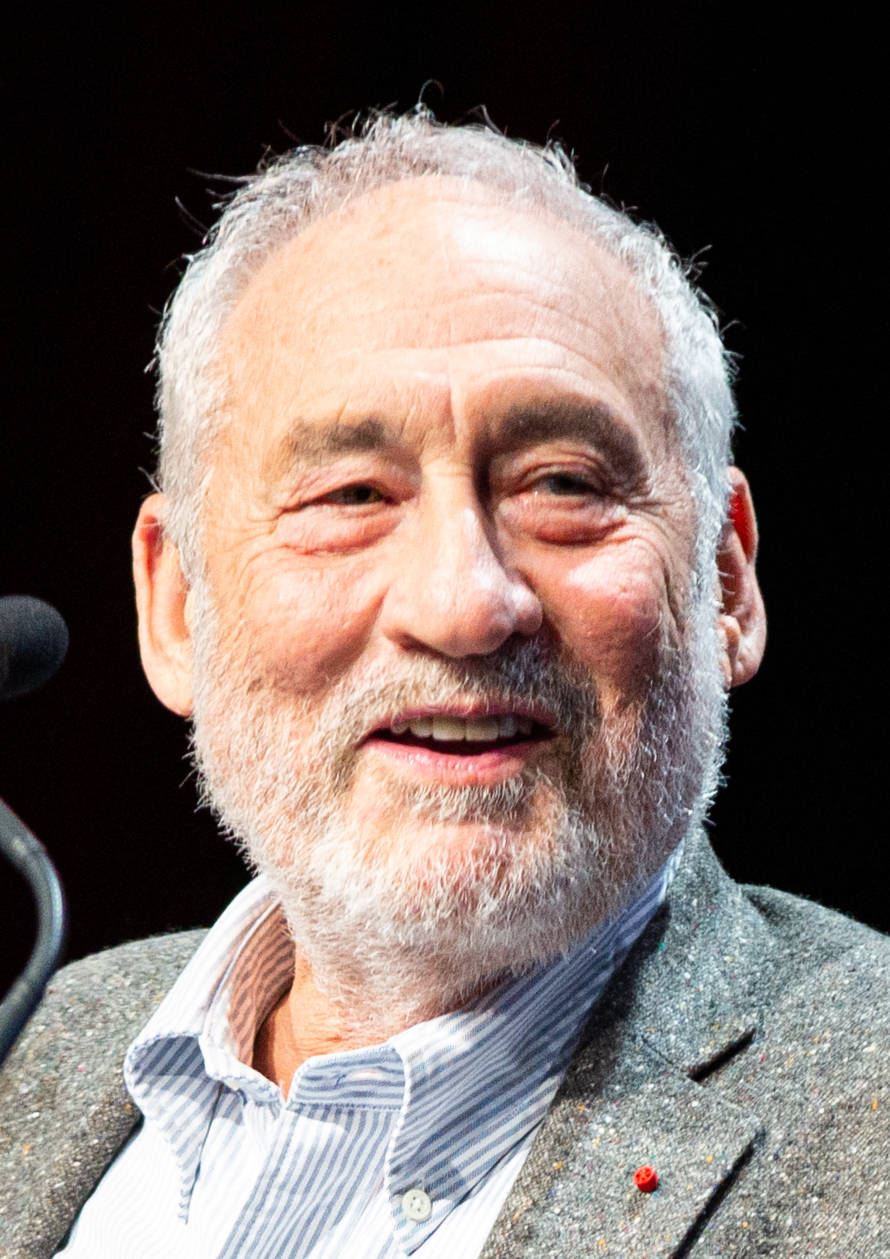
Joseph E. Stiglitz
He showed how hidden information bends markets for loans, jobs and insurance, and argued that governments must help repair the damage.
The Nobel citation: “for their analyses of markets with asymmetric information”
- Born
- February 9, 1943, Gary, IN, USA
- Shared with
- George A. Akerlof, A. Michael Spence
- Affiliation at the time
- Columbia University, USA
Economics prize
2001
Shared with 2 other laureates.
Age that year
58years
Born in 1943.
Sources cited
21
Fact-checked September 24, 2026.
- He left Amherst for graduate school at MIT without a degree. His last-minute fellowship left him about a dollar a day to live on after rent.
- Paul Samuelson, the 1970 economics laureate, also came from Gary, Indiana. As a graduate student Stiglitz edited Samuelson's collected papers.
- His first paper at an academic meeting was written with George Akerlof, one of the two economists he shared the 2001 prize with.
- A stay in Kenya from 1969 was pivotal for his work on information; sharecropping, where tenants give landlords half or more of the crop, puzzled him.
- He chaired President Clinton's Council of Economic Advisers, then served as World Bank chief economist until 2000, leaving amid clashes with the IMF and US Treasury.
The breakthrough
How the less informed side of a market sorts, screens and rations
Old textbook models assumed that everyone in a market knows everything that matters. Stiglitz spent the 1970s working out what happens when they do not. His best-known paper, written with Michael Rothschild in 1976, looks at insurance. A driver knows whether she is careful; the insurer does not. Stiglitz showed that the insurer can get customers to reveal their own risk by offering a menu of policies. Think of a phone company offering a cheap plan with high extra charges and a pricier plan with none: people pick the plan that suits their habits and so tell the company who they are. In insurance, careful drivers choose the low premium with a high deductible, while riskier drivers pay more for fuller cover. This is called screening. With Andrew Weiss in 1981, he showed why banks often refuse some loans outright instead of simply raising the interest rate: a higher rate scares off safe borrowers and draws in riskier ones. Other work explained why firms may pay above the going wage, so that workers have more to lose if caught slacking, which helps explain lasting unemployment. With Sanford Grossman he showed that prices can never fully reflect everything traders know, because nobody would pay to gather information that prices already reveal for free.[3],[5],[6],[7]
“the reason that the hand may be invisible is that it is simply not there”
What it meant for humanity
Stiglitz's theory changed how economists and governments think about ordinary contracts: insurance policies, bank loans, job pay and farm tenancy. The Nobel committee said that he and his co-laureates built the core of modern information economics, and that their methods are now taught in universities all over the world. His work showed that when information is uneven, markets can leave people without credit or insurance even when trade would help both sides, which strengthens the case for well-designed regulation. He saw that shift reach policy directly. While he served on President Clinton's Council of Economic Advisers, first as a member and then as chairman, ideas he had helped develop, such as adverse selection and moral hazard, entered the everyday language of the health-care debate.
As chief economist of the World Bank from 1997 to 2000, he argued that the IMF's standard prescriptions of tight budgets, high interest rates and rapid opening of capital markets were deepening crises in East Asia and hurting countries moving from communism to markets. He took the dispute public, and believed the pressure helped ease the harshest measures. In 2000 he founded the Initiative for Policy Dialogue, which brings officials, academics, unions and journalists together to weigh policy options in developing countries such as Nigeria, Vietnam and the Philippines. In 2008 and 2009 he chaired a commission for the French government on measuring progress beyond GDP. The OECD launched its Better Life Index in 2011 in line with the commission's recommendations; the index compares countries on health, housing, jobs and other parts of well-being. Earlier, in the 1980s, he helped the Seneca Nation calculate how much an unfair lease had cost it, work he believed helped secure a fairer settlement.
- With Michael Rothschild he showed how insurers can sort customers by risk through a menu of policies, trading lower premiums for higher deductibles, a practice now familiar to anyone buying insurance.[5],[6]
- His work with Andrew Weiss explained why banks may ration credit instead of raising rates, work the Nobel committee said had a substantial impact on corporate finance, monetary theory and macroeconomics.[5]
- He served as a member and then chairman of the US Council of Economic Advisers under President Clinton, and as World Bank chief economist from 1997 to 2000.[1],[2],[7]
- The commission he chaired on measuring economic performance and social progress reported in 2009; the OECD launched its Better Life Index in 2011 in line with its recommendations.[14],[15]
- In 2000 he founded the Initiative for Policy Dialogue, which has run policy dialogues with officials, academics, unions and the press in countries including Serbia, Nigeria, Vietnam and the Philippines.[2],[7]
Impact in numbers
Stiglitz's lasting contribution is a way of seeing markets: when one side knows more than the other, prices stop doing their job, and loans, insurance and jobs can be rationed or mispriced even in competitive markets. That idea now runs through the study of banking, insurance, labor markets, taxation and development, and it gave intellectual backing to the view that well-designed government action can improve on unregulated markets. His influence on policy came through advising the US president, running research at the World Bank, and a stream of widely read books and commissions, including the effort to measure progress beyond GDP that fed into the OECD's Better Life Index. None of this can honestly be turned into a count of lives or dollars. His policy record is also mixed: his critiques of the IMF remain disputed, and he underrated risk at Fannie Mae and Freddie Mac. We therefore record no quantified claims.
EconomyHealthEnvironment
No number is given here on purpose. Some contributions cannot be counted honestly, and we would rather describe them than invent a figure.
The double edge
No physical harm has been traced to Stiglitz's research, but some of his judgments on real-world finance proved wrong or remain disputed. In 2002 he co-wrote a paper, commissioned by Fannie Mae, that put the risk to the government from a default on Fannie Mae and Freddie Mac debt at effectively zero if they met their capital test; six years later both firms were taken over by regulators and drew about $190 billion in federal aid. His attacks on the IMF were fiercely contested: its chief economist, Kenneth Rogoff, answered in a 2002 open letter that questioned his facts and judgment. As an adviser to Greece in 2010, he said he was confident the country would not default; by late 2011 private bondholders were asked to accept losses of about half their bonds' face value. We quantify no harm here.
- Moderate
A 2002 paper that underrated the risk at Fannie Mae and Freddie Mac
In a March 2002 paper commissioned and published by Fannie Mae, Stiglitz and Jonathan and Peter Orszag estimated that the stress scenario in the firms' capital rule had odds of one in 500,000 or less, so government risk from a default was effectively zero if they held enough capital. They did note the rule might not capture a Depression-like shock. In September 2008 regulators took over both firms, which had drawn about $190 billion in aid by 2012.[7],[11],[12]
- Minor
Disputed attacks on the IMF
His 2002 book Globalization and Its Discontents blamed IMF policies for worsening the 1997 Asian crisis and Argentina's collapse. The IMF's research director Kenneth Rogoff replied in a 2002 open letter that the analysis was highly controversial at best, and other critics disputed his praise for Malaysia's capital controls. Stiglitz said the letter was never actually sent to him and stood by his views.[9],[13]
- Minor
Confidence about Greece in 2010
Advising the Greek government in 2010, he told Bloomberg TV he was very confident Greece would not default, calling the country the target of a speculative attack. In October 2011 eurozone leaders and the IMF agreed a deal under which private bondholders took a write-down of about half the face value of their Greek bonds.[7],[20]
Against the odds
Stiglitz grew up in postwar America and no source records him facing antisemitism himself. His story sits at the end of a harsher era. His parents were born near Gary early in the century and lived there through the 1920s, when the Indiana Ku Klux Klan grew to about 250,000 members, about 30 percent of the state's native-born men, and was openly hostile to Jews, Catholics and Black people. Until the 1950s and 1960s, American Jews still met college quotas, restricted clubs and resorts, housing covenants and job barriers. Elite academic economics was especially slow to open: Yale College gave no Jew tenure until after the Second World War, and as late as 1964 Dartmouth had just two Jewish economists among 21 teachers. MIT, where Stiglitz studied, was unusually open to Jewish scholars. By the time he became a professor at Yale, those doors had largely opened. He was born in 1943, in the middle of the Holocaust. His wife's grandfather, the Paris publisher Jacques Schiffrin, lost his job under Nazi-era anti-Jewish laws in 1940 and fled with his family to the United States in 1941. Stiglitz himself grew up in modest circumstances in a segregated steel town, and he traced his lifelong concern with poverty, unemployment and discrimination to what he saw there.
1923
Discrimination
In the 1920s, while his parents were young people in northwest Indiana, the Indiana Klan reached about 250,000 members and was hostile to Jews, Catholics and Black people. It collapsed after 1925.[2],[18]
—
Quota
Into the postwar years American Jews faced college quotas, restricted clubs and resorts, housing covenants and job discrimination. Yale College granted no Jew tenure until after the Second World War, and in 1964 Dartmouth had two Jewish economists among 21 teachers.[19],[21]
1940
Persecution
His wife's grandfather, the publisher Jacques Schiffrin, was dismissed by Gallimard in November 1940 under anti-Jewish laws and escaped France with his family in 1941. Stiglitz has cited this history when speaking of his own Jewish identity.[8],[16],[17]
1963
Other
He moved to MIT on a small last-minute fellowship that left him about a dollar a day beyond his rent. His parents, he said, had enough money but could not afford extras like camp, which a well-off uncle helped pay for.[2],[9]
Jewish background
Stiglitz was born in Gary, Indiana, into a Jewish family. His father, Nathaniel David Stiglitz, ran an insurance agency; his mother, Charlotte (née Fishman), was a teacher. In a 2003 interview he said he had a very strong religious upbringing and a strong Jewish background, though he no longer follows a religion. In a 2017 post on Twitter he wrote that he is Jewish and that his wife's family fled France during the war. His wife, the journalist Anya Schiffrin, is the granddaughter of the publisher Jacques Schiffrin, who lost his job under anti-Jewish laws in 1940 and escaped to the United States in 1941.[7],[8],[9],[10],[16],[17]
Key dates
February 9, 1943
Born in Gary, Indiana, a steel town founded by U.S. Steel, to an insurance agent and a schoolteacher.[1],[2],[4],[9]
1960
Enters Amherst College on a full scholarship; he later becomes president of the student council.[2],[7]
1963
Joins the March on Washington, then leaves Amherst for graduate study at MIT without yet having a degree.[2]
1965
Goes to Cambridge University as a Fulbright scholar for 1965-66.[2]
1967
Receives his PhD in economics from MIT.[3]
1969
Works at the Institute for Development Studies at the University of Nairobi, Kenya, a stay he called pivotal for his ideas on information.[2],[4]
November 1976
Publishes, with Michael Rothschild, the insurance-market paper on screening cited by the Nobel committee.[5],[7]
1979
Receives the John Bates Clark Medal of the American Economic Association.[7]
June 1981
Publishes, with Andrew Weiss, the paper explaining credit rationing in markets with imperfect information.[5],[7]
1993
Joins President Clinton's Council of Economic Advisers; he chairs it from June 1995 to February 1997.[1],[2],[7]
1997
Becomes chief economist and senior vice president of the World Bank.[1],[2],[7]
2000
Leaves the World Bank in January amid US Treasury pressure to silence his criticism of the IMF, and founds the Initiative for Policy Dialogue.[2],[7]
2001
Shares the economics prize with George Akerlof and Michael Spence; joins Columbia University.[1],[3]
September 2009
His commission on measuring economic performance and social progress, created by the French government in 2008, publishes its final report.[7],[14]
Sources
- 1.Joseph E. Stiglitz - Facts · NobelPrize.org (Nobel Prize Outreach)
- 2.Joseph E. Stiglitz - Biographical · NobelPrize.org (from Les Prix Nobel 2001), 2001
- 3.The Prize in Economic Sciences 2001 - Press release · NobelPrize.org (Royal Swedish Academy of Sciences), 2001
- 4.Information and the Change in the Paradigm in Economics (Nobel Prize Lecture, 8 December 2001) · NobelPrize.org, 2001
- 5.The Prize in Economic Sciences 2001 - Popular information · NobelPrize.org (Royal Swedish Academy of Sciences), 2001
- 6.The Prize in Economic Sciences 2001 - Award ceremony speech · NobelPrize.org, 2001
- 7.Joseph Stiglitz · Wikipedia
- 8.Post by Joseph E. Stiglitz (@JosephEStiglitz), 18 April 2017 · Twitter, 2017
- 9.Interview with Professor Joseph Stiglitz (Jamie Kern), archived copy · Columbia Business School, Tamer Center for Social Enterprise, 2003
- 10.Stiglitz, Joseph E. 1943- (Joseph Eugene Stiglitz) · Encyclopedia.com (Cengage, Contemporary Authors)
- 11.Implications of the New Fannie Mae and Freddie Mac Risk-based Capital Standard (Stiglitz, J. Orszag, P. Orszag), Fannie Mae Papers vol. I, issue 2, archived copy · Fannie Mae, 2002
- 12.Federal takeover of Fannie Mae and Freddie Mac · Wikipedia
- 13.Globalization and Its Discontents · Wikipedia
- 14.Commission on the Measurement of Economic Performance and Social Progress · Wikipedia
- 15.OECD Better Life Index · Wikipedia
- 16.Jacques Schiffrin · Wikipedia
- 17.André Schiffrin · Wikipedia
- 18.Indiana Klan · Wikipedia
- 19.MIT's Openness to Jewish Economists (E. Roy Weintraub), CHOPE Working Paper 2013-05 · Center for the History of Political Economy, Duke University, 2013
- 20.Greek government-debt crisis · Wikipedia
- 21.Antisemitism in the United States · Wikipedia
Fact-checked on September 24, 2026 by a separate AI fact-checking pass that re-opened the sources, with 9 corrections made. How we check
Suggest a correction