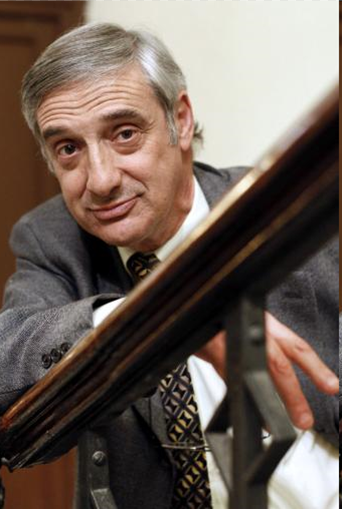

Sveriges Riksbank Prize in Economic Sciences · 2025
Joel Mokyr
Economic historian who showed how science and skilled hands, working together, turned short bursts of invention into lasting prosperity.
The Nobel citation: “for having identified the prerequisites for sustained growth through technological progress”
- Born
- July 26, 1946, Leiden, the Netherlands
- Shared with
- Philippe Aghion, Peter Howitt
- Affiliation at the time
- Northwestern University, USA; Eitan Berglas School of Economics, Tel Aviv University, Israel
Economics prize
2025
Shared with 2 other laureates.
Age that year
79years
Born in 1946.
Sources cited
20
Fact-checked September 24, 2026.
- He was born in Leiden in 1946 to Dutch Jewish parents who had survived the Theresienstadt ghetto. His father died when he was one.
- At nine he moved to Israel with his mother and sister, grew up in Haifa and served in the Israeli army before studying at the Hebrew University.
- He joked to colleagues that, Jewish as he is, he was more likely to be elected pope than to win a Nobel Prize.
- A study he co-wrote tracked 759 British inventors and 'tweakers' born before 1830 and found that 40 percent of them never took out a patent.
- He has taught at Northwestern University since 1974 and has supervised more than 65 PhDs in economics and history.
The breakthrough
Why growth stopped stalling: the feedback loop between 'why' and 'how'
For most of history, good inventions came and went. Windmills, the printing press and mechanical clocks all made life better, yet living standards barely changed from one generation to the next, and every burst of progress eventually fizzled out. Then, starting in Britain around 1800, growth kept going and never stopped. Joel Mokyr set out to explain why. Working from historical sources, he split useful knowledge into two kinds. 'Prescriptive' knowledge is the how-to: recipes, instructions and blueprints. 'Propositional' knowledge is the why: the regularities of nature that explain why a technique works. Before the Industrial Revolution, craftspeople mostly knew that something worked but not why, so it was hard to improve on it, and inventors wasted effort on dead ends such as perpetual-motion machines or turning metals into gold. In what Mokyr called the 'Industrial Enlightenment', scientists and skilled tinkerers began feeding each other ideas: understanding air pressure and vacuums helped improve the steam engine, and new machines raised new scientific questions. Think of two climbers roped together, each pulling the other higher. Mokyr added two more ingredients: enough skilled mechanics to turn ideas into working machines, and a society open enough to let the new replace the old, even when powerful groups fought back.[2],[3],[4]
“History exemplifies how in the past ingenuity has solved the technical challenges of society, from smallpox vaccination to nitrogen fixing to cancer therapy.”
What it meant for humanity
Mokyr did not invent a medicine or a machine. His contribution is an explanation of how the modern world became rich, and of why that wealth cannot be taken for granted. The Nobel committee credits two centuries of sustained growth with pulling huge numbers of people out of poverty. Growth of close to two percent a year, which many industrial countries have kept up since the early 1800s, is enough to double a person's income over a working life. Mokyr often points to life expectancy as the clearest sign of what growth has achieved: worldwide, it has more than doubled since 1900, from 32 years to about 71 in 2021. His work gives governments a checklist for keeping that engine running: fund science, keep scientists in touch with the people who build things, train a deep pool of skilled technicians, and protect the free flow of ideas across borders. It also warns that progress creates losers, and that established interests have repeatedly tried to smother new technology, from a German city council attacking the inventor of an improved lathe in 1561 to the Luddite machine-breaking riots in England. The Nobel committee drew on this work to warn that limits on academic freedom and knowledge walled off by region threaten future growth, and to suggest that artificial intelligence could speed up the loop between science and invention. As a teacher, Mokyr has supervised more than 65 doctoral students over five decades at Northwestern, and his students now train students of their own.
- Identified the feedback loop between scientific 'why' knowledge and practical 'how' knowledge as the engine that turned one-off inventions into growth that sustains itself.[3],[4]
- Coined the term 'Industrial Enlightenment' for the social changes that linked scientists with artisans, mechanics and farmers in 18th-century Europe.[4]
- In a study with a co-author, built a database of 759 British inventors and 'tweakers' born before 1830 and found that more than half published in, or belonged to, scientific or technical societies.[4],[19]
- Documented how guilds, city councils and rioting workers have resisted new technology throughout history, making a society's openness to change a precondition for growth.[3],[4]
- Points to life expectancy, which has more than doubled worldwide since 1900, as the clearest measure of what sustained growth has done for ordinary people, not just the rich.[8],[20]
- Supervised more than 65 PhDs in economics and history, many of whom now teach at leading universities.[5],[9]
Impact in numbers
Mokyr's contribution is an explanation, not a technology, so this profile attaches no numbers to it. Sustained economic growth since about 1800 has transformed human life, but it was produced by millions of scientists, engineers, workers and institutions; crediting a share of it to the historian who explained it would be false precision. His influence runs through ideas: the distinction between knowing how and knowing why, the 'Industrial Enlightenment', the importance of skilled tinkerers, and the case that growth depends on open societies willing to tolerate disruption. These ideas shape how economists and policymakers think about science funding, technical training, academic freedom and the free movement of knowledge. They also informed the Nobel committee's warning that for most of human history economies stood still rather than grew, and that the machinery of progress needs protecting.
EconomyTechnologyEducation
No number is given here on purpose. Some contributions cannot be counted honestly, and we would rather describe them than invent a figure.
The double edge
No harms flow directly from Mokyr's historical research, but his account has critics. Some scholars argue that it leans too heavily on culture and on a handful of exceptional thinkers, gives too little weight to institutions and rivalry between states, and says little about the position of women. A rival account by Robert Allen holds that high wages and scarce labor, rather than science, drove early British invention; one leading reviewer judged the two explanations complementary rather than competing. Mokyr is openly optimistic about technology, but he has acknowledged that the creative destruction he studies can wipe out jobs, widen the gap between rich and poor and harm the environment. The Nobel committee likewise stressed that sustained growth is not the same as sustainable growth.
- Minor
Scholarly critiques of a culture-centered explanation
Reviewers have praised A Culture of Growth while arguing that it leans too hard on a small number of exceptional individuals, underplays institutions and rivalry between states, and says little about differences in the position of women. Allen's rival wage-based account is still debated, though a leading review saw the two as complementary.[4],[15],[16]
- Minor
The costs of the growth he explains
The innovation-driven growth Mokyr studies has also brought pollution, climate change, dangerous products and job losses. In his Nobel banquet speech he conceded that critics of growth have a point, and he has warned that if institutions get worse while technology gets better, the results can be devastating.[3],[6],[10]
Against the odds
Mokyr was born in 1946 into a Dutch Jewish community that had just been largely destroyed. Under German occupation, Jews in the Netherlands were registered, forced to wear the yellow star and deported; of about 107,000 sent east, mostly to Auschwitz and Sobibor, only about 5,200 survived, and fewer than a quarter of Dutch Jews lived through the war. His parents and his older brother, then a child, were held in Theresienstadt, a ghetto where more than three-quarters of the Jewish prisoners died there or after being deported onward. They came back, but his father died in 1948, when Joel was one. His mother, a Zionist who had concluded from the war that Israel was the only place a Jew could feel safe, took him and his sister to Israel in 1955. Mokyr, then nine, did not want to go and did not speak Hebrew. The young country was poor: food was rationed, the family ate meat about once a week, and they lived largely on his father's small pension. At home, the family never talked about the camp. He grew up in Haifa, did his military service and studied at the Hebrew University before leaving for Yale. In the United States he faced no comparable barriers, and he has spent more than 50 years at Northwestern.
—
Persecution
His parents and his older brother, then a child, were deported to the Theresienstadt ghetto during the Holocaust and survived; most Dutch Jews did not.[7],[13],[14]
1948
Other
His father died in 1948, when Mokyr was one, leaving his mother to head the family.[7]
1955
Poverty
After moving to Israel at nine without speaking Hebrew, he grew up amid rationing; the family ate meat about once a week and lived mainly on his late father's modest pension.[5],[7]
Jewish background
Mokyr was born in Leiden to Dutch Jewish parents, Salomon Mok and Gonda Jacobs, who had survived the Theresienstadt ghetto. His mother, an enthusiastic Zionist, moved the family to Israel in 1955, where he grew up in Haifa, served in the army and studied at the Hebrew University. He holds American and Israeli citizenship, teaches at Tel Aviv University as well as Northwestern, and has said he feels more at home in Tel Aviv than in the Netherlands. He jokes openly about being Jewish, and he has voiced concern that Israel could drift toward theocracy.[5],[7],[9],[12],[18]
Key dates
July 26, 1946
Born in Leiden, the Netherlands, to Jewish parents who had survived Theresienstadt.[1],[7]
1948
His father dies when Joel is one year old.[7]
1955
Emigrates from Utrecht to Israel at nine with his mother and sister, and grows up in Haifa.[5],[7]
1968
After Israeli military service, earns a BA in economics and history from the Hebrew University of Jerusalem.[5],[12]
1974
Completes his PhD in economics at Yale and joins Northwestern University, where he has stayed ever since.[8],[12]
1983
Publishes Why Ireland Starved, a quantitative study of Irish poverty from 1800 to 1851, the years leading up to and including the Great Famine.[12]
1990
Publishes The Lever of Riches, a history of technological creativity and economic progress.[4],[12]
2002
Publishes The Gifts of Athena, setting out propositional and prescriptive knowledge and the 'Industrial Enlightenment'.[4],[12]
2006
Receives the Heineken Prize for History from the Royal Netherlands Academy of Arts and Sciences.[12]
2015
2016
Publishes A Culture of Growth, on why a culture of progress took root in early modern Europe.[8],[12]
October 13, 2025
Awarded half of the Prize in Economic Sciences; the other half goes to Philippe Aghion and Peter Howitt.[2]
December 8, 2025
Delivers his Nobel lecture in Stockholm on whether technological progress can be sustained.[17]
2026
Named one of the Carnegie Corporation of New York's Great Immigrants.[11]
Sources
- 1.Joel Mokyr – Facts – 2025 · NobelPrize.org (Nobel Prize Outreach), 2025
- 2.Press release: The Prize in Economic Sciences 2025 · The Royal Swedish Academy of Sciences / NobelPrize.org, 2025
- 3.Popular science background: From stagnation to sustained growth · The Royal Swedish Academy of Sciences / NobelPrize.org, 2025
- 4.Scientific background to the Sveriges Riksbank Prize in Economic Sciences in Memory of Alfred Nobel 2025 · The Committee for the Prize in Economic Sciences, Royal Swedish Academy of Sciences, 2025
- 5.Joel Mokyr – Interview transcript, December 2025 · NobelPrize.org (Nobel Prize Outreach), 2025
- 6.Joel Mokyr's speech at the Nobel Prize banquet, 10 December 2025 · NobelPrize.org (Nobel Prize Outreach), 2025
- 7.Waarom ontstond juist in Europa de industriële revolutie? Met zijn antwoord won Joel Mokyr de Nobelprijs voor Economie · NRC, 2025
- 8.Joel Mokyr wins Nobel Prize in Economic Sciences · Northwestern Now, Northwestern University, 2025
- 9.Joel Mokyr wins Nobel Prize in economics · Northwestern Magazine, 2025
- 10.Northwestern's Joel Mokyr wins Nobel Prize in economics · Evanston RoundTable, 2025
- 11.Great Immigrants: Joel Mokyr · Carnegie Corporation of New York, 2026
- 12.Joel Mokyr, Curriculum Vitae (February 2024) · Department of Economics, Northwestern University, 2024
- 13.The Netherlands · United States Holocaust Memorial Museum, Holocaust Encyclopedia
- 14.Theresienstadt · United States Holocaust Memorial Museum, Holocaust Encyclopedia
- 15.Culture and institutions: a review of Joel Mokyr's A Culture of Growth (Geoffrey M. Hodgson) · Journal of Institutional Economics, Cambridge University Press, 2021
- 16.A Culture of Growth: The Origins of the Modern Economy, by Joel Mokyr (review by Victoria Bateman) · Times Higher Education, 2016
- 17.Joel Mokyr – Prize lecture: The Past and Future of Innovation: Can Progress be sustained? · NobelPrize.org (Nobel Prize Outreach), 2025
- 18.Joel Michael Mokyr, son of Salomon Mok and Gonda Maria Jacobs · Dutch Jewry Database (dutchjewry.org)
- 19.The Rate and Direction of Invention in the British Industrial Revolution: Incentives and Institutions (Ralf R. Meisenzahl and Joel Mokyr) · National Bureau of Economic Research / University of Chicago Press, in The Rate and Direction of Inventive Activity Revisited, 2012
- 20.Life Expectancy · Our World in Data, 2023
Fact-checked on September 24, 2026 by a separate AI fact-checking pass that re-opened the sources, with 8 corrections made. How we check
Suggest a correction