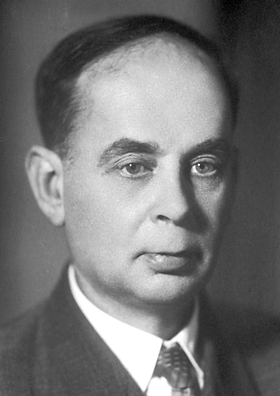

Nobel Prize in Physics · 1958
Il´ja M. Frank
He helped explain the blue glow made when particles outrun light in water, turning a faint curiosity into a tool for physics and medicine.
The Nobel citation: “for the discovery and the interpretation of the Cherenkov effect”
- Born
- October 23, 1908, Leningrad (now St. Petersburg), Russia
- Died
- June 22, 1990, Moscow, USSR (now Russia)
- Shared with
- Pavel A. Cherenkov, Igor Y. Tamm
- Affiliation at the time
- Lomonosov Moscow State University, Russia; P.N. Lebedev Physical Institute, Russia
Physics prize
1958
Shared with 2 other laureates.
Age that year
50years
Born in 1908.
Headline credited impact
552–918lives saved
Air-pollution deaths prevented by nuclear power replacing fossil fuels. How it was built
Sources cited
27
Fact-checked September 24, 2026.
- With Igor Tamm he explained in 1937 why fast electrons make water glow blue: they outrun light, which in water travels at only about 75% of its speed in a vacuum.
- On a 1930s cosmic-ray expedition to Mount Elbrus, his son writes, he and his future co-laureate Pavel Cherenkov climbed both of its summits in a single day.
- He founded the neutron physics laboratory at Dubna's Joint Institute for Nuclear Research in 1957 and led it until 1988. It now bears his name.
- In 1973 he signed an Academy letter condemning Andrei Sakharov. After Sakharov died he publicly asked forgiveness, one of only two signers reported to have apologized.
- In Stockholm in 1958, he recalled, photographers took the three Soviet laureates to the zoo to shoot them in front of polar bears, as if bears were part of Russian life.
The breakthrough
Explaining the Cherenkov glow: light from particles that outrun light
Others had seen that pure water and other clear liquids give off a faint blue light when struck by gamma rays from radium, and assumed it was fluorescence. In 1934 Pavel Cherenkov, a graduate student of Sergei Vavilov, showed it was not: it hardly depended on what the liquid was made of, and experiments showed that it came from fast electrons knocked loose by the rays. Frank, who took part in the experiments, and the theorist Igor Tamm explained the glow in 1937. Nothing can beat the speed of light in empty space, but light slows down inside matter. In water it travels at only about three-quarters of its top speed, so a fast electron can move faster than light does in the same material. As the electron rushes through, it briefly disturbs the atoms along its path, and they give off tiny waves of light. Normally these cancel out. When the electron outpaces them, they pile up into a cone of blue light, much as a speedboat that outruns its own ripples leaves a V-shaped wake. The angle of the cone reveals how fast the particle is moving. Frank kept exploring the optics of moving light sources. With Vitaly Ginzburg he predicted in 1945 a related effect, transition radiation, which a charged particle gives off when it crosses the boundary between two materials. It was first observed at the end of the 1950s.[1],[3],[4],[5],[6],[9],[19]
“The weakness of the glow seemed to preclude any application of the phenomenon in physics, and so much the more in engineering.”
What it meant for humanity
At first the Cherenkov glow looked like a curiosity too faint to be useful, as Frank himself recalled. It became a standard tool of particle physics. Because the angle of the light cone reveals a particle's speed, Cherenkov counters could pick out particles by velocity, and they were crucial to the 1955 discovery of the antiproton. Today enormous detectors watch for the same glow. Japan's Super-Kamiokande, a tank of 50,000 tonnes of ultrapure water lined with more than 11,000 light sensors, recorded the Cherenkov flashes that showed neutrinos change identity, work honored with the 2015 Nobel Prize in Physics. IceCube, at the South Pole, uses 5,160 sensors spread through a cubic kilometer of Antarctic ice to catch the light from neutrino collisions. Transition radiation, which Frank predicted with Vitaly Ginzburg, has helped the ATLAS experiment at CERN's Large Hadron Collider tell electrons from other particles. The glow has also moved into hospitals and nuclear inspection. At one community hospital, cameras that record the Cherenkov light given off by patients' skin during radiotherapy monitored more than 1,700 treatments in their first year, catching patient movement and radiation reaching places it should not. Inspectors of the International Atomic Energy Agency use a Cherenkov viewing device to confirm, without moving anything, that spent nuclear fuel stored under water is present and intact. Frank's second career mattered too. His laboratory's measurements of neutrons in uranium-graphite lattices supported the first Soviet reactor in 1946, and the Dubna neutron laboratory he founded in 1957 became one of the world's largest centers of neutron research, with work ranging from nuclear physics to the study of materials.
- Cherenkov counters, which measure a particle's speed from the angle of its light cone, played a decisive part in the 1955 discovery of the antiproton, according to the 1958 Nobel presentation speech.[3]
- Giant Cherenkov detectors catch neutrinos: Super-Kamiokande's 50,000 tonnes of water revealed that neutrinos change identity (2015 Nobel Prize), and IceCube watches a cubic kilometer of Antarctic ice.[19],[20]
- Transition radiation, predicted by Ginzburg and Frank, has let the 300,000 straw tubes of CERN's ATLAS detector tell electrons from pions.[4],[21]
- Cherenkov imaging during radiotherapy, which shows the beam on a patient's skin, monitored over 1,700 treatments in its first year at a community hospital and flagged problems such as patient movement and stray dose.[23]
- IAEA safeguards inspectors use the Digital Cerenkov Viewing Device to verify spent nuclear fuel in storage ponds in seconds, without moving the fuel, and have checked entire ponds of thousands of assemblies.[22]
- The Laboratory of Neutron Physics he founded at Dubna in 1957, built around pulsed reactors he helped create, became one of the world's largest centers of neutron research.[5],[6],[7]
Impact in numbers
Most of Frank's legacy is scientific and cannot honestly be counted: the theory that turned a faint glow into Cherenkov detectors, which helped find the antiproton and now catch neutrinos in Japan and Antarctica; transition radiation, used to identify particles at CERN; and a Dubna neutron laboratory where he founded schools of neutron physics. Newer uses in radiotherapy and nuclear safeguards are real but too young or too diffuse to quantify. We record one small, low-confidence ripple claim. His laboratory's reactor-physics measurements for the first Soviet reactor are an early link in the chain behind Soviet-designed nuclear power, so we credit him 0.03% of the air-pollution deaths that world nuclear power is estimated to have prevented, the same whole-outcome range used for Bohr and Moissan. We record no numeric harm claim. The Soviet bombs his laboratory's measurements supported were never used in war, and no reliable casualty count exists for the Semipalatinsk tests; those harms are described in words above.
Fundamental scienceTechnologyHealthEnergy
Each number is the laureate’s credited share of a real-world outcome, cumulative to 2025. The whole outcome, the share of credit, and the reasoning are shown so you can check the arithmetic. Outcomes shared with other laureates are counted once on the impact page.
- Low confidenceRippleModeledEnergy
Air-pollution deaths prevented by nuclear power replacing fossil fuels
552–918
lives saved, credited share
That is 0.03% of 1.8–3.1 million lives saved since 1971.
How this number was built
Same whole-outcome range as the Bohr and Moissan profiles. Kharecha and Hansen (2013) calculate that world nuclear power prevented an average of 1.84 million net deaths in 1971-2009 (low), about 76,000 a year in 2000-2009; extending that rate over 2010-2025 adds 16 x 76,000 = 1.22 million, so high = 3.06 million. Share 0.0003: from 1946 Frank's laboratory made precision measurements of neutrons in uranium-graphite lattices in close contact with Igor Kurchatov, took part in launching F-1, the first Soviet reactor, and developed a pulsed method for studying neutron diffusion. But this fed mainly the Soviet line of reactors, a minority of world output; other groups often measured the same constants independently; and fission physics and reactor engineering carry nearly all the credit. It is set well below Moissan's 0.002. Credited: about 550-920 lives.[5],[6],[8],[9],[26],[27]
Sources: Joint Institute for Nuclear Research (JINR), Dubna; Frank Laboratory of Neutron Physics, JINR; P. N. Lebedev Physical Institute (FIAN) and Joint Institute for Nuclear Research; Istoriya Rosatoma (Rosatom history portal); NASA Goddard Institute for Space Studies (archived copy); PubMed (US National Library of Medicine)
The double edge
Frank's science also served Soviet nuclear weapons. From 1946 his Laboratory of the Atomic Nucleus at the Lebedev Institute studied reactor physics and nuclear reactions of the lightest nuclei, much of it under a special government project and in close contact with the physicist Igor Kurchatov. A January 1949 letter from Yulii Khariton and Kurchatov proposed assigning his group experiments within the hydrogen-bomb effort, and a biographical album published by his two institutes says the laboratory contributed greatly to both the atomic and the hydrogen bomb. He won a 1953 Stalin Prize for nuclear-physics research linked to RDS-6s, the first Soviet thermonuclear device, exploded at the Semipalatinsk test site in Kazakhstan on 12 August 1953. That site hosted 456 nuclear explosions, and officials estimate that about one million people lived in its zone of radiation impact. Our sources describe his laboratory's role as experiments and supporting theory on neutrons and nuclear reactions, not the design of the weapons. Separately, in 1973 he signed a letter by academicians condemning Andrei Sakharov, the physicist turned human-rights campaigner. He later regretted giving in to pressure and, after Sakharov's death, publicly accepted a share of the blame and asked forgiveness.
- Major
Measurements for the Soviet atomic and hydrogen bomb programs
His laboratory measured neutron behavior in uranium-graphite lattices and studied how fast neutrons interact with tritium, lithium and uranium nuclei, mostly under a special government project. A 1949 Khariton-Kurchatov letter proposed assigning his group experiments for the hydrogen-bomb effort, and he won a 1953 Stalin Prize for research linked to the RDS-6s thermonuclear device.[5],[6],[8],[9],[18]
- Moderate
Fallout from Soviet nuclear testing
RDS-6s was exploded at the Semipalatinsk test site in Kazakhstan on 12 August 1953. The site hosted 456 nuclear explosions over 40 years, and officials estimate about one million people lived in its zone of radiation impact. Frank's laboratory supplied nuclear data and studies, not weapon designs.[24],[25]
- Moderate
Signing the 1973 letter against Sakharov
In August 1973 Frank was among 40 members of the USSR Academy of Sciences whose letter in the Soviet press attacked Andrei Sakharov's statements and activity. He later regretted giving in to pressure from the Academy's leadership and, after Sakharov's death, publicly asked his forgiveness.[16],[17],[18]
Against the odds
Frank grew up in a family shaped by the Russian Empire's anti-Jewish laws. His father, Mikhail, was born in Moscow in 1878 into a Jewish family and was raised partly by his grandfather, a tea trader named among those who pushed for Moscow's first synagogue. Religious labels carried legal weight in tsarist Russia, and in 1902 Mikhail was baptized into the Orthodox Church so that he could marry Elizaveta Gratsianova, a Russian Orthodox woman. His brother, the philosopher Semyon Frank, missed out on a teaching post in 1902 because of his religion and joined the St Petersburg University faculty only in 1912, the year he converted. After the pogroms of 1881-82, new quotas limited Jews' access to higher education and the professions, and some Jews converted to get ahead. Ilya, born in 1908 and raised in his mother's faith, faced no documented antisemitic barriers himself. His hardships were those of his generation: revolution and civil war, which stranded the family in Crimea, where many students at his father's university went hungry; student years with no fixed home; and wartime evacuation to Kazan, where his father died of tuberculosis in 1942 after a winter of cold and hunger. In the late 1940s and early 1950s the campaign against 'rootless cosmopolitans' and the Doctors' Plot targeted Jewish intellectuals; our sources show no sign that Frank himself was singled out. In 1948 the Moscow Jewish cemetery where his grandmother lay was destroyed, and housing was later built on the site.
1902
Discrimination
His father, from a Moscow Jewish family, was baptized Russian Orthodox in 1902 in order to marry Frank's mother. The same year his uncle Semyon lost a planned teaching post because of his religion; he received a university post only in 1912, the year he converted. After the 1880s, tsarist quotas led some Jews seeking careers to convert.[11],[13]
1922
Exile
His uncle, the philosopher Semyon Frank, was expelled from Soviet Russia in 1922 on one of the so-called philosophers' ships, along with other leading intellectuals. He never returned, and the brothers met again only on Mikhail's rare trips abroad.[8],[11]
—
Poverty
Revolution and civil war kept the family in Crimea, where many students at his father's university went hungry. As a young student Frank had no permanent home, at times sleeping on a couch in a dentist's office or on a reading-room table in a children's library.[8],[17]
1941
War
In 1941 the family was evacuated to Kazan. His son was born there that August; food was scarce, and the winter that followed was bitterly cold. His father, weakened by cold and hunger, died of tuberculosis in 1942.[8],[11],[12]
1949
Discrimination
In 1949 the press campaign against 'rootless cosmopolitans' named mostly Jews (over 70% of those attacked in February-March), and the Doctors' Plot of 1953 was the peak of Stalin's late antisemitic campaign. Frank, of Jewish descent and inside the atomic project, is not known to have been targeted.[14],[15]
Jewish background
His father, the mathematician Mikhail Frank, was born in Moscow in 1878 into a Jewish family and was raised partly by his grandfather, a tea trader named among those who pushed for Moscow's first synagogue; the Encyclopaedia Judaica describes Ilya's father as Jewish. In 1902 Mikhail was baptized Russian Orthodox to marry Elizaveta Gratsianova, whose mother came from a family of Orthodox clergy. Ilya was raised in his mother's faith. He lost it as a young man. One witness, cited by Russian Wikipedia, reports that shortly before his death he said he had been an agnostic all his adult life and had become an Orthodox believer. No source shows him identifying as Jewish.[8],[10],[11],[12],[17],[18]
Key dates
October 23, 1908
Born in St Petersburg, the younger son of the mathematician Mikhail Frank and the physician Elizaveta Gratsianova.[1],[2]
1930
Graduates from Moscow State University as a student of Sergei Vavilov; the next year he joins the State Optical Institute in Leningrad.[2],[8]
1934
Joins the Lebedev Physical Institute of the USSR Academy of Sciences and, at Vavilov's suggestion, switches from optics to nuclear physics.[2],[5],[9]
1937
With Igor Tamm, publishes the theory of the Cherenkov glow; the same year he marries the historian Ella Beilikhis.[1],[2],[4]
1945
With Vitaly Ginzburg, predicts transition radiation, emitted when a charged particle crosses the boundary between two materials.[4],[6]
1946
Heads the new Laboratory of the Atomic Nucleus, takes part in building F-1, the first Soviet reactor, and shares a Stalin Prize for the Cherenkov work.[5],[6],[8]
1953
Wins a Stalin Prize for reactor physics and light-nuclei research linked to RDS-6s, the first Soviet thermonuclear device.[5],[8],[9]
1957
Founds and becomes director of the Laboratory of Neutron Physics at the Joint Institute for Nuclear Research in Dubna.[2],[6],[7]
December 10, 1958
Shares the Nobel Prize in Physics with Pavel Cherenkov and Igor Tamm for the discovery and interpretation of the Cherenkov effect.[1],[3]
1960
His laboratory launches IBR, a pulsed reactor for neutron research, followed by IBR-30 in 1969.[5],[7]
1973
Signs a letter by 40 academicians condemning Andrei Sakharov.[16]
1978
The IBR-2 pulsed reactor, built under his leadership, reaches physical start-up at Dubna; it is fully launched in 1984.[6],[7],[9]
January 1990
After Sakharov's death, publicly accepts his share of blame for the Academy's attacks and asks forgiveness.[17],[18]
June 22, 1990
Sources
- 1.Il´ja M. Frank - Facts · NobelPrize.org (Nobel Prize Outreach)
- 2.Il´ja M. Frank - Biographical · NobelPrize.org (from Nobel Lectures, Physics 1942-1962, Elsevier, 1964), 1964
- 3.The Nobel Prize in Physics 1958 - Award ceremony speech by Professor K. Siegbahn · NobelPrize.org, 1958
- 4.Optics of Light Sources Moving in Refractive Media, Nobel Lecture by I. M. Frank, 11 December 1958 (PDF) · NobelPrize.org (from Nobel Lectures, Physics 1942-1962, Elsevier, 1964), 1958
- 5.Ilya Mikhailovich Frank: first FLNP JINR director, laureate of Nobel Prize · Joint Institute for Nuclear Research (JINR), Dubna, 2023
- 6.I.M. Frank (biography and chronology) · Frank Laboratory of Neutron Physics, JINR
- 7.FLNP History · Frank Laboratory of Neutron Physics, JINR
- 8.Ilia Mikhailovich Frank: To the 110th Anniversary (bilingual book-album), compiled by V. M. Berezanskaya, M. A. Lukichev and N. M. Shaulskaya · P. N. Lebedev Physical Institute (FIAN) and Joint Institute for Nuclear Research, 2018
- 9.Frank Ilya Mikhailovich, 1908-1990 (biography, in Russian) · Istoriya Rosatoma (Rosatom history portal)
- 10.Frank, Ilya Mikhailovich, by Michael Denman · Encyclopaedia Judaica, 2nd ed. (via Encyclopedia.com), 2007
- 11.Winding lines of life in the topological space of history (materials for the biographies of Mikhail Ludvigovich Frank and Semyon Ludvigovich Frank), by G. E. Alyaev (in Russian) · Istoriya. Nauchnoe obozrenie OSTKRAFT, no. 5-6 (2020); PDF hosted by the V. I. Vernadsky Crimean Federal University museum, 2020
- 12.Frank Mikhail Ludvigovich (1878-1942) (in Russian) · Biografika SPbGU, St Petersburg State University
- 13.Conversion, by Magda Teter · YIVO Encyclopedia of Jews in Eastern Europe
- 14.Anticosmopolitan Campaign, by Yaacov Ro'i · YIVO Encyclopedia of Jews in Eastern Europe
- 15.Doctors' Plot, by Jonathan Brent · YIVO Encyclopedia of Jews in Eastern Europe
- 16.Materials about Sakharov (A Chronicle of Current Events, no. 30, 31 December 1973) · A Chronicle of Current Events (English translation archive), 1973
- 17.Sovetskii Frank (Soviet Frank), by Elena Gorovits (in Russian) · Jewish.ru, 2022
- 18.Frank, Ilya Mikhailovich (in Russian) · Russian Wikipedia
- 19.Popular information: The Nobel Prize in Physics 2015 (neutrino oscillations) · NobelPrize.org (Royal Swedish Academy of Sciences), 2015
- 20.IceCube Neutrino Observatory (detector description) · IceCube Neutrino Observatory, University of Wisconsin-Madison
- 21.Inner Detector (ATLAS Transition Radiation Tracker) · ATLAS Experiment, CERN
- 22.The International Atomic Energy Agency's Experience Verifying Spent Fuel Using the Digital Cerenkov Viewing Device, by C. Orton et al. · INMM Annual Meeting Proceedings (Institute of Nuclear Materials Management), 2017
- 23.Cherenkov imaging for visualizing radiotherapy: one year of clinical use, by Tami Freeman · Physics World (IOP Publishing), 2022
- 24.Soviet Hydrogen Bomb Program · Atomic Heritage Foundation / National Museum of Nuclear Science & History
- 25.UN News special report: 'Ground Zero' at the former Semipalatinsk nuclear test site in Kazakhstan · UN News (United Nations), 2019
- 26.Coal and Gas are Far More Harmful than Nuclear Power, by Pushker Kharecha and James Hansen (Science Brief, April 2013) · NASA Goddard Institute for Space Studies (archived copy), 2013
- 27.Prevented mortality and greenhouse gas emissions from historical and projected nuclear power, by P. A. Kharecha and J. E. Hansen (Environ. Sci. Technol. 47, 4889-4895) · PubMed (US National Library of Medicine), 2013
Fact-checked on September 24, 2026 by a separate AI fact-checking pass that re-opened the sources, with 6 corrections made. How we check
Suggest a correction