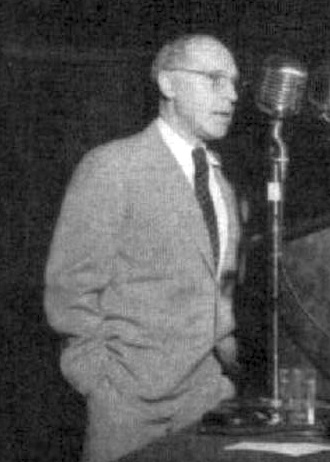

Nobel Prize in Physiology or Medicine · 1946
Hermann J. Muller
He proved that X-rays can change genes, giving science mutations on demand, then warned the world to protect its genes from radiation.
The Nobel citation: “for the discovery of the production of mutations by means of X-ray irradiation”
- Born
- December 21, 1890, New York, NY, USA
- Died
- April 5, 1967, Indianapolis, IN, USA
- Affiliation at the time
- Indiana University, USA
Disputed inclusion. Sources disagree on whether this laureate meets our standard of at least one Jewish parent. The evidence is set out under Jewish background below. We count this laureate by default, and the methodology page shows how the results change without disputed cases.
Medicine prize
1946
Awarded alone.
Age that year
56years
Born in 1890.
Headline credited impact
$4.3–5.5billion in economic value
Producer benefits from eradicating screwworm with radiation-sterilized flies (US, Mexico, Central America). How it was built
Sources cited
27
Fact-checked September 24, 2026.
- His X-ray experiments made fruit flies mutate about 150 times more often than normal, giving scientists a way to create mutations on demand.
- He went to Columbia on a scholarship and spent summers as a bank runner and hotel clerk; the clerk job paid $25 a month plus board for 14-hour days.
- In December 1936 he called Soviet agronomist Trofim Lysenko a fraud at a Moscow meeting of about 3,000 people, then left the USSR by volunteering in Spain's civil war.
- A 1950 letter from Muller encouraged US entomologists to sterilize screwworms with radiation, a key step toward the sterile-fly method that kept the pest out of the US for decades.
- He was one of 11 signers of the 1955 Russell-Einstein Manifesto against nuclear war, alongside Albert Einstein and Bertrand Russell.
The breakthrough
X-rays cause mutations: the founding of radiation genetics (1926-1927)
Genes usually copy themselves faithfully, but now and then one changes. These changes, called mutations, are the raw material of evolution, yet in the 1920s they were so rare that scientists could barely study them. Muller wanted to know whether anything could make them happen faster. First he built a way to count them. He bred a special strain of fruit fly, called ClB, whose X chromosome carried markers that revealed whether a father's chromosome had picked up a lethal mutation: if it had, a whole class of grandsons never appeared. Counting missing grandsons turned a hit-or-miss search into a precise measurement. In late 1926 he exposed male flies to X-rays and bred them with ClB females. Mutations turned up about 150 times more often than in untreated flies, and bigger doses caused more of them. Many of the new mutations matched ones that had appeared naturally in fly labs over the previous 15 years. Picture a typist copying a long book: normally a typo slips in every few thousand pages, but shake the desk and the typos pile up in step with the shaking. Muller announced the result in the journal Science in 1927. It showed that genes are physical things that can be damaged and gave every genetics lab a way to make mutations on demand. It also meant that radiation could harm human genes, a danger Muller spent the rest of his life warning about.[1],[3],[4],[5],[7],[25]
“They leave, we believe, no escape from the conclusion that there is no threshold dose”
What it meant for humanity
Muller's discovery changed biology first. Before 1927 geneticists had to wait for rare natural mutations; afterwards any laboratory could produce them in bulk, in almost any living thing, and use them to map genes and learn what genes do. The Nobel presentation speech called it one of the foundation stones of modern biology. It also reached farms. Plant breeders adopted radiation, and later chemicals, to create useful new traits. The FAO/IAEA Mutant Variety Database lists more than 3,300 mutant plant varieties, about 70 percent of them made with gamma rays or X-rays. They include fragrant rice grown across northeastern Thailand, short-stemmed barley that had a major impact on Europe's brewing industry, durum wheat that covered a third of Italy's durum fields, and the Rio Red grapefruit of Texas. Radiation also became a pest-control tool. After reading Muller's 1950 article on sterilizing flies with radiation, US entomologists wrote to him, and he encouraged them. Their sterile insect technique, which floods an area with sterile male flies, eradicated the flesh-eating New World screwworm from the United States, Mexico and Central America, sparing livestock, wildlife and people, until a resurgence that began in Panama in 2023 spread north through Central America and Mexico and, in June 2026, into Texas. Muller also used his fame to protect people from radiation. He told radiologists to shield patients' reproductive organs, pressed for lower doses in medicine and industry, warned that escalating nuclear tests endangered everyone, and signed the 1955 Russell-Einstein Manifesto against nuclear war. His biographer judges that he helped rein in the most serious misuse of radiation in medicine and industry. In Edinburgh he steered his student Charlotte Auerbach toward chemical causes of mutation, which led her, with pharmacologist John Robson, to show that mustard gas damages genes, the first strong chemical mutagen found.
- By 2021 the IAEA Mutant Variety Database listed 3,365 plant varieties bred from induced mutations; about 70% were made with gamma rays or X-rays, the kind of radiation Muller first showed could change genes.[5],[9],[10]
- Two Thai rice varieties bred from gamma-irradiated seed, RD6 and RD15, came to cover about 80% of rice fields in northeastern Thailand; their 1989-98 harvest was worth about $16.9 billion as milled rice.[9]
- Muller's 10 March 1950 letter encouraged USDA entomologist Edward Knipling to try radiation on screwworm flies. Sterile-fly releases later kept the US, Mexico and Central America free of the pest for decades, worth about $1.3 billion a year to producers.[11],[12],[14],[15]
- In his Nobel lecture he urged radiologists to shield the reproductive organs of anyone exposed to radiation, and he campaigned for radiation safety in medicine and industry for the rest of his life.[3],[5],[6]
- He was one of 11 signers of the 1955 Russell-Einstein Manifesto, which warned that a nuclear war could wipe out the human race and called on governments to resolve their disputes without war.[17]
Impact in numbers
Muller's most important legacy resists counting. X-ray mutagenesis gave genetics its first way to make mutations at will, and much of mid-century genetics was built with it. With Lewis Stadler's independent work on barley and maize, it also founded mutation breeding. More than 3,300 mutant plant varieties are registered, but no reliable global estimate of their area or value exists, and radiation breeding also depended on Stadler, Ake Gustafsson in Sweden and thousands of breeders, so we make no numeric claim for it. Nor do we count his radiation-safety campaigns: the shielding and lower doses he pressed for surely prevented harm, but no study measures how much, and critics argue that the no-threshold model he championed also imposed costs. We record one conservative ripple claim: the eradication of the New World screwworm with radiation-sterilized flies, a method his 1950 article and letter helped launch. We credit him with 5 percent of the producer benefits documented by FAO and USDA.
Fundamental scienceFoodEconomyHealthPeace
Each number is the laureate’s credited share of a real-world outcome, cumulative to 2025. The whole outcome, the share of credit, and the reasoning are shown so you can check the arithmetic. Outcomes shared with other laureates are counted once on the impact page.
- Medium confidenceRippleModeledFood
Producer benefits from eradicating screwworm with radiation-sterilized flies (US, Mexico, Central America)
$4.3–5.5
billion in economic value, credited share
That is 5% of $86–109 billion in economic value since 1967.
How this number was built
Annual producer benefits: US $796M, Mexico $292M, Central America $77.9M (Wyss, via FAO/IAEA 2005). USDA APHIS (2025) dates the US $796M to 1996, not inflation-adjusted, so x2.0 (BLS CPI) = $1.59B, $0.58B, $0.16B in 2024 dollars; FAO's 896/329/88 set is the same in ~2001 dollars. APHIS puts mid-1970s US benefits, with Mexican outbreaks still recurring, at $200M/yr = $1.17B. Low: US 1967-82 less outbreak years 1972 and 1976 (14 yr) + 1983-2025 (43 yr), all at $1.17B = $66.5B; Mexico 1992-2023 $18.7B; C. America 2001-22 $3.4B; less ~$1.3B program cost x2.0 = ~$86B. High: US 1967-82 at $1.17B ($18.7B) + 1983-2025 at $1.59B ($68.4B); Mexico to 2024 $19.3B; C. America 1995-2023 $4.5B; less $1.3B x1.61 = ~$109B. Mexico's late-2024 reinfestation ends it. Share 0.05: Muller showed radiation sterilizes sperm and urged Knipling to try it; Knipling, Bushland and a 45-year program did the rest.[11],[12],[13],[14],[15],[16],[24],[26],[27]
Sources: FAO/IAEA (Springer); USDA APHIS Veterinary Services; US Bureau of Labor Statistics; US Department of Agriculture, National Agricultural Library; US Department of Agriculture, National Agricultural Library; Food and Agriculture Organization of the United Nations; Congressional Research Service; The Texas Tribune; The Texas Tribune
The double edge
Muller's record has three shadows. The first is eugenics. He attacked the racist, class-based eugenics of his day, but all his life he promoted a 'positive' eugenics, from a 1936 appeal to Stalin to a later campaign for sperm banks stocked by chosen donors, ideas many critics saw as a revival of the discredited movement. The second is the no-threshold claim in his Nobel lecture. Toxicologist Edward Calabrese argues that Muller knew of a not-yet-published study that cut against it, calls the statement deceptive, and says Muller's authority helped make the linear no-threshold model the basis of radiation and chemical risk assessment. Critics of Calabrese, such as John Beyea, reply that the evidence of the time strongly supported a linear model and that regulators would probably have adopted it anyway. The third is political judgment. In the early 1930s he admired the Soviet Union and secretly helped edit a left-wing student paper in breach of university rules; after the war he supported building atomic and hydrogen bombs and argued that fallout deaths from testing were a price to accept for military preparedness, until bombs grew far larger.
- Moderate
A lifelong advocate of 'positive' eugenics
Muller denounced American and Nazi eugenics as racist and elitist, yet promoted breeding for intelligence and health. In 1936 he sent his book Out of the Night to Stalin with a long letter urging a Soviet eugenics program. From the late 1950s he urged 'germinal choice', freezing sperm of gifted, healthy men for later use. He rejected coercion and late in life would not endorse a planned California sperm bank built on old-line eugenics, but many critics saw a revival of the discredited movement.[5],[6],[7]
- Moderate
The disputed no-threshold claim
Calabrese has argued since 2011 that Muller had read a manuscript by Ernst Caspari and Curt Stern that challenged linearity, yet told his Nobel audience there was no threshold; he calls this deceptive and says it helped shift cancer and mutation risk assessment to a linear model. In a wider debate with Calabrese, John Beyea argues that the 1950s evidence clearly favored a linear model for genetic damage and that US radiation protection would likely have used it regardless.[3],[18],[19],[20],[23]
- Minor
Political misjudgments
In the early 1930s he saw the Soviet Union as a promising society and anonymously helped edit The Spark, a student paper, breaking University of Texas rules. His biographer calls both errors. After the war he backed developing atomic and hydrogen bombs and treated the cancer and genetic deaths expected from test fallout as a price of military preparedness, supporting a ban on atmospheric testing only once bombs reached very large yields.[5],[6]
Against the odds
Muller did not face the legal persecution that Jewish scientists endured in Europe, and no source we found says antisemitism blocked his career. His Jewish ancestry came through his mother and was partial, and he was raised Unitarian. Still, he knew the prejudice of his era: his biographer says he sometimes invoked his Jewish roots to stand with Jewish colleagues facing antisemitism in the United States and Germany, and when war came he worried about staying in Britain partly because he and his wife were both part Jewish. His own obstacles were poverty and politics. His father died in 1900, and at Columbia he took odd jobs, including summer work with 14-hour days, to help support his mother and sister. His left-wing activism drew FBI scrutiny in Texas and cost him his post there. In Berlin in 1933, Nazi storm troopers raided his institute. In Stalin's Soviet Union, where he had gone to build a genetics laboratory, two of his collaborators were executed and his patron Nikolai Vavilov died in prison; Muller, who had publicly called Lysenko a fraud, barely escaped, leaving by way of the Spanish Civil War. Back home he spent years without a permanent post, was called before the House Un-American Activities Committee in 1953, and in 1955 was barred as a US delegate to the Atoms for Peace conference in Geneva.
1900
Poverty
His father died in 1900, leaving the family with limited means. Muller reached Columbia on a scholarship; in college and graduate school he worked as a bank runner, hotel clerk and night-school English teacher to help support his mother and sister.[2],[5]
1933
Persecution
In 1933 Nazi storm troopers hunting for communists raided the Berlin institute where he worked and manhandled staff members. Muller got away through a side door and soon left Germany for the Soviet Union.[5],[6]
1936
Dismissal
Because he had secretly helped edit the left-wing student paper The Spark, the University of Texas told him he could return only after a trial before the faculty senate. He resigned.[5],[6]
1937
Persecution
After he denounced Lysenko in Moscow as Stalin's purges spread, Muller left the USSR by volunteering in the Spanish Civil War. His collaborators Solomon Levit and Isador Agol were executed, and his patron Nikolai Vavilov died in prison.[5],[6],[8]
1940
War
With World War II under way, he returned to the United States, partly out of concern for his and his wife's safety because both were part Jewish.[7]
1953
Persecution
Distrusted as a former Soviet sympathizer, he was called before the House Un-American Activities Committee in March 1953. In that climate of fear he and his wife burned thousands of papers, including letters, to protect students and colleagues.[5],[6]
1955
Other
In 1955 Willard Libby, who suspected him of being a Soviet double agent, barred him as a US delegate to the Atoms for Peace conference in Geneva.[6]
Jewish background
Muller's father's family were Rhineland Catholics who became Unitarians; he was raised Unitarian, became an atheist and later led the American Humanist Association. His Nobel Foundation biography says his mother's parents came from Britain and were mainly of Sephardic Jewish descent, from families settled in England and Ireland for generations. His biographer Elof Carlson calls the maternal family mixed Jewish and Anglican and Muller less than half Jewish by descent. Muller sometimes cited this heritage to stand with Jewish colleagues facing antisemitism in the US and Germany. Jinfo, citing Encyclopaedia Judaica, lists him as having a Jewish mother.[2],[5],[7],[21],[22]
Key dates
December 21, 1890
Born in New York City to Hermann J. Muller Sr., who ran the family's art metal works, and Frances Lyons Muller.[1],[2]
1907
A scholarship awarded on his entrance-exam grades lets him enter Columbia College, where he soon turns to genetics.[2]
1915
Julian Huxley recruits him to teach at the new Rice Institute in Houston; Columbia awards his PhD, on crossing over, in 1916.[2],[5]
1920
Joins the University of Texas at Austin, becoming a full professor in 1925.[2]
1927
Publishes 'Artificial Transmutation of the Gene' in Science, reporting that X-rays raise the mutation rate about 150-fold, and presents the full data in Berlin.[5],[7],[25]
1932
With his marriage failing and his politics under attack in Austin, he leaves for Berlin on a Guggenheim Fellowship.[2],[5],[6]
1933
After Nazi storm troopers raid his Berlin institute, he accepts Nikolai Vavilov's invitation to set up a genetics laboratory in the Soviet Union.[2],[5],[6]
December 1936
Publicly calls Trofim Lysenko a fraud at a mass meeting in Moscow as Stalin's purges spread; two of his collaborators are later executed.[5],[6]
1937
Leaves the USSR, serves with Norman Bethune's blood-transfusion unit in the Spanish Civil War, then moves to the University of Edinburgh.[2],[5],[8]
1945
After five years in temporary posts at Amherst College, becomes professor of zoology at Indiana University.[2],[5]
1946
Awarded the unshared Nobel Prize in Physiology or Medicine for discovering that X-rays produce mutations.[1],[4]
March 10, 1950
Writes to USDA entomologist Edward Knipling, who had read his article on radiation-sterilized flies, encouraging him to sterilize screwworms with radiation.[11],[12],[13]
July 9, 1955
The Russell-Einstein Manifesto is released with Muller as one of its 11 signers; it warns that nuclear war threatens humanity's survival.[17]
April 5, 1967
Dies in Indianapolis, three years after retiring from Indiana University.[1],[2]
Sources
- 1.Hermann J. Muller - Facts · NobelPrize.org (Nobel Prize Outreach)
- 2.Hermann J. Muller - Biographical · NobelPrize.org (from Les Prix Nobel / Nobel Lectures, Physiology or Medicine 1942-1962), 1964
- 3.The Production of Mutations (Nobel Lecture, 12 December 1946) · NobelPrize.org, 1946
- 4.Award ceremony speech, Nobel Prize in Physiology or Medicine 1946 (Professor T. Caspersson) · NobelPrize.org, 1946
- 5.Hermann Joseph Muller 1890-1967: A Biographical Memoir (Elof Axel Carlson) · National Academy of Sciences (hosted by Indiana University Department of Biology), 2009
- 6.Speaking Out About the Social Implications of Science: The Uneven Legacy of H. J. Muller (Elof Axel Carlson), Genetics 187:1-7 · Genetics Society of America (via PubMed Central), 2011
- 7.Muller, Hermann Joseph (Elof Axel Carlson), Complete Dictionary of Scientific Biography · Charles Scribner's Sons / Gale, via Encyclopedia.com
- 8.About Hermann J. Muller (Elof Axel Carlson, ed. Michael Lynch) · Indiana University Bloomington, Department of Biology, 2016
- 9.The Role of Induced Mutations in World Food Security (M. C. Kharkwal and Q. Y. Shu), in Induced Plant Mutations in the Genomics Era · Food and Agriculture Organization of the United Nations, 2009
- 10.From Classical Radiation to Modern Radiation: Past, Present, and Future of Radiation Mutation Breeding (Ma, Kong, Sun, Wang and Guo), Frontiers in Public Health 9:768071 · Frontiers, 2021
- 11.STOP Screwworms: 1940-1950 · US Department of Agriculture, National Agricultural Library
- 12.STOP Screwworms: Introduction · US Department of Agriculture, National Agricultural Library
- 13.The development and application of the sterile insect technique (SIT) for New World screwworm eradication (A. M. Van der Vloedt and W. Klassen), World Animal Review special issue · Food and Agriculture Organization of the United Nations, 1991
- 14.Impact of Screwworm Eradication Programmes Using the Sterile Insect Technique (M. Vargas-Teran, H. C. Hofmann and N. E. Tweddle), in Sterile Insect Technique: Principles and Practice in Area-Wide Integrated Pest Management · FAO/IAEA (Springer), 2005
- 15.New World Screwworm: Current Issues (CRS Insight IN12558) · Congressional Research Service, 2025
- 16.The U.S. last beat screwworm in 1966. Can current leaders learn from the past's playbook? · The Texas Tribune, 2026
- 17.Statement: The Russell-Einstein Manifesto · Pugwash Conferences on Science and World Affairs, 1955
- 18.Muller's Nobel lecture on dose-response for ionizing radiation: ideology or science? (E. J. Calabrese), Archives of Toxicology 85:1495-1498 · Springer (abstract via PubMed), 2011
- 19.Muller's Nobel Prize Lecture: when ideology prevailed over science (E. J. Calabrese), Toxicological Sciences 126:1-4 · Oxford University Press (abstract via PubMed), 2012
- 20.Lessons to be learned from a contentious challenge to mainstream radiobiological science (the linear no-threshold theory of genetic mutations) (J. Beyea), Environmental Research 154:362-379 · Elsevier (abstract via PubMed), 2017
- 21.Jewish Nobel Prize Winners in Physiology or Medicine · Jinfo.org
- 22.List of Jewish Nobel laureates · Wikipedia
- 23.Response to, "On the origins of the linear no-threshold (LNT) dogma by means of untruths, artful dodges and blind faith" (J. Beyea), Environmental Research 148:527-534 · Elsevier (abstract via PubMed), 2016
- 24.First U.S. screwworm case confirmed in South Texas · The Texas Tribune, 2026
- 25.Artificial Transmutation of the Gene (H. J. Muller), Science 66:84-87 · American Association for the Advancement of Science (record via PubMed), 1927
- 26.New World Screwworm Ready Reference Guide - Historical Economic Impact · USDA APHIS Veterinary Services, 2025
- 27.Historical Consumer Price Index for All Urban Consumers (CPI-U): U.S. city average, all items (December 2024 edition) · US Bureau of Labor Statistics, 2025
Fact-checked on September 24, 2026 by a separate AI fact-checking pass that re-opened the sources, with 11 corrections made. How we check
Suggest a correction