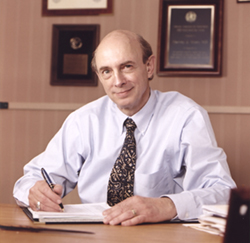

Nobel Prize in Physiology or Medicine · 2020
Harvey J. Alter
He tracked a hidden virus through donated blood, helping make transfusions safe from hepatitis C and opening the way to a cure.
The Nobel citation: “for the discovery of Hepatitis C virus”
- Born
- September 12, 1935, New York, NY, USA
- Shared with
- Michael Houghton, Charles M. Rice
- Affiliation at the time
- National Institutes of Health, USA
Medicine prize
2020
Shared with 2 other laureates.
Age that year
85years
Born in 1935.
Headline credited impact
7,000–68,000lives saved
Hepatitis B deaths averted by vaccination through 2025. How it was built
Sources cited
29
Fact-checked September 24, 2026.
- Early in the NIH heart-surgery study Alter later ran, about a third of transfused patients caught hepatitis; from 1992 to 1997 his team found no hepatitis C in 650 patients.
- In 1975 he and his NIH colleagues named the mystery illness "non-A, non-B hepatitis," a placeholder that lasted until the virus was identified in 1989.
- A 1961 army draft notice steered him to the NIH instead; he reported there three days before he was due at Fort Dix.
- His coded panel of blood samples stumped about 20 labs hoping they had a test for the mystery virus, until Chiron's new hepatitis C test cracked the code.
- As a young NIH fellow he co-discovered the Australia antigen with Baruch Blumberg, the clue that led to the hepatitis B virus.
The breakthrough
Unmasking the hidden virus behind transfusion hepatitis (1970-1989)
In the 1960s, a blood transfusion could save your life and then quietly damage your liver. At the NIH, Alter ran a long study of heart-surgery patients, who received lots of blood. They gave blood samples every week or two, then monthly, for six months, and every sample was frozen for later testing. About a third developed hepatitis, a liver inflammation spotted by a rise in a liver enzyme. Switching to unpaid volunteer donors and testing for the newly found hepatitis B virus cut cases sharply, but many remained. In 1975 Alter's team showed these leftover cases were not hepatitis A or B, so they called the culprit "non-A, non-B." Next they showed it was infectious: blood from patients, and even from healthy-looking donors, gave the disease to chimpanzees. Later tests showed the agent was tiny and wrapped in a fatty coat, like a virus, and that about one in five long-term infections led to cirrhosis, a scarred and failing liver. Think of detectives who cannot see the thief but can describe his size, his coat and his crimes. Alter also built a coded panel of samples that no false lead could pass. By 1989 Michael Houghton's team at the Chiron company found the virus's genes and made a blood test. It cracked Alter's coded panel, and hepatitis C finally had a name.[3],[4],[5],[7]
“Cure is no longer constrained by science, but is a matter of dollars.”
What it meant for humanity
Before Alter's work, getting blood was a gamble. In the NIH study of heart-surgery patients that he led from 1970, about a third had caught hepatitis from transfusions, and paid donors' blood was far riskier: 51% of patients who got at least one paid unit developed hepatitis, against 7% of those who got only volunteer blood. These findings helped push the United States to an all-volunteer blood supply and to testing donors, first for hepatitis B, then for a stand-in marker, and from 1990 for hepatitis C itself. Among his patients, the hepatitis rate fell from about 30% to 10%, then 4%, then to essentially zero: from 1992 to 1997 his team followed 650 transfused patients and found not one hepatitis C infection. The Lasker Foundation called it a 200-fold drop. Nearly every country now tests donated blood for hepatitis C, so people who need transfusions are protected from a silent infection that can scar the liver over decades. Knowing the virus also made drugs possible. Pills taken for a few weeks now cure more than 95% of patients, and the World Health Organization counts about 12.5 million people who received this curative treatment between 2015 and 2022. The Nobel Assembly says the blood tests and medicines have saved millions of lives. The job is unfinished: about 47 million people still lived with hepatitis C in 2024, the virus caused about 240,000 deaths that year, and WHO says only about one in five people with hepatitis C since 2015 has been treated.
- Transfusion hepatitis in NIH heart-surgery patients fell from about 30% around 1970 to no hepatitis C at all among 650 patients followed from 1992 to 1997; the Lasker Foundation called the fall 200-fold.[3],[7]
- In 1975 Alter's team showed that most transfusion hepatitis was neither hepatitis A nor B, and in 1978 that it could be passed to chimpanzees, proving an infectious agent was at work.[3],[4],[5]
- His team's finding that about one in five chronic cases progressed to cirrhosis helped convince doctors that non-A, non-B hepatitis was a serious disease, not a harmless lab abnormality.[3],[7]
- WHO reports that about 12.5 million people received curative hepatitis C treatment from 2015 to 2022; the pills cure more than 95% of patients.[5],[12]
- As a young NIH fellow working with Baruch Blumberg, he spotted the Australia antigen, later shown to be the coat of the hepatitis B virus and the first blood marker for any hepatitis virus.[2],[3],[8]
- The work is unfinished: WHO estimates about 47 million people lived with hepatitis C in 2024 and it caused about 240,000 deaths that year; only about 20% of people with the virus since 2015 have been treated.[13]
Impact in numbers
Alter's contribution was patient, methodical clinical science: following transfused patients for months at a time over decades, freezing every sample, and refusing to let an unexplained disease be dismissed. That work defined hepatitis C before anyone could see the virus, showed it was dangerous, and gave the field a trusted test panel. We count two outcomes. For donor screening, which his studies predicted would work and then confirmed, we credit him with 10% of the transfusion infections prevented since 1990, because Chiron's scientists found the virus and built the test. For the pills that now cure hepatitis C, we credit him with only 3%, as a downstream effect: Charles Rice, Ralf Bartenschlager, other labs and drug companies made the cures possible, and Alter says he had no part in them. We make no lives-saved claim: hepatitis C kills slowly, over decades, so deaths averted to date cannot yet be counted reliably, even though the Nobel Assembly says the tests and drugs have saved millions of lives.
Health
Each number is the laureate’s credited share of a real-world outcome, cumulative to 2025. The whole outcome, the share of credit, and the reasoning are shown so you can check the arithmetic. Outcomes shared with other laureates are counted once on the impact page.
- Low confidenceDirectModeledHealth
Transfusion recipients spared hepatitis C by donor screening
150,000–610,000
people benefited, credited share
That is 10% of 1.5–6.1 million people benefited since 1990.
How this number was built
WHO counted 118.5M donations in 2018. Median HCV-reactive rates by income group (0.007%, 0.19%, 0.38%, 1.00%) weighted by donation shares (40%, 34%, 24%, 2%) give ~0.18%, or ~210k reactive units a year kept out of the supply. Assume 1990-2025 (36 yrs) averaged 50-100% of that and 0.4-0.8 recipient infections averted per reactive unit (some reactives are false positives; some units go to several patients): 36 x 105k-210k x 0.4-0.8 = 1.5-6.1M. Cross-check: Alter's lecture extrapolates ~2.4M US cases prevented in 1990-2010 alone. Share 0.10: his NIH studies defined the disease, built the validation panel and showed donor testing would stop ~90% of cases, but Chiron's team found the virus and made the test. Low confidence: the averaging and per-unit factors are assumptions.[3],[4],[7],[15]
Sources: World Health Organization; NobelPrize.org (Nobel Foundation); Lasker Foundation; The Nobel Assembly at Karolinska Institutet
- Medium confidenceRippleModeledHealth
People cured of hepatitis C by direct-acting antiviral pills
375,000–450,000
people benefited, credited share
That is 3% of 12.5–15 million people benefited since 2015.
How this number was built
WHO: 12.5M people received curative hepatitis C treatment in 2015-22. Polaris counted 0.64M treatment starts in 2020, a pandemic low; add 0.6-1.0M a year for 2023-25, giving 14.3-15.5M treated, consistent with WHO's 2026 finding that about 20% of people with HCV since 2015 were treated. Cure rates exceed 95% in studies; assume 90-97% in practice: about 12.5-15M cured. Ripple share 0.03: the drugs needed the virus identified (Houghton's team), proof it caused disease and lab systems to study it (Rice, Bartenschlager and others), and industry drug design. Alter says he had no role in the treatments; his part was defining the disease they treat.[5],[6],[12],[13],[14]
Sources: World Health Organization; World Health Organization; Polaris Observatory HCV Collaborators; The Nobel Committee for Physiology or Medicine; NobelPrize.org (Nobel Prize Outreach)
- Medium confidenceRippleModeledHealth
Hepatitis B deaths averted by vaccination through 2025
7,000–68,000
lives saved, credited share
That is 2% of 350,000–3.4 million lives saved since 1982.
How this number was built
Same outcome, range and share logic as the Blumberg profile, counting only deaths averted by end-2025. Li et al. (Lancet 2021, s24): vaccination averted 640,000 hepatitis B deaths (95% CrI 190,000-1.5M) in 98 low- and middle-income countries in 2000-2019 and 1.6M (460,000-2.9M) in 2020-2030. Low: 190k + 0.40 x 460k = 374k, rounded down to 350k. High: 1.5M + 0.55 x 2.9M = 3.1M, plus up to 10% for other countries and 1982-1999 = 3.4M. Share 0.02 (Blumberg 0.2; total 0.22): Alter co-discovered the Australia antigen as Blumberg's NIH fellow (s3, s25), but Blumberg tied it to hepatitis and devised the vaccine with Millman, and vaccine makers and delivery programmes were essential.[3],[21],[22]
Sources: The Lancet, via PubMed Central; Virology Journal (BioMed Central), via PubMed Central; NobelPrize.org (Nobel Foundation)
- Medium confidenceRippleModeledHealth
Children spared lifelong hepatitis B infection by vaccination
2.2–5.2
million people benefited, credited share
That is 2% of 110–260 million people benefited since 1982.
How this number was built
Lifetime benefit the deaths-to-2025 claim omits: chronic infection brings lifelong liver-cancer and cirrhosis risk. High: Nayagam et al. (s21) model that infant vaccination had prevented 210M new chronic infections by 2015; adding 2016-2025 births (1.365B, UN via OWID, s23) x 4 points = 55M gives ~265M, rounded down to 260M. Low, a simpler check: WHO (s22) says under-5 prevalence fell from ~5% before vaccination to just under 1% by 2019, 4 points. Cohorts born 1995-2014 (2.77B) at a gain rising linearly from 0 to 4 points (average 2) = 55M; 2015-2025 (1.51B) x 4 points = 60M; total 116M, rounded down to 110M. Counterfactual: no vaccine. Counts infections in vaccinated children, not transfusion infections averted by donor screening. Share 0.02 (Blumberg 0.2): Alter co-discovered the Australia antigen as Blumberg's fellow (s3, s25); Blumberg tied it to hepatitis and devised the vaccine.[3],[22],[23],[24],[25]
Sources: The Lancet Infectious Diseases, via PubMed; World Health Organization; Our World in Data; NobelPrize.org (Nobel Foundation); Virology Journal (BioMed Central), via PubMed Central
- Low confidenceDirectModeledHealth
Transfusion recipients spared hepatitis B by donor screening, 2008-2025
80,000–310,000
people benefited, credited share
That is 5% of 1.6–6.2 million people benefited since 2008.
How this number was built
2008-2025 only. WHO: 91.8M donations in 2008, 118.5M in 2018; linear between, flat after = 1.99B. Median HBsAg-reactive rates by income group 0.01/0.29/1.96/2.81%, weighted by 2018 donation shares 40/34/24/2% (WHO 2021) = 0.63%: 12.5M units kept out. Infections averted per unit: 0.15 (Allain, Ghana: recipients over 10, often already immune) to 0.5 (Gocke 1972, US: 52% of recipients of antigen-positive blood were infected). Low x 0.9: 11% of donations not screened to standard (WHO 2011). 12.5M x 0.9 x 0.15 = 1.7M, rounded down to 1.6M; 12.5M x 0.5 = 6.2M. Only susceptible recipients count, so no vaccinated child from the vaccine claim is counted. Rough: medians, unconfirmed reactives. Share 0.05 (Blumberg 0.2, Yalow 0.01): Alter co-discovered the antigen (s3, s25); his NIH studies measured what screening prevented.[3],[15],[22],[26],[27],[28],[29]
Sources: World Health Organization (archived 16 May 2022); World Health Organization; World Health Organization; Blood (American Society of Hematology), via PubMed; JAMA, via PubMed; NobelPrize.org (Nobel Foundation); Virology Journal (BioMed Central), via PubMed Central
The double edge
No serious harm flows from Alter's own work, but it carries real controversies. Proving that the mystery agent was infectious depended on experiments in chimpanzees, a practice the NIH stopped supporting in 2015. The cures his discovery made possible arrived at prices that kept many patients from them: a course of Gilead's Sovaldi was priced at $84,000 in the United States, and Alter himself has said that cure is now limited by money, not science. And the Nobel's three-person limit left out others who did essential work, including Chiron's Qui-Lim Choo and George Kuo.
- Minor
The proof depended on chimpanzee experiments
Chimpanzees were the only animals besides humans known to catch the virus, and Alter's proof that the agent was transmissible came from injecting them with patient blood; many became long-term carriers. Alter calls them an invaluable model. In November 2015 the NIH announced it would no longer support biomedical research on chimpanzees and began retiring its animals to a sanctuary.[3],[5],[19]
- Moderate
Cures priced out of reach for many patients
A 2015 US Senate Finance Committee investigation found Gilead priced Sovaldi at $1,000 a pill, or $84,000 a course, to maximize revenue, and that in 2014 Medicaid programs spent over $1 billion on it yet treated under 2.4% of enrolled patients with hepatitis C. Alter, who says he had nothing to do with the drugs, calls their cost a major barrier to cure.[3],[6],[18]
- Minor
A prize for three, a discovery by many
Nobel rules allow at most three laureates per prize. Chiron's Qui-Lim Choo and George Kuo, Houghton's partners for years in the hunt to clone the virus, were left out; Houghton had refused a $100,000 Gairdner prize payment in 2013 because that award excluded them. Alter's own work leaned on close NIH colleagues such as Robert Purcell.[3],[20]
Against the odds
Alter grew up in a safe place during a terrible time for Jews. He was six when the United States entered World War II, and he later wrote that he grasped the full horror of the Holocaust only when he saw films of the camps. His Queens neighborhood was largely German; he recalls some neighbors cheering Roosevelt's death in 1945 because they saw the president as too friendly to Jews, though he says open antisemitism was rare. The wider barriers in his chosen field were real. From the 1920s most American medical schools quietly capped the number of Jewish students, at Yale at no more than five per class, and the quotas persisted into the 1950s before disappearing by 1970. Alter entered the University of Rochester's medical school in 1956, and there is no record that a quota blocked him. His own account stresses luck more than obstacles: a 1961 draft notice sent him to the NIH instead of the army, and a chance line in a lab dish led him into hepatitis research. Compared with Jewish laureates who fled Europe, he faced little personal discrimination, and he describes his own childhood as protected.
1945
Discrimination
In his mostly German neighborhood of Ridgewood, Queens, some neighbors cheered the death of President Roosevelt, whom they saw as too friendly to Jews. Alter describes the antisemitism around him as mostly latent rather than open.[2]
1956
Quota
When Alter entered medical school in 1956, many American medical schools still limited Jewish admissions under quotas dating from the 1920s, which were gone by 1970. There is no record that a quota affected his own admission to Rochester.[9],[16],[17]
Jewish background
Alter was born in New York City in 1935 into a Jewish family; his parents were American-born children of immigrants from western Russia and Poland. He grew up in Ridgewood, Queens, where his mother kept kosher and a rabbi lived next door, though the family drove on the Sabbath. He was raised to believe that marrying outside the faith would wound his parents, and a DNA test showed almost entirely Ashkenazi Jewish ancestry. He writes of the six million Jews killed in the Holocaust as his people. In a 2020 Nobel interview he called medicine the expected path for a Jewish boy in New York. In 2026 he accepted the David Nassy Award at a Jewish American Heritage Month event on Capitol Hill.[2],[6],[10],[11]
Key dates
September 12, 1935
Born in New York City into a Jewish family; grows up in Ridgewood, Queens.[1],[2]
1956
Graduates from the University of Rochester and enters its medical school.[2],[9]
1960
Earns his MD at Rochester and begins internship and residency at Strong Memorial Hospital.[2],[9]
November 27, 1961
Facing the army draft, he takes a post at the NIH instead, reporting three days before he was due at Fort Dix.[2]
1965
With Baruch Blumberg, publishes the discovery of the Australia antigen, later shown to be part of the hepatitis B virus.[3],[7],[8]
1969
After training in Seattle and at Georgetown, returns to the NIH Clinical Center blood bank to study transfusion hepatitis.[2],[9]
1970
Takes charge of the NIH study of transfused heart-surgery patients; volunteer donors and hepatitis B testing cut cases by about 70%.[3]
1975
Shows that most transfusion hepatitis is caused by neither hepatitis A nor B, and names it non-A, non-B hepatitis.[3],[4],[5]
1978
Proves the unknown agent is infectious by transmitting it to chimpanzees.[3],[4]
1989
Chiron publishes the hepatitis C virus and an antibody test that had cracked his coded sample panel; US donor screening begins in 1990.[3],[7]
2000
Shares the Lasker Award for Clinical Medical Research with Michael Houghton.[7]
2002
Becomes the first scientist from the NIH Clinical Center to win election to the National Academy of Sciences.[8]
October 5, 2020
Wins the Nobel Prize in Physiology or Medicine with Michael Houghton and Charles M. Rice for the discovery of hepatitis C virus.[1],[4],[8]
May 2026
Receives the David Nassy Award at a Jewish American Heritage Month celebration on Capitol Hill.[11]
Sources
- 1.Harvey J. Alter - Facts · NobelPrize.org (Nobel Prize Outreach), 2020
- 2.Harvey J. Alter - Biographical · NobelPrize.org (Nobel Prize Outreach)
- 3.Hepatitis C Virus: From Hippocrates to Cure (Nobel Lecture, 7 December 2020) · NobelPrize.org (Nobel Foundation), 2020
- 4.The Nobel Prize in Physiology or Medicine 2020 - Press release · The Nobel Assembly at Karolinska Institutet, 2020
- 5.Scientific Background: The Discovery of Hepatitis C Virus (Advanced information, Nobel Prize in Physiology or Medicine 2020) · The Nobel Committee for Physiology or Medicine, 2020
- 6.Interview with Harvey J. Alter, December 2020 · NobelPrize.org (Nobel Prize Outreach), 2021
- 7.Hepatitis C virus and its detection in blood for transfusions (2000 Lasker-DeBakey Clinical Medical Research Award) · Lasker Foundation, 2000
- 8.NIH intramural researcher Dr. Harvey Alter wins 2020 Nobel Prize in Physiology or Medicine · National Institutes of Health, Office of the Director (via EurekAlert!), 2020
- 9.Harvey J. Alter · Wikipedia
- 10.Jewish researcher Harvey Alter shares Nobel Prize in medicine for identifying hepatitis C virus · Jewish Telegraphic Agency, 2020
- 11.From Beverly Hills to Capitol Hill: Three American Jews Honored · Jewish Journal, 2026
- 12.Global hepatitis report 2024: action for access in low- and middle-income countries · World Health Organization, 2024
- 13.Global hepatitis report 2026 · World Health Organization, 2026
- 14.Global change in hepatitis C virus prevalence and cascade of care between 2015 and 2020: a modelling study (Lancet Gastroenterology & Hepatology) · Polaris Observatory HCV Collaborators, 2022
- 15.Global status report on blood safety and availability 2021 · World Health Organization, 2022
- 16.Why Did the United States Medical School Admissions Quota for Jews End? (American Journal of the Medical Sciences) · Edward C. Halperin, 2019
- 17.Jewish American Heritage Month: The Forgotten History of Quotas in American Medical School Admissions · Himmelfarb Health Sciences Library, George Washington University, 2023
- 18.Wyden-Grassley Sovaldi Investigation Finds Revenue-Driven Pricing Strategy Behind $84,000 Hepatitis Drug · United States Senate Committee on Finance, 2015
- 19.NIH Plan to Retire All NIH-Owned and -Supported Chimpanzees · National Institutes of Health, Office of Research Infrastructure Programs
- 20.Trio wins Nobel Prize in medicine for discovery of hepatitis C virus · STAT, 2020
- 21.Estimating the health impact of vaccination against ten pathogens in 98 low-income and middle-income countries from 2000 to 2030 (Li X et al., Lancet 397:398-408) · The Lancet, via PubMed Central, 2021
- 22.Medical virology of hepatitis B: how it began and where we are now (Gerlich WH, Virology Journal 10:239) · Virology Journal (BioMed Central), via PubMed Central, 2013
- 23.Requirements for global elimination of hepatitis B: a modelling study (Nayagam S et al., Lancet Infect Dis 16:1399-1408) · The Lancet Infectious Diseases, via PubMed, 2016
- 24.Hepatitis B - Fact sheet · World Health Organization, 2025
- 25.Number of births per year (UN World Population Prospects) · Our World in Data, 2024
- 26.Blood safety and availability (fact sheet, Table 1: prevalence of transfusion-transmissible infections in blood donations by income group) · World Health Organization (archived 16 May 2022), 2022
- 27.Global Database on Blood Safety: Summary Report 2011 (2008 data: 91.8 million donations) · World Health Organization, 2011
- 28.The risk of hepatitis B virus infection by transfusion in Kumasi, Ghana (Allain JP et al., Blood 101:2419-2425) · Blood (American Society of Hematology), via PubMed, 2003
- 29.A prospective study of posttransfusion hepatitis: the role of Australia antigen (Gocke DJ, JAMA 219:1165-1170) · JAMA, via PubMed, 1972
Fact-checked on September 24, 2026 by a separate AI fact-checking pass that re-opened the sources, with 14 corrections made. How we check
Suggest a correction