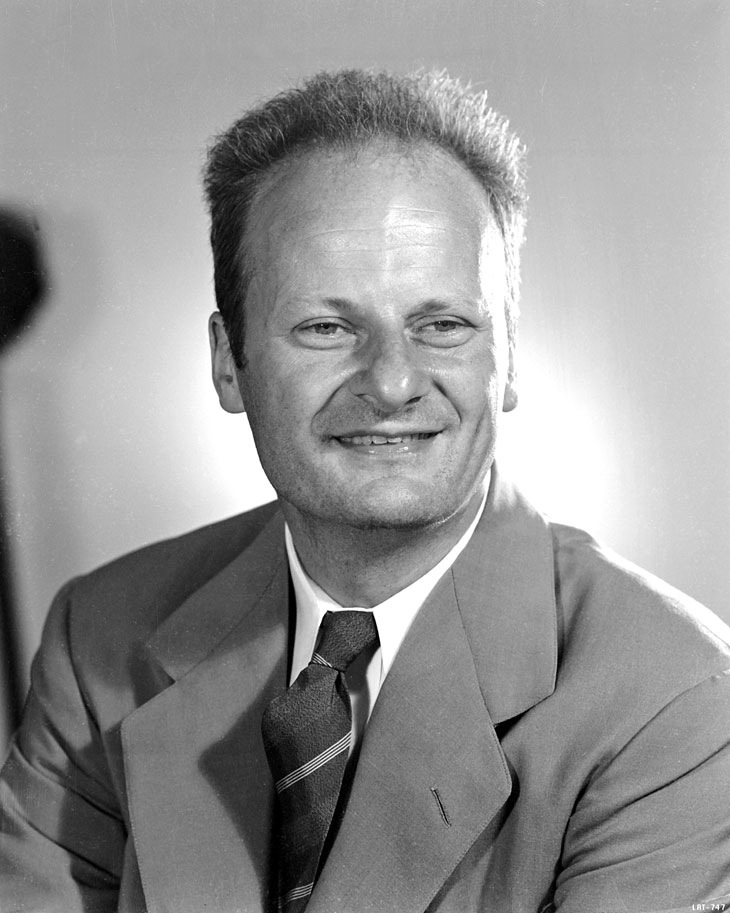

Nobel Prize in Physics · 1967
Hans Bethe
Explained how the Sun and stars shine, helped build the atomic bomb, then spent six decades working to rein in nuclear weapons.
The Nobel citation: “for his contributions to the theory of nuclear reactions, especially his discoveries concerning the energy production in stars”
- Born
- July 2, 1906, Strasbourg, Germany (now France)
- Died
- March 6, 2005, Ithaca, NY, USA
- Affiliation at the time
- Cornell University, USA
Physics prize
1967
Awarded alone.
Age that year
61years
Born in 1906.
Headline credited impact
2,250–2,500people benefited
Cancer patients treated with proton and other particle-beam therapy. How it was built
Sources cited
20
Fact-checked September 24, 2026.
- In April 1933 Nazi racial law cost him his university job because his mother was of Jewish origin. By 1935 he was at Cornell, where he stayed for 70 years.
- After a 1938 conference on the stars, he worked out within about two weeks the carbon cycle that powers big stars. The Nobel Prize for it came 29 years later.
- In 2020 a detector in Italy caught neutrinos from the carbon cycle he described, showing it makes about 1% of the Sun's energy. In massive stars it is the main source.
- He led the Los Alamos theory division that calculated how the Hiroshima and Nagasaki bombs would perform, then spent six decades pressing to limit nuclear weapons.
- He published significant physics papers in every decade from the 1920s into the 2000s, and well into his nineties he was still studying exploding stars.
The breakthrough
How the Sun and the stars make their energy
For a long time no one knew what keeps the Sun shining. If it burned like coal, or slowly shrank under its own gravity, it would have run out long before the billions of years that life on Earth needed. By the 1930s physicists suspected nuclear reactions deep inside stars, but no one had shown which ones. In 1938, after a conference in Washington, Bethe went through the possible reactions one by one, ruled out almost all of them, and showed that two routes remained. In both, four hydrogen nuclei fuse into one helium nucleus. A tiny bit of mass disappears and becomes energy: nearly 20 million times more, weight for weight, than burning carbon. In the Sun and smaller stars, protons join step by step in the proton-proton chain, whose rate he calculated with Charles Critchfield. In bigger, hotter stars, carbon and nitrogen nuclei act like a reusable machine in a factory: they take in protons, pass through several forms, and end each round as carbon again, ready to start over. This is the carbon-nitrogen cycle. Carl Friedrich von Weizsäcker proposed that cycle independently, but Bethe was the one who calculated how fast it runs and how strongly it depends on temperature, so he could check it against what astronomers saw in real stars. His 1939 paper became a foundation of modern astrophysics.[1],[3],[4],[6]
“You have given me the Prize I believe for a lifetime of quiet work in physics rather than for any spectacular single contribution.”
What it meant for humanity
Bethe's work on the stars changed how people understand the sky. It explained why the Sun can shine steadily for billions of years, long enough for life to evolve, and it became the starting point for later work on how stars age and on where the chemical elements come from. The theory passed a hard test in 2020, when a detector caught neutrinos from the carbon cycle he had described 81 years earlier. His other physics reached further into everyday life. His 1930 formula for how fast charged particles slow down in matter is still used to predict where a proton beam stops inside a patient, part of the physics behind proton therapy for cancer. His 1947 calculation of the Lamb shift, a tiny energy difference in the hydrogen atom, showed that the theory of light and electrons could give sensible answers and laid the foundation for modern quantum electrodynamics. His review articles on nuclear physics, known as the Bethe Bible, taught a generation of nuclear physicists, and he trained many Cornell students. After the war he became one of the most trusted scientific voices on nuclear weapons. As a presidential science adviser he pressed for a nuclear test ban and chaired the panel that produced the first design for a system to check that the Soviets were not testing in secret. That work fed into the 1963 Limited Test Ban Treaty, which ended atmospheric tests by the United States, the Soviet Union and Britain, and the fallout they spread. His 1968 article with Richard Garwin, showing how easily missile defenses could be fooled, helped build the case for the 1972 Anti-Ballistic Missile Treaty, and in the 1980s he argued against the Star Wars missile shield. He also championed nuclear power as the answer to dwindling fossil fuels.
- As a member of the President's Science Advisory Committee he chaired a panel on detecting Soviet nuclear tests and took part in the 1958 Geneva talks, work that led to the 1963 Limited Test Ban Treaty.[6],[10],[11]
- A 1968 Scientific American article he wrote with Richard Garwin showed that decoys could defeat missile defenses. It informed physicists and Congress and helped lead to the 1972 Anti-Ballistic Missile Treaty.[6],[10]
- His 1930 formula for how charged particles lose energy in matter is used to predict proton ranges in the body; particle-beam therapy had treated more than 450,000 cancer patients by about the end of 2024.[16],[17]
- In 2020 the Borexino detector in Italy observed neutrinos from the carbon-nitrogen-oxygen cycle, the first direct evidence that it runs in the Sun, where it makes about 1% of the energy. In massive stars it is the main source.[15]
- His 1947 calculation of the Lamb shift, worked out on a train journey after the Shelter Island conference, laid the foundation for modern quantum electrodynamics, the theory of light and matter.[2],[6]
- His three 1936-37 review articles on nuclear physics, nicknamed the Bethe Bible, were used like textbooks by nuclear physicists for many years.[2],[3],[6]
Impact in numbers
Bethe's best-known work, explaining how stars shine, changed human understanding of the universe rather than any count of lives, so we put no number on it. His practical record is mixed and hard to measure. On the harm side, he led the theoretical work behind the first atomic bombs, and we credit him with a small share (2%) of the deaths at Hiroshima and Nagasaki. On the benefit side, we credit him with a tiny share (0.5%) of the patients treated with proton and other particle-beam therapy, whose planning uses his 1930 energy-loss formula. He also consulted on reactor design and argued for nuclear power for decades, but no source ties a measurable part of nuclear power's benefits to him, so we give it no number. His arms-control advice, which helped produce the 1963 test ban and the 1972 ABM Treaty, may have mattered more than any of these. But no honest method can count the lives those treaties saved or the credit due to one adviser among many, so we record none.
Fundamental sciencePeaceHealthEnergy
Each number is the laureate’s credited share of a real-world outcome, cumulative to 2025. The whole outcome, the share of credit, and the reasoning are shown so you can check the arithmetic. Outcomes shared with other laureates are counted once on the impact page.
- Low confidenceRippleSourced totalHealth
Cancer patients treated with proton and other particle-beam therapy
2,250–2,500
people benefited, credited share
That is 0.5% of 450,000–500,000 people benefited since 1954.
How this number was built
A 2026 Frontiers in Oncology review, citing PTCOG, reports that more than 450,000 patients had been treated with particle (mostly proton) therapy by about the end of 2024 (low). Newhauser and Zhang cite at least 93,895 by March 2013, so about (450,000 - 93,895) / 11.75 years = 30,000 a year since; high adds a generous 50,000 for 2025. This counts patients treated, not lives saved, and protons' edge over modern X-ray therapy is debated for many cancers. Share 0.005: planning uses the Bethe-Bloch stopping-power formula (Bethe 1930, refined by Felix Bloch in 1933) to predict where a beam stops, but a simpler empirical rule from 1905 is also fairly accurate, and Bragg's peak, Wilson's 1946 proposal, accelerators, imaging and clinicians were all essential. Result: about 2,250-2,500 patients.[16],[17]
Sources: PubMed Central (National Library of Medicine); PubMed Central (National Library of Medicine)
- HarmMedium confidenceDirectSourced totalPeace
Deaths from the atomic bombings of Hiroshima and Nagasaki within two to four months
3,000–4,920
deaths caused, credited share
That is 2% of 150,000–246,000 deaths caused since 1945.
How this number was built
RERF estimates acute deaths within two to four months at 90,000-166,000 in Hiroshima and 60,000-80,000 in Nagasaki, so 150,000-246,000 in total (the same range as the Bohr, Einstein and Rotblat profiles; later cancer deaths excluded). Share 0.02: from 1943 Bethe headed the Los Alamos Theoretical Division, which calculated critical masses and yields and completed the implosion theory used in the Nagasaki bomb. That is a larger role than Bohr's or Einstein's (0.01 each), but he was one of several division leaders under Oppenheimer in a project employing thousands, the discovery of fission and the engineering were equally essential, and US leaders decided to use the bombs. Result: about 3,000-4,900 deaths credited.[6],[7],[11],[18]
Sources: Radiation Effects Research Foundation (RERF); National Academy of Sciences, Biographical Memoirs (archived copy, Internet Archive); Encyclopedia.com; Atomic Heritage Foundation, National Museum of Nuclear Science & History
The double edge
Bethe helped build the weapons he later spent his life trying to limit. From 1943 he led the theoretical division at Los Alamos, which worked out critical masses, explosive yields and the implosion design used in the Trinity test and the Nagasaki bomb. The bombs dropped on Hiroshima and Nagasaki killed an estimated 150,000 to 246,000 people within two to four months. In a 1997 interview he said he did not regret his part in the atomic bomb, which he and others built for fear that Nazi Germany would get it first. He called the hydrogen bomb immoral, yet after President Truman ordered it built he returned to Los Alamos and, once Teller and Ulam found a workable design, led the theoretical effort to develop it. He reasoned that someone else would do the work if he did not, and that staying inside gave him influence for disarmament; he later admitted he wished he had been a more consistent idealist. In 1955 his theory of ablation helped make missile warheads that survive the heat of re-entry, which aided the development of intercontinental ballistic missiles.
- Major
Led the theory work behind the first atomic bombs
As head of the Los Alamos Theoretical Division from 1943, he oversaw calculations of critical masses and bomb efficiency and completed the theory of the implosion method used at the Trinity test and in the Fat Man bomb dropped on Nagasaki. The Hiroshima and Nagasaki bombings killed an estimated 150,000 to 246,000 people within two to four months.[6],[7],[11],[18]
- Major
Helped design the hydrogen bomb he had opposed
In 1950 he argued in Scientific American that it would be immoral to bring such an all-destroying weapon into the world. After Truman ordered it built, he returned to Los Alamos and, after the 1951 Teller-Ulam idea, headed the theory work on thermonuclear weapons, as he had for the fission bomb. The first H-bomb test in 1952 was roughly 1,000 times more powerful than the Hiroshima bomb.[7],[9],[10],[19],[20]
- Moderate
Helped make long-range missile warheads work
In 1955, while consulting for the AVCO Corporation, he worked out a general theory of ablation, in which a heat shield burns away in a controlled way. It was used to design warheads that survive the heat of re-entry and helped make intercontinental ballistic missiles workable.[7],[9]
Against the odds
When Hitler took power in January 1933, Germany had about 523,000 Jews, less than 1 percent of its people. On April 7, 1933, the new government passed a law that forced 'non-Aryans' out of the civil service, which included teachers at state universities. It was the first major Nazi law to single out Jews as Jews. Bethe had been raised in a Christian home where religion mattered little, but his mother was born Jewish, which gave him two Jewish grandparents, and under the new rules that was enough to bar him from state service. That April he lost his post as acting assistant professor at Tübingen. His teacher Arnold Sommerfeld gave him a stopgap fellowship in Munich and persuaded William Lawrence Bragg to bring him to Manchester, and in October 1933 Bethe left Germany. After a year in Manchester and a term in Bristol on temporary posts, he reached Cornell in 1935. His mother stayed behind. After the Kristallnacht pogrom of November 1938, when more than 1,400 synagogues were burned and about 26,000 Jewish men were locked in concentration camps, she became afraid to remain and reached the United States in 1939. Even in America, as a German-born non-citizen when the war began, Bethe was kept out of classified war work until he became a citizen and was cleared in 1941.
1933
Discrimination
From April 1933 a new Nazi law forced Jewish civil servants, including teachers at state universities, out of their jobs. It was the first major Nazi law to single out Jews as Jews. Germany's roughly 523,000 Jews were less than 1 percent of the population.[12],[13]
1933
Dismissal
In April 1933 he was dismissed as acting assistant professor at the University of Tübingen under the new Nazi civil service law, because his mother was of Jewish origin and he had two Jewish grandparents.[6],[7],[12]
1933
Exile
He left Germany for England in October 1933, living on a one-year lectureship in Manchester and then a term's fellowship in Bristol while he waited to start at Cornell. He arrived in Ithaca in February 1935.[2],[7]
1938
Persecution
His mother, born Jewish, was still in Germany at the time of the Kristallnacht pogrom in November 1938. Afraid to stay, she emigrated to the United States in 1939, entering on the French quota because the German quota was full.[6],[14],[19]
1941
Other
As a German-born non-citizen when war broke out, he was barred from classified work. A paper he co-wrote on armor plate was classified and put beyond his own reach; he was cleared only in December 1941, after becoming a US citizen.[6]
Jewish background
Bethe's mother, Anna Kuhn, was born Jewish in Strasbourg, the daughter of a professor of medicine there; his father, the physiologist Albrecht Bethe, was Protestant. According to the Dictionary of Scientific Biography, his mother had converted to Lutheranism before she met his father, and Hans, an only child, grew up in a Christian home where religion mattered little. Wikipedia says he later became an atheist, and the Encyclopaedia Judaica says he never claimed a Jewish affiliation of his own. The Nazis still counted him as non-Aryan because he had two Jewish grandparents, and in 1933 that ancestry cost him his job in Germany.[6],[7],[8],[9],[19]
Key dates
July 2, 1906
Born in Strasbourg, then part of Germany, the only child of physiologist Albrecht Bethe and Anna Kuhn.[1],[6]
July 1928
Earns his PhD in theoretical physics in Munich under Arnold Sommerfeld.[2]
1930
Publishes his theory of how fast charged particles lose energy passing through matter, which he considered his best paper.[6],[16]
April 1933
Dismissed from the University of Tübingen under Nazi racial laws because of his mother's Jewish origin.[6],[7]
October 1933
Leaves Germany for a temporary lectureship at the University of Manchester, England.[2]
February 1935
Joins Cornell University, his academic home for the rest of his life; promoted to professor in 1937.[2],[8]
1938
Works out the nuclear reactions that power the Sun and other stars; his paper Energy Production in Stars appears in 1939.[1],[6]
September 1939
Marries Rose Ewald, daughter of his former mentor Paul Ewald; earlier that year his mother had reached the United States safely.[6],[19]
1943
Becomes head of the Theoretical Division at Los Alamos, where the first atomic bombs are designed.[7],[11]
1947
Calculates the Lamb shift in hydrogen, laying the foundation for modern quantum electrodynamics.[2],[6]
1952
Spends six months back at Los Alamos working on the hydrogen bomb, which he had opposed.[2],[10]
1963
The Limited Test Ban Treaty is signed, capping years of his work on detecting nuclear tests.[6],[10]
1967
Receives the Nobel Prize in Physics, unshared, for the theory of nuclear reactions and energy production in stars.[1],[3]
March 6, 2005
Sources
- 1.Hans Bethe - Facts · NobelPrize.org (Nobel Prize Outreach)
- 2.Hans Bethe - Biographical · NobelPrize.org (from Nobel Lectures, Physics 1963-1970, Elsevier, 1972), 1967
- 3.The Nobel Prize in Physics 1967 - Presentation Speech by Professor O. Klein · NobelPrize.org, 1967
- 4.Energy Production in Stars - Nobel Lecture, December 11, 1967 (PDF) · NobelPrize.org, 1967
- 5.Hans Bethe - Banquet speech (Stockholm, 10 December 1967) · NobelPrize.org (from Les Prix Nobel en 1967), 1967
- 6.Hans Albrecht Bethe, 1906-2005: A Biographical Memoir, by Gerald E. Brown and Sabine Lee · National Academy of Sciences, Biographical Memoirs (archived copy, Internet Archive), 2009
- 7.Bethe, Hans Albrecht (Complete Dictionary of Scientific Biography entry, Encyclopaedia Judaica entry and other reference entries) · Encyclopedia.com
- 8.Hans Bethe, a titan of physics and conscience of science, dies at age 98 · Cornell Chronicle, Cornell University, 2005
- 9.Hans Bethe, Prober of Sunlight and Atomic Energy, Dies at 98 (William J. Broad) · The New York Times (archived copy, Internet Archive), 2005
- 10.In Memoriam: Hans Bethe (1906-2005), by Richard L. Garwin and Frank von Hippel · Arms Control Association (Arms Control Today), 2005
- 11.Hans Bethe · Atomic Heritage Foundation, National Museum of Nuclear Science & History
- 12.Law for the Restoration of the Professional Civil Service · United States Holocaust Memorial Museum, Holocaust Encyclopedia
- 13.Germany: Jewish Population in 1933 · United States Holocaust Memorial Museum, Holocaust Encyclopedia
- 14.Kristallnacht · United States Holocaust Memorial Museum, Holocaust Encyclopedia
- 15.Experimental evidence of neutrinos produced in the CNO fusion cycle in the Sun (Borexino Collaboration, Nature 587, 577-582) · Nature, 2020
- 16.The physics of proton therapy, by Wayne D. Newhauser and Rui Zhang (Physics in Medicine and Biology 60, R155-R209) · PubMed Central (National Library of Medicine), 2015
- 17.Advances in proton therapy technology and global clinical applications (Frontiers in Oncology 16:1718677) · PubMed Central (National Library of Medicine), 2026
- 18.Frequently Asked Questions (estimated acute deaths in Hiroshima and Nagasaki) · Radiation Effects Research Foundation (RERF)
- 19.Hans Bethe · Wikipedia
- 20.Hydrogen Bomb - 1950 · Atomic Heritage Foundation, National Museum of Nuclear Science & History
Fact-checked on September 24, 2026 by a separate AI fact-checking pass that re-opened the sources, with 11 corrections made. How we check
Suggest a correction