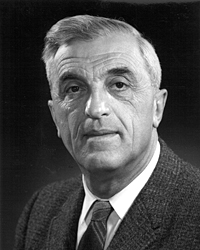

Nobel Prize in Physics · 1952
Felix Bloch
He found a way to pick up the faint magnetic signals of atomic nuclei, the physics behind NMR chemistry and hospital MRI scanners.
The Nobel citation: “for their development of new methods for nuclear magnetic precision measurements and discoveries in connection therewith”
- Born
- October 23, 1905, Zurich, Switzerland
- Died
- September 10, 1983, Zurich, Switzerland
- Shared with
- E. M. Purcell
- Affiliation at the time
- Stanford University, USA
Physics prize
1952
Shared with 1 other laureate.
Age that year
47years
Born in 1905.
Headline credited impact
9–33million people benefited
People who have benefited from MRI examinations worldwide since the early 1980s. How it was built
Sources cited
28
Fact-checked September 24, 2026.
- His 1928 doctoral thesis, written as Werner Heisenberg's first graduate student, laid the basis for the band theory of solids, which explains semiconductors.
- In 1933 a Nazi law forced him out of his post at Leipzig. He believed Stanford found him through a list of scholars displaced by antisemitism and Nazism.
- His first nuclear magnetic signals came from protons in ordinary water. Amplified by radio electronics, such signals could even be played through a loudspeaker.
- He won Stanford University's first Nobel Prize, and in 1954 he became the first Director-General of CERN, Europe's particle physics laboratory.
- In 2025, the year he would have turned 120, his family gave his Nobel medal to CERN, where it is displayed beside Wolfgang Pauli's.
The breakthrough
Nuclear induction: listening to the magnetism of atomic nuclei (1946)
Many atomic nuclei, including the single proton at the heart of every hydrogen atom, act like tiny spinning magnets. Put a sample in a strong magnetic field and a very slight surplus of them, about one in a million, lines up with the field. Bloch's idea, which he called nuclear induction, was to tip that lined-up magnetism with a weak radio wave. It works only at one exact frequency, the way a swing goes higher only if you push it in rhythm. Once tipped, the nuclei wobble around the field like a spinning top, and their moving magnetism creates a small voltage in a nearby coil of wire, the same principle a bicycle dynamo uses to make electricity. Ordinary radio electronics can then amplify the signal, show it on a screen or even play it through a loudspeaker. Late in 1945, Edward Purcell's team at Harvard detected such signals in paraffin wax. A few weeks later Bloch, William Hansen and Martin Packard at Stanford found them in water, and neither group knew of the other's work. The exact frequency reveals which kind of nucleus is signalling. Bloch also wrote the Bloch equations, which describe how the tipped magnetism settles back through two relaxation times, now called T1 and T2, that depend on the nuclei's surroundings.[3],[5],[6],[7]
“Free imagination is the inestimable prerogative of youth and it must be cherished and guarded as a treasure.”
What it meant for humanity
Nuclear magnetic resonance began as a way to measure nuclei, but it became a way to look inside matter without harming it. The signal of a nucleus shifts slightly with its chemical surroundings, a 'chemical shift' studied in experiments in Bloch's own laboratory. By 1991 the Royal Swedish Academy of Sciences described NMR spectroscopy as perhaps chemistry's most important measuring technique, used on everything from small drug molecules to proteins and nucleic acids. The biggest change for ordinary people came in medicine. In the 1970s Paul Lauterbur and Peter Mansfield showed how to turn NMR signals into pictures, and the first MRI machines reached health care in the early 1980s. By 2002 about 22,000 machines performed more than 60 million examinations a year. Today there are perhaps 50,000 machines and, by a 2022 industry estimate, more than 95 million scans a year. MRI uses no ionizing radiation. It is especially good at showing the brain and spinal cord, is central to diagnosing and following multiple sclerosis, helps surgeons map tumors, and has replaced some invasive tests, such as diagnostic knee arthroscopy. Bloch's relaxation times help MRI show how tissues work, not only their shape. Robert Hofstadter, a Stanford colleague who wrote Bloch's National Academy of Sciences memoir, judged MRI probably the greatest advance in medical imaging since X-rays. Bloch's earlier theory mattered too. His 1928 thesis explained how electrons move through the regular lattice of a crystal. The 'Bloch waves' he found became the basis of the band theory of solids, from which grew the theory of semiconductors that underpins transistors and computer chips.
- By 2002, about 22,000 MRI machines were in use worldwide, performing more than 60 million examinations a year, all without ionizing radiation.[19]
- There are now perhaps 50,000 MRI machines worldwide. A 2022 GE HealthCare estimate put their combined output at more than 95 million scans a year.[21],[22]
- In 1991 the Royal Swedish Academy of Sciences called NMR spectroscopy perhaps chemistry's most important measuring technique, used from drug molecules to proteins.[20]
- The relaxation times T1 and T2 in Bloch's 1946 equations track chemical bonding and biological processes, which lets MRI study physiology as well as anatomy.[6],[7]
- His 1928 'Bloch waves' became the basis of the band theory of solids, from which followed the theory of semiconductors used in transistors and chips.[6],[7]
- As CERN's first Director-General, from October 1954 to August 1955, he led Europe's new joint laboratory for particle physics.[6],[12]
Impact in numbers
Bloch's legacy runs through two very different technologies. His 1928 theory of electrons in crystals is a foundation stone of solid-state physics, the science behind semiconductors. His 1946 nuclear induction method, found at the same time as Edward Purcell's independent work, grew into NMR spectroscopy, a basic tool of chemistry and structural biology, and into MRI, which lets doctors see soft tissue without X-rays. We credit him with only small shares of these outcomes, because each needed many later contributors: Lauterbur, Mansfield and Ernst for imaging and modern NMR, and generations of engineers for chips. The MRI estimate discounts scans judged low-value and rests on a stated guess about how many scans each person has. We also record a very small share of the Hiroshima and Nagasaki deaths, for his brief wartime bomb work. He also shaped science through people and institutions: he was Stanford's first Nobel laureate and CERN's first leader, and a teacher who urged students to guard their imagination.
HealthFundamental scienceTechnologyEconomy
Each number is the laureate’s credited share of a real-world outcome, cumulative to 2025. The whole outcome, the share of credit, and the reasoning are shown so you can check the arithmetic. Outcomes shared with other laureates are counted once on the impact page.
- Low confidenceRippleModeledHealth
People who have benefited from MRI examinations worldwide since the early 1980s
9–33
million people benefited, credited share
That is 3% of 300 million–1.1 billion people benefited since 1981.
How this number was built
Same whole-outcome range as the Rabi profile, so totals line up. Nobel Assembly: clinical MRI began in the early 1980s; >60M exams in 2002. GE HealthCare: >95M scans a year. Low: 0 (1981) rising to 60M (2002) = 0.66B exams; 60M to 95M over 2003-17 = 1.18B; 95M a year in 2018-25 = 0.76B; total 2.6B. High: 110M by 2017, 130M by 2025, total 2.9B. Check: Lohrke et al. cite >300M contrast MRIs by ~2015, with contrast in ~25% of exams, so at least 1.2B exams by then. Martella et al. cite estimates that 20-50% of imaging is low-value, so 50-80% count as beneficial; assume 4 (low) or 2 (high) scans per person: 2.6B x 0.5 / 4 = 0.33B, rounded to 0.3B; 2.9B x 0.8 / 2 = 1.17B, rounded to 1.1B. Share 0.03, like Rabi's: Bloch and Purcell found bulk NMR independently, building on Rabi's method; MRI also needed Lauterbur, Mansfield, Ernst, magnets and computers.[6],[19],[20],[22],[23],[28]
Sources: NobelPrize.org (Nobel Assembly at Karolinska Institutet); GE HealthCare; Springer / PubMed Central; MDPI / PubMed Central; National Academy of Sciences / National Academies Press; NobelPrize.org (Royal Swedish Academy of Sciences)
- Low confidenceRippleModeledEconomy
Cumulative world semiconductor sales, a proxy for the quantum-based electronics economy
$71–80
billion in economic value, credited share
That is 0.5% of $14.2–16 trillion in economic value since 1955.
How this number was built
Same whole-outcome range as the Bohr and Einstein profiles. WSTS worldwide semiconductor billings for 1986-2025 sum to $10.28 trillion nominal; converting each year with the Minneapolis Fed CPI table gives $14.2 trillion in 2024 dollars (low). High ($16T): $14.2T + rough, unsourced allowances of ~$0.5T for pre-1986 chip sales and ~$1T for lasers and other quantum devices outside WSTS = ~$15.7T, rounded up. NIST notes that quantum science underpins transistors and lasers. Share 0.005: Hofstadter writes that Bloch's 1928 thesis gave the basis of band theory, from which A. H. Wilson's theory of semiconductors followed. But band theory had several authors, including Peierls and Wilson, and chips also needed the rest of quantum theory and decades of materials science and engineering.[6],[7],[25],[26],[27]
Sources: World Semiconductor Trade Statistics (WSTS); Federal Reserve Bank of Minneapolis; National Institute of Standards and Technology (Taking Measure blog); National Academy of Sciences / National Academies Press; Encyclopedia.com
- HarmMedium confidenceDirectSourced totalPeace
Deaths from the atomic bombings of Hiroshima and Nagasaki within two to four months
150–246
deaths caused, credited share
That is 0.1% of 150,000–246,000 deaths caused since 1945.
How this number was built
The Radiation Effects Research Foundation estimates acute deaths within two to four months at 90,000-166,000 in Hiroshima and 60,000-80,000 in Nagasaki, so 150,000-246,000 in total (the same range as the Bohr and Einstein profiles; later cancer deaths excluded). Share 0.001, as for Rotblat: Bloch measured fission-neutron energies for the project at Stanford and spent a few months of 1943 at Los Alamos, on theory with Bethe and on the implosion method later used in the Nagasaki bomb, before leaving for radar work. His part was minor. The project's leaders, thousands of other scientists and engineers, and the decision to bomb the cities carry nearly all the responsibility.[7],[8],[15],[16],[17],[18]
Sources: Radiation Effects Research Foundation (RERF); Encyclopedia.com; ETH Library, ETH Zurich; Atomic Heritage Foundation, National Museum of Nuclear Science & History; Atomic Heritage Foundation, National Museum of Nuclear Science & History; Atomic Heritage Foundation, National Museum of Nuclear Science & History
The double edge
Bloch took a brief part in building the atomic bomb. Early in the war he used Stanford's cyclotron to measure the energies of neutrons released in fission, classified work for the bomb project. In 1943 he spent several months at Los Alamos, partly on the implosion method later used in the bomb dropped on Nagasaki. He left that autumn for radar countermeasures work at Harvard. His reasons were never fully explained; one account says he disliked the laboratory's military atmosphere. In a 1943 letter he wrote that he had once believed in art for art's sake in physics, but was now glad to put it to use for the war. His share in the bombs was small, but it was real. The technologies built on his work carry smaller risks. MRI magnets can pull loose metal objects into the scanner as projectiles, and scans can cause burns. Some gadolinium contrast agents were linked in 2006 to a rare, potentially fatal disease in people with kidney failure. In countries with many scanners, MRI is also at risk of overuse.
- Moderate
Wartime work on the atomic bomb
At Oppenheimer's invitation, Bloch measured fission-neutron energies for the Manhattan Project at Stanford, then worked at Los Alamos from early summer to autumn 1943, on theory with Hans Bethe and on the implosion method later used in the Fat Man bomb dropped on Nagasaki. He then left for radar research at Harvard.[7],[8],[15],[16],[17]
- Minor
MRI accidents and burns
MRI's strong magnet can turn keys, oxygen tanks and other metal objects into projectiles, and its radio energy can heat the body or implants. The FDA receives about 300 adverse-event reports a year for MRI scanners and coils, mostly burns; other reports involve projectile injuries, crushed fingers and hearing damage.[24]
- Minor
Gadolinium contrast agents
Contrast agents are given in about a quarter of MRI scans. In 2006 some gadolinium agents were linked to nephrogenic systemic fibrosis, an uncommon scarring disease that can kill, in people whose kidneys have failed. Regulators then issued stability recommendations, and reported cases have fallen.[23]
- Minor
Overuse of MRI
MR imaging expert Peter Rinck warns that countries with saturated scanner markets, such as the United States, Japan, Korea, Switzerland and Germany, face a high risk of overuse, and notes OECD data showing US examinations rising sharply in 1997-2006 while illness rates stayed constant.[21]
Against the odds
Bloch grew up in a Switzerland where Jews had won full legal equality only in the decades before his birth, between 1866 and 1879. Zurich had become a center of Swiss Jewish life, and his biographers do not describe antisemitic treatment in his youth, though a quieter antisemitism was growing in Switzerland after 1918. The real blow came in Germany. Bloch was a lecturer at Leipzig, working alongside Werner Heisenberg, when Hitler took power. On 7 April 1933 the new government's civil service law ordered Jews out of state posts, including university jobs. Heisenberg wanted to keep him, but the education ministry enforced the law strictly, and Bloch had to give up his position that spring. He had seen the danger coming in late 1932 and secured a Rockefeller fellowship, so he spent the next months moving between Zurich, Paris, Utrecht, Copenhagen and Rome. His name was put on a list of scholars displaced by antisemitism and Nazism, which he believed is how Stanford found him. The 1936 List of Displaced German Scholars held nearly 1,800 names, his among them. Displaced academics fared far better than most victims of Nazism, and as a Swiss citizen he had a safe home to return to. In 1940 he married Lore Misch, a physicist who had also fled Germany.
—
Discrimination
In Switzerland, Jews won full legal equality only between 1866 and 1879. After 1918 a latent antisemitism grew, and from 1933 Swiss immigration, naturalization and refugee policy often held hidden antisemitic elements.[11]
1933
Dismissal
Nazi Germany's April 1933 civil service law barred Jews from state posts, including university jobs. It forced Bloch to give up his position at the University of Leipzig in May 1933, against his and Heisenberg's wishes.[8],[10]
1933
Exile
He left Leipzig for good and spent months moving between Zurich, Paris, Utrecht, Copenhagen and Rome on a Rockefeller fellowship, before emigrating to the United States to join Stanford in April 1934.[2],[6],[7]
1936
Persecution
His name appeared on the 1936 List of Displaced German Scholars, compiled by refugee academics to help people pushed out by the Nazi regime find work abroad.[6],[9]
Jewish background
Bloch was born in Zurich to Jewish parents. His father, Gustav Bloch, a grain wholesaler, had moved to Zurich from Bohemia in 1890 and become a Swiss citizen. His mother, Agnes (née Mayer, also spelled Meyer), was a cousin from Vienna. In 1933 Nazi Germany's anti-Jewish civil service law forced him out of his post at Leipzig, and his name went onto a list of scholars displaced by antisemitism and Nazism. The sources consulted record no religious practice. In later life he belonged to groups including American Professors for Peace in the Middle East and the Committee of Concerned Scientists, and he received an honorary degree from a university in Jerusalem.[2],[6],[7],[8]
Key dates
October 23, 1905
Born in Zurich, Switzerland, to Gustav Bloch, a grain wholesaler, and Agnes Bloch (née Mayer).[1],[2],[6]
1924
Enters the Federal Institute of Technology (ETH) in Zurich to study engineering, switching to physics after a year.[2],[8]
1928
Earns his doctorate at Leipzig as Heisenberg's first graduate student, with a thesis on electrons in crystals that lays the basis for band theory.[2],[6],[8]
1933
Forced out of his Leipzig post by the Nazi civil service law, he leaves the city in the spring, never to return.[2],[6],[8]
April 1934
Arrives at Stanford University as acting associate professor of physics.[2],[6]
1939
With Luis Alvarez at the Berkeley cyclotron, measures the neutron's magnetic moment to about one percent accuracy.[2],[6]
March 14, 1940
Marries Lore Misch, an X-ray crystallographer and refugee from Germany. They have four children.[2],[6]
1943
Works at Los Alamos on the atomic bomb project, then leaves in the autumn for radar countermeasures research at Harvard.[2],[8],[15]
1946
With William Hansen and Martin Packard, detects nuclear induction signals from protons in water, and publishes the Bloch equations.[3],[6],[7]
December 10, 1952
Receives half of the Nobel Prize in Physics in Stockholm, shared with Edward Purcell. It is Stanford's first Nobel Prize.[1],[4],[6],[14]
October 1954
Becomes the first Director-General of CERN in Geneva, serving until August 1955.[2],[12]
1971
Retires from Stanford as professor emeritus.[14]
September 10, 1983
Dies of a heart attack in Zurich, the city of his birth, at age 77.[1],[7],[8]
October 14, 2025
CERN unveils his Nobel medal, donated by his family, for permanent display in its library.[13]
Sources
- 1.Felix Bloch - Facts · NobelPrize.org (Nobel Prize Outreach)
- 2.Felix Bloch - Biographical (from Nobel Lectures, Physics 1942-1962) · NobelPrize.org (Nobel Prize Outreach), 1952
- 3.The principle of nuclear induction (Nobel Lecture, 11 December 1952) · NobelPrize.org (Nobel Prize Outreach), 1952
- 4.Felix Bloch's Address to the University Students on the Evening of December 10, 1952 (Banquet speech) · NobelPrize.org (Nobel Prize Outreach), 1952
- 5.The Nobel Prize in Physics 1952 - Presentation Speech by Professor E. Hulthén · NobelPrize.org (Nobel Prize Outreach), 1952
- 6.Felix Bloch, October 23, 1905-September 10, 1983, by Robert Hofstadter (Biographical Memoirs, vol. 64) · National Academy of Sciences / National Academies Press, 1994
- 7.Bloch, Felix (Complete Dictionary of Scientific Biography entry by Kostas Gavroglu; Encyclopaedia Judaica entry by Michael Denman; and other reference entries) · Encyclopedia.com
- 8.Felix Bloch (1905-1983): short portrait · ETH Library, ETH Zurich
- 9.The scientific exodus from Nazi Germany, by Andrew Grant · Physics Today (AIP Publishing), 2018
- 10.Law for the Restoration of the Professional Civil Service · United States Holocaust Memorial Museum, Holocaust Encyclopedia
- 11.Judentum (Knoch-Mund, Kaufmann, Weingarten, Picard, von Cranach), Historisches Lexikon der Schweiz · Historisches Lexikon der Schweiz (HLS), 2016
- 12.Felix Bloch, Director-General October 1954 - August 1955 · CERN
- 13.Felix Bloch's Nobel medal now on display at CERN, by Anaïs Schaeffer · CERN, 2025
- 14.Felix Bloch · Stanford University, Department of Physics
- 15.Felix Bloch (profile) · Atomic Heritage Foundation, National Museum of Nuclear Science & History
- 16.Seth Neddermeyer (profile) · Atomic Heritage Foundation, National Museum of Nuclear Science & History
- 17.Bombings of Hiroshima and Nagasaki - 1945 · Atomic Heritage Foundation, National Museum of Nuclear Science & History
- 18.Frequently Asked Questions: How many people died as a result of the atomic bombings? · Radiation Effects Research Foundation (RERF)
- 19.Press release: The Nobel Prize in Physiology or Medicine 2003 (magnetic resonance imaging) · NobelPrize.org (Nobel Assembly at Karolinska Institutet), 2003
- 20.Press release: The Nobel Prize in Chemistry 1991 (high-resolution NMR spectroscopy) · NobelPrize.org (Royal Swedish Academy of Sciences), 1991
- 21.Magnetic Resonance in Medicine, Chapter 21: Facts and Figures, by Peter A. Rinck · The Round Table Foundation / European Magnetic Resonance Forum, 2024
- 22.Committing to sustainability in MRI · GE HealthCare, 2022
- 23.25 Years of Contrast-Enhanced MRI: Developments, Current Challenges and Future Perspectives (Lohrke J, Frenzel T, Endrikat J, et al., Advances in Therapy) · Springer / PubMed Central, 2016
- 24.MRI (Magnetic Resonance Imaging): Benefits and Risks · US Food and Drug Administration, 2017
- 25.Historical Billings Report (WSTS Blue Book monthly data, 1986 to date) · World Semiconductor Trade Statistics (WSTS), 2026
- 26.Consumer Price Index, 1913- · Federal Reserve Bank of Minneapolis
- 27.A Quantum Leap Forward: How Tiny Particles Can Bring Us Exciting New Tech, by Corey Stambaugh · National Institute of Standards and Technology (Taking Measure blog), 2025
- 28.Diagnostic Technology: Trends of Use and Availability in a 10-Year Period (2011-2020) among Sixteen OECD Countries (Martella M, Lenzi J, Gianino MM, et al., Healthcare) · MDPI / PubMed Central, 2023
Fact-checked on September 24, 2026 by a separate AI fact-checking pass that re-opened the sources, with 8 corrections made. How we check
Suggest a correction