
Nobel Prize in Physics · 1960
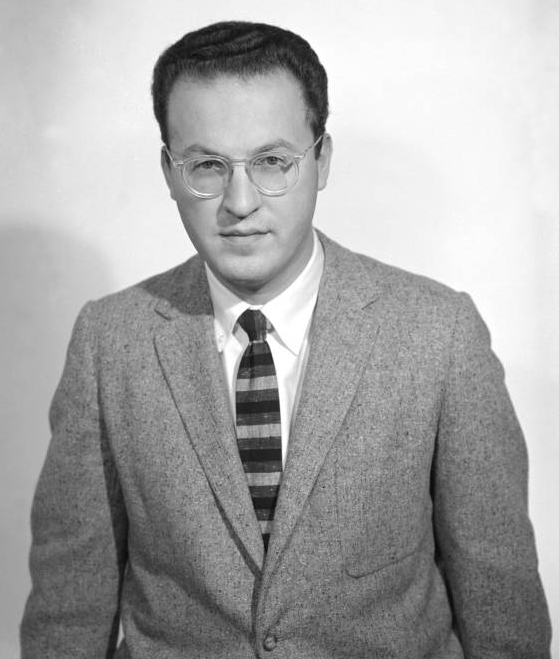
Donald A. Glaser
His bubble chamber let physicists see the paths of invisible particles, and he later co-founded Cetus, often called the first biotech firm.
The Nobel citation: “for the invention of the bubble chamber”
- Born
- September 21, 1926, Cleveland, OH, USA
- Died
- February 28, 2013, Berkeley, CA, USA
- Affiliation at the time
- University of California, USA
Physics prize
1960
Awarded alone.
Age that year
34years
Born in 1926.
Sources cited
24
Fact-checked September 24, 2026.
- His first bubble chamber held just a few cubic centimeters of ether, about the size of his thumb. The invention won him the 1960 Nobel Prize in Physics at age 34.
- He called the story that beer bubbles inspired him a myth. He did test hot beer near a radioactive source; the physics building reeked, and his teetotal chairman nearly fired him.
- In first or second grade, his principal urged sending him to a school for slow learners. His mother had his IQ tested instead, and the school dropped the idea.
- At the 1960 Nobel banquet he wore a white vest lent by 1951 laureate Edwin McMillan. Emilio Segrè had worn the same vest the year before.
- In 1971 he co-founded Cetus, often called the first biotech company. PCR, the DNA-copying method, was invented there, though he said he had no part in inventing it.
The breakthrough
The bubble chamber: making particle tracks visible in a boiling liquid (1952)
Atoms are built from particles far too small to see, and when accelerators smash them together, new short-lived particles fly out. To study them, physicists need to see their paths. For decades the cloud chamber had done this in gas: a charged particle left a trail of droplets, much like the white trail behind a jet plane. But the accelerators of the 1950s made particles so energetic that they shot straight through a thin gas. A gas chamber big enough to stop them would have had to be 100 meters long or more. Glaser's answer was to use a liquid, which is far denser. Think of a warm soda bottle: take off the cap and it foams. Glaser heated a liquid above its normal boiling point while keeping it under pressure, then suddenly released the pressure. For a brief moment the liquid is ready to boil but has not started. A charged particle passing through leaves a little energy along its path, and tiny bubbles form there, marking its track. A flash photo captures the trail within thousandths of a second. Then the pressure is restored, and the cycle repeats every few seconds, in step with the accelerator's pulses. His first chamber, built in 1952, held a few cubic centimeters of ether heated to about 140°C, though ether normally boils at 35°C. Later chambers, filled with liquid hydrogen and placed inside magnets that bend the tracks, grew to meters long.[2],[3],[5],[6]
“My work was inspired and was, in fact, only possible because of the work of my predecessors in this field.”
What it meant for humanity
The bubble chamber did not cure a disease or feed anyone. Its gift was understanding: it showed physicists what matter is made of. A dense liquid catches far more collisions than a gas, and a chamber could take a picture every few seconds, so each busy lab collected millions of photographs a year. A Berkeley colleague called it the dominant particle detector of the 1960s and '70s. With it, physicists uncovered a 'zoo' of new particles. Luis Alvarez's hydrogen chambers at Berkeley revealed many short-lived particles, work that won him the 1968 physics prize. In 1964 Brookhaven's 80-inch chamber found the omega-minus, a result that strongly supported a new scheme for sorting the zoo into orderly families, a kind of periodic table for particles. At CERN, the giant Gargamelle chamber helped show in 1972-74 that quarks carry fractional charges, and in 1973 gave the first direct evidence of the weak neutral current, backing the theory that unites electromagnetism and the weak nuclear force. The flood of pictures also pushed physicists toward machines that recognize patterns. The same physics lives on in bubble detectors, small gels dotted with superheated droplets that count neutrons. They measure unwanted neutron doses around radiotherapy machines, and they have measured radiation in space since 1989, including doses worn by astronauts on the space station. Glaser then helped start an industry. In 1971 he co-founded Cetus, often called the first biotechnology company. Cetus worked on cancer treatments based on interleukin and interferon, and one of its scientists, Kary Mullis, invented PCR, the DNA-copying method now central to medical research and forensics. Glaser said he had no part in that invention.
- In 1964 a Brookhaven team found the omega-minus particle with its 80-inch bubble chamber, the world's largest when it started up in 1963. The result strongly supported a new scheme for sorting the growing list of particles into orderly families.[11]
- CERN's 4.8-meter Gargamelle chamber supplied data in 1972-74 that, with US electron results, showed quarks carry a third or two-thirds of a proton's charge. In 1973 it gave the first direct evidence of the weak neutral current.[12]
- Luis Alvarez won the 1968 Nobel Prize in Physics for finding many short-lived 'resonance' particles, work that rested on his liquid-hydrogen bubble chambers and his computer methods for sorting through their photographs.[10]
- Bubble detectors, gels holding superheated droplets that turn into bubbles when hit by neutrons, work on the bubble chamber's principle. They measure neutron doses near radiotherapy machines and have measured radiation in space since 1989.[13],[14],[15]
- Each busy bubble-chamber lab produced millions of photographs a year, pushing physicists toward machine pattern recognition. A track-finding method Paul Hough of Ann Arbor filed to patent in 1960 was later refined to detect lines and curves in pictures.[3],[16],[17]
- Cetus, which Glaser co-founded in 1971, worked on cancer treatments based on interleukin and interferon. Kary Mullis, one of its scientists, invented PCR there, winning a share of the 1993 Nobel Prize in Chemistry.[7],[8],[18],[19]
Impact in numbers
We make no numerical claims for Glaser. The bubble chamber's payoff was knowledge: it helped map the particle zoo, supported the quark model and gave early evidence for the unified electroweak theory, but there is no honest way to turn that into lives saved or dollars. Its spin-offs, such as bubble detectors that measure neutron doses for radiotherapy patients, nuclear workers and astronauts, are real but have no published totals we could use. His other large legacy, co-founding Cetus, is hard to credit to him in numbers. Cetus's drugs and PCR came from company scientists; his own job there, he said, was mainly to recruit molecular biologists. He had no part in inventing PCR, though he recalled arguing against a chief executive's attempt to drop the project. A small founder's share of the biotech industry could be argued, but any figure would rest on guesswork about his role rather than on his science. His career shows how a simple instrument, used by physicists around the world, can move a whole field.
Fundamental scienceTechnologyHealthEconomy
No number is given here on purpose. Some contributions cannot be counted honestly, and we would rather describe them than invent a figure.
The double edge
We found no documented harms from the bubble chamber or from Glaser's own research. Glaser did name one cost of his success: the flood of bubble-chamber film turned his lab into a large operation of photo scanners that he likened to a sweatshop, and the field moved toward huge teams and machines. He disliked the shift, and it was one reason he left physics.
Against the odds
Glaser's own path shows American opportunity more than persecution, and we found no record of antisemitism aimed at him. His family's story starts with flight, though. His parents were children of about eight or nine when they left the Russian Empire in the early 1900s, from what Glaser believed was Ukraine. Glaser said families like theirs fled pogroms in which many Jews were killed. They arrived with little education, settled in Cleveland, and finished high school at night while working. They were among more than two and a half million East European Jews who came to America between 1881 and 1924, when restrictive laws largely shut the door. The America they found had barriers of its own. Developers' policies had kept Jews out of some of Cleveland's eastern suburbs, and most US medical schools capped Jewish admissions from the 1920s. Antisemitism was widespread in Depression-era America. Glaser's early hurdles were personal. A school principal wanted to move him to a school for slow learners, and his parents warned they could not pay for graduate school, so he earned nearly straight A's in college. Later, funders dismissed his bubble-chamber idea as too speculative, and one official called testing it an irresponsible use of public money.
—
Persecution
His parents left the Russian Empire (from Ukraine, he believed) as children of about eight or nine in the early 1900s. Glaser said families like theirs fled pogroms in which Jews were being killed in large numbers.[6],[20],[21]
—
Discrimination
In Cleveland, developers had kept Jews out of some eastern suburbs, and in the 1950s a court fight partly driven by antisemitism delayed a new synagogue in suburban Beachwood. We found no sign such barriers touched Glaser personally.[22]
—
Quota
From the 1920s most US medical schools capped the number of Jewish students, and the caps were still entrenched at the end of World War II, a time of widespread antisemitism. Glaser studied physics, and we found no sign quotas affected him.[23],[24]
—
Other
Bored in early grade school, he fell behind, and his principal recommended a school for slow learners. His mother, who had little schooling herself, had his IQ tested to keep him in regular school.[6]
—
Other
Funders first turned down the bubble chamber as too speculative. When he asked to test it at Brookhaven's accelerator, the official in charge called it an irresponsible use of public money; a Michigan colleague's intervention got him in.[6],[7]
Jewish background
Glaser's parents, William and Lena Glaser, were Jewish immigrants who came separately, as children, from the Russian Empire (from Ukraine, Glaser believed) in the early 1900s. He said families like theirs left because of pogroms in which many Jews were killed. Both settled in Cleveland with their large families. When he won the Nobel Prize in 1960, the Jewish Telegraphic Agency reported that he was a regular contributor to the United Jewish Appeal. We found little else about his personal relationship to Judaism; in his long oral history he mentioned his Jewish background mainly to explain why his parents emigrated.[2],[6],[7],[9]
Key dates
September 21, 1926
Born in Cleveland, Ohio, to William J. Glaser, a businessman, and Lena Glaser, Jewish immigrants from the Russian Empire.[1],[2],[6]
1946
Earns a B.Sc. in physics and mathematics at the Case School of Applied Science in Cleveland, having played viola in the Cleveland Philharmonic as a student, then teaches math there that spring.[1],[6],[7]
1949
Finishes his Caltech PhD research on cosmic rays under Carl Anderson and joins the University of Michigan faculty; the degree is formally awarded in 1950.[1],[4]
1952
At Michigan, builds the first bubble chamber: a thumb-sized glass vessel of superheated ether that shows the tracks of passing particles.[1],[3],[6],[8]
1953
Presents his results to the American Physical Society and meets Luis Alvarez, whose Berkeley team goes on to build large liquid-hydrogen bubble chambers.[3],[7]
1959
Moves to the University of California, Berkeley, as a professor of physics.[1],[7]
1960
Marries Ruth Bonnie Thompson; they later have two children.[1],[7]
December 10, 1960
Receives the Nobel Prize in Physics, unshared, for the invention of the bubble chamber, at age 34.[2],[5],[8]
1962
Leaves physics for molecular biology, partly because bubble-chamber research had grown into big teams, big machines and constant travel.[1],[6]
1971
Co-founds Cetus Corporation in Berkeley with Ronald Cape and Peter Farley to apply molecular biology to medicine and agriculture.[1],[7],[8],[18]
1975
Marries Lynn Bercovitz, a painter and musician.[1]
1991
Cetus is sold to Chiron Corporation. By then Glaser has turned to neuroscience, building computer models of human vision.[1],[7],[8]
February 28, 2013
Sources
- 1.Donald A. Glaser - Biographical (with 2005 addendum) · NobelPrize.org (from Nobel Lectures, Physics 1942-1962, Elsevier, 1964; addendum 2005), 1964
- 2.Donald A. Glaser - Facts · NobelPrize.org (Nobel Prize Outreach)
- 3.Elementary Particles and Bubble Chambers (Nobel Lecture, 12 December 1960) · NobelPrize.org, 1960
- 4.Donald A. Glaser - Banquet speech (Stockholm, 10 December 1960) · NobelPrize.org, 1960
- 5.Award ceremony speech, Nobel Prize in Physics 1960 (Presentation Speech by Professor K. Siegbahn) · NobelPrize.org, 1960
- 6.Donald Glaser: The Bubble Chamber, Bioengineering, Business Consulting, and Neurobiology (oral history conducted 2003-2004 by Eric Vettel) · Regional Oral History Office, The Bancroft Library, University of California, Berkeley, 2006
- 7.In Memoriam: Donald Arthur Glaser, Professor of Physics and Molecular and Cell Biology, Emeritus, UC Berkeley, 1926-2013 · University of California Academic Senate, 2013
- 8.Physics Nobelist and biotech pioneer Donald Glaser dies at 86 (by Robert Sanders) · Berkeley News, University of California, Berkeley, 2013
- 9.Donald Glaser, Young Jewish Nobel Prize Winner, is Contributor to U.J.A. · Jewish Telegraphic Agency (archive, 7 November 1960), 1960
- 10.Luis Alvarez - Facts (Nobel Prize in Physics 1968) · NobelPrize.org (Nobel Prize Outreach)
- 11.Our History: Accelerators (80-inch and 7-foot bubble chambers) · Brookhaven National Laboratory
- 12.Gargamelle · CERN
- 13.Superheated liquid and its place in radiation physics (S.C. Roy, Radiation Physics and Chemistry 61: 271-281) · Elsevier (copy hosted on the Jefferson Lab wiki), 2001
- 14.Measuring radiation in space with bubble detectors · Canadian Space Agency
- 15.Radi-N2: Tracking space radiation and its risks · Canadian Space Agency
- 16.US Patent 3,069,654: Method and means for recognizing complex patterns (Paul V. C. Hough, filed 1960, granted 1962) · Google Patents (US Patent and Trademark Office record), 1962
- 17.Use of the Hough transformation to detect lines and curves in pictures (R.O. Duda and P.E. Hart) · Communications of the ACM, 1972
- 18.The Original Biotech (letter to the editor by Arnold L. Demain) · The Scientist, 2004
- 19.Kary B. Mullis - Facts (Nobel Prize in Chemistry 1993) · NobelPrize.org (Nobel Prize Outreach)
- 20.Pogroms (Holocaust Encyclopedia) · United States Holocaust Memorial Museum
- 21.A Century of Immigration, 1820-1924 (From Haven to Home: 350 Years of Jewish Life in America) · Library of Congress
- 22.Jews & Judaism (Encyclopedia of Cleveland History) · Case Western Reserve University
- 23.Why Did the United States Medical School Admissions Quota for Jews End? (E.C. Halperin, American Journal of the Medical Sciences 358: 317-325) · PubMed (National Library of Medicine), 2019
- 24.The United States and the Holocaust (Holocaust Encyclopedia) · United States Holocaust Memorial Museum
Fact-checked on September 24, 2026 by a separate AI fact-checking pass that re-opened the sources, with 8 corrections made. How we check
Suggest a correction