
Nobel Prize in Physiology or Medicine · 2021
David Julius
A Brooklyn grandson of Jewish immigrants who used chili peppers to find the nerve sensor that feels burning heat and pain.
The Nobel citation: “for their discoveries of receptors for temperature and touch”
- Born
- November 4, 1955, New York, NY, USA
- Shared with
- Ardem Patapoutian
- Affiliation at the time
- University of California, USA
Medicine prize
2021
Shared with 1 other laureate.
Age that year
66years
Born in 1955.
Sources cited
27
Fact-checked September 24, 2026.
- He found the body's sensor for painful heat by using capsaicin, the chemical that makes chili peppers taste hot.
- His grandparents fled Czarist Russia and antisemitism. He grew up in Brighton Beach, Brooklyn, a landing place for Eastern European immigrants, many of them Jewish.
- He is the fourth Nobel laureate from Brooklyn's Abraham Lincoln High School, after Arthur Kornberg, Paul Berg and Jerome Karle.
- After a year of three-hour daily subway trips, he took himself out of elite Stuyvesant High School and switched to his local public school.
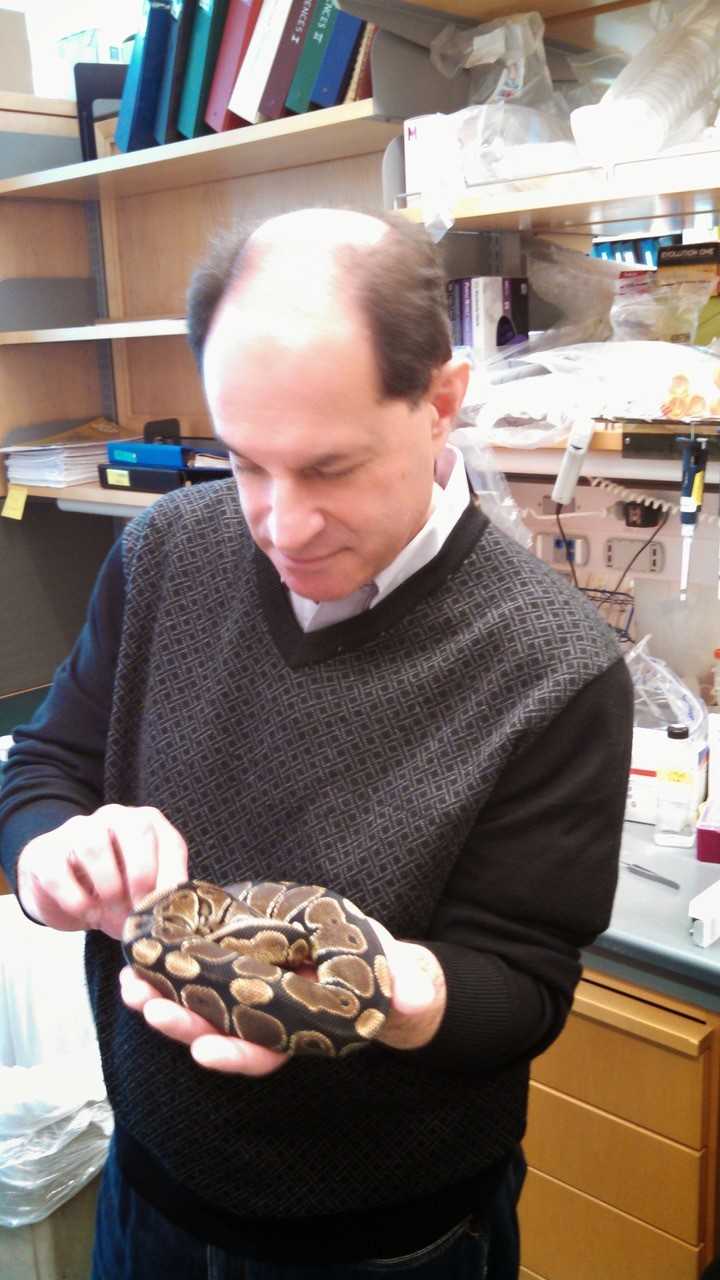
- His lab studied the same heat sensor in vampire bats, which carry a version tuned to about 30°C that helps them find warm blood.
The breakthrough
Finding the nerve sensors for heat, cold and chemical pain
Touch a hot pan and you pull your hand away before you even think. Nerve endings in your skin sense the heat and send an electrical signal to your brain. But until the late 1990s, nobody knew which molecule actually detects heat. Julius found it with a trick from the kitchen. Capsaicin, the chemical in chili peppers, makes your mouth feel like it is burning, so he guessed that capsaicin and real heat might set off the same sensor. His team made a library of genes that are switched on in pain-sensing nerve cells. They put batches of about 16,000 genes at a time into ordinary lab cells that do not normally react to capsaicin, then watched for cells that lit up when capsaicin was added. They narrowed one glowing batch down to a single gene. It made a gate-like protein in the cell's outer wall, called an ion channel, that opens in response to capsaicin. It also opens at temperatures that feel painfully hot. That is why chili peppers feel hot: they flip the same switch as heat does. The sensor is now called TRPV1. Mice bred without it had trouble sensing painful heat and did not react to capsaicin. Julius's lab then used menthol from mint to find TRPM8, a sensor for cold, and mustard oil to show that another channel, TRPA1, senses sharp chemical irritants. Together these showed how the body turns temperature and irritants into nerve signals.[1],[3],[4],[5],[6],[7],[8],[26]
“While Nobel Prizes are awarded to specific individuals, their power is in inspiring the world to value and trust fact-based thinking”
What it meant for humanity
Pain is the body's alarm system, and Julius found some of its first molecular sensors. Before 1997, scientists knew that certain nerve cells respond to heat and to capsaicin, but not what molecule does the sensing. His discovery of TRPV1, followed by the cold sensor TRPM8 and the irritant sensor TRPA1, gave researchers concrete targets. The Nobel Assembly said the work launched intense research into how the nervous system senses heat, cold and touch, and that this knowledge is being used to develop treatments for conditions including chronic pain. That need is large. In 2021 about 51.6 million adults in the United States, roughly one in five, lived with chronic pain. Julius has pointed to the opioid epidemic as a sign of how poorly current treatments meet that need. So far the payoff in the clinic is modest and partly indirect. A high-strength capsaicin skin patch, approved in the United States in 2009 for nerve pain after shingles and in 2020 for diabetic nerve pain in the feet, is now described by regulators as a TRPV1 agonist: it first overstimulates the pain fibers, which then quiet down, and its maker says relief can last up to three months. It gives a non-opioid option. Attempts to make pills that block TRPV1 ran into side effects, and Julius wrote in his 2021 Nobel lecture that TRPV1 and TRPA1 drugs were still being tested. In 2013 his lab and Yifan Cheng's used an advanced microscope method, cryo-EM, to see TRPV1's shape in near-atomic detail, as part of that method's 'resolution revolution'. His lab also cloned a serotonin-gated channel that anti-nausea drugs target (1991) and, with colleagues, the platelet receptor that the widely used blood thinner clopidogrel blocks (2001).
- In 1997 his team cloned the capsaicin receptor, now called TRPV1, and showed that it is also switched on by painful heat. In 2000 they showed that mice lacking it show no pain response to capsaicin and have trouble sensing painful heat.[3],[5],[6]
- In 2002 his lab used menthol to find TRPM8, a cold sensor (found independently by Ardem Patapoutian's lab), and in 2004 showed that mustard oil acts through TRPA1, a sensor for irritants and inflammatory pain.[3],[7],[8],[15],[16]
- The need is large: in 2021 about 51.6 million US adults, 20.9 percent, had chronic pain, and 17.1 million had pain that substantially limited daily life.[25]
- With UCSF colleague Yifan Cheng, his lab used cryo-electron microscopy to reveal TRPV1's structure in near-atomic detail in 2013, part of the method's 'resolution revolution'.[2],[9],[15]
- The US drug label for the 8% capsaicin patch, a non-opioid treatment for nerve pain, calls it a TRPV1 agonist. It was approved for pain after shingles in 2009 and for diabetic nerve pain in the feet in 2020.[13],[14]
- In 2001 his lab and colleagues cloned P2Y12, the platelet receptor that the antiplatelet drugs ticlopidine and clopidogrel act on, whose identity had been unknown.[10]
Impact in numbers
Julius's contribution is mainly knowledge, so this profile makes no numerical impact claim. He found the molecules that let nerves feel burning heat, cold and chemical irritation, which turned pain from a black box into a set of named, testable targets. That matters because chronic pain affects about one in five American adults and the main existing drugs, opioids and anti-inflammatories, have well-known limits. The only approved medicine acting on his receptor, a high-dose capsaicin patch, relies on a desensitizing effect of capsaicin that Hungarian researchers described decades earlier, so it cannot fairly be credited mainly to him, and no published count of patients helped exists. Pills that block TRPV1 have so far failed because of fevers and dulled heat pain. What his work has delivered for certain is a molecular explanation of everyday experiences, from the bite of chili and the cool of mint to the throb of a sunburn, plus tools, structures and drug targets that pain researchers worldwide now use.
HealthFundamental science
No number is given here on purpose. Some contributions cannot be counted honestly, and we would rather describe them than invent a figure.
The double edge
We found no documented misuse of Julius's discoveries and no personal controversy. The harms so far have come from efforts to turn TRPV1 into drugs. Because TRPV1 helps the body sense heat and control its temperature, pills that block it can raise body temperature and dull the warning pain from hot objects. In Amgen's early trials of one such drug, AMG 517, body temperature rose, generally more at higher blood levels of the drug. When it was given after molar extraction, it caused long-lasting fevers, with the highest body temperature above 40°C. Its makers concluded that such blockers could not be used on their own as general painkillers. Julius noted these on-target side effects in his Nobel lecture. The approved capsaicin patch works through the same receptor. Its US label warns of burning pain during treatment and short-term rises in blood pressure, and since 2024 it has also warned of severe second- and third-degree burns reported after use.
- Minor
TRPV1-blocking painkillers caused high fevers in trials
In Amgen's phase 1 trials of the TRPV1 blocker AMG 517, the drug raised body temperature. Given after molar extraction, it caused long-lasting fevers, with a peak body temperature above 40°C. The researchers concluded that selective TRPV1 blockers could not be developed as stand-alone systemic drugs. Julius's Nobel lecture notes that the fever is usually small and brief but can be larger in rare cases, and that such drugs also reduce sensitivity to painful heat, weakening a protective reflex.[4],[12],[26]
- Minor
Side effects of the capsaicin patch
The current US label for the capsaicin patch lists application-site pain, redness and itching, and short-term rises in blood pressure during or shortly after treatment. A warning added in 2024 says second-degree and third-degree burns have been reported, and post-approval reports also include scarring and accidental exposure of the eyes and throat.[13]
Against the odds
Julius's story shows what the escape from persecution made possible one generation later, not a life of persecution itself. His grandparents left Czarist Russia, where Jews faced waves of violence. From 1881 to 1884, after the killing of Tsar Alexander II, mobs attacked Jewish communities across the empire's south and west, and these attacks made the word pogrom widely known. Rioters killed, raped and robbed Jews, at times with the backing of officials or police. Between 1881 and 1924 more than two and a half million Jews from Eastern Europe came to the United States, driven by persecution and poverty. Julius writes that his grandparents fled antisemitism in pursuit of a better life. In the new country the barriers were milder but real. In the 1920s Columbia, Harvard and Yale began limiting how many Jewish students they admitted, and those schools did not admit many more Jews until the 1960s. Julius was born in 1955, after the worst of that era. His parents went to tuition-free Brooklyn College, and he describes a modest, close-knit Brighton Beach home where family money went to the children's opportunities. We found no record of antisemitism he personally faced. He entered MIT in the 1970s, though no one in his family had attended a private college, and his parents stretched to pay the tuition.
—
Persecution
His grandparents were among the Eastern European Jews who fled Czarist Russia and its antisemitism for Brooklyn, where they settled in the Brighton Beach immigrant enclave.[2],[18],[22],[23]
—
Discrimination
In the generation before his, Columbia, Harvard and Yale began limiting Jewish admissions in the 1920s, and they did not admit many more Jews until the 1960s. By the time Julius applied to college in the 1970s, those barriers had largely eased.[24]
—
Poverty
His family lived in the bottom flat of a small semi-attached house with relatives upstairs. MIT tuition was a stretch for his parents, who warned he might have to move to a state college if money ran short. He paid his way in part with summer jobs such as packing merchandise and cleaning offices.[2]
Jewish background
Julius was born in 1955 and grew up in Brighton Beach, Brooklyn. In his Nobel autobiography he writes that his grandparents were Eastern European immigrants who fled Czarist Russia and antisemitism, and that his parents grew up in that immigrant enclave. His maternal grandmother lived upstairs from his family and his paternal grandparents lived a few blocks away. When he won the Nobel Prize, the Jewish Telegraphic Agency and the Times of Israel reported on his Jewish family roots. We found no statement by Julius about his own religious practice or personal Jewish identity.[2],[18],[19],[20],[21]
Key dates
November 4, 1955
Born in New York City. He grows up in Brighton Beach, Brooklyn, the grandson of Jewish immigrants who fled Czarist Russia.[1],[2]
1977
Earns a bachelor's degree in life sciences at MIT, after undergraduate research in Alexander Rich's lab.[2],[17]
1984
Completes a PhD at UC Berkeley under Randy Schekman and Jeremy Thorner, where he identified the yeast enzyme KEX2, first of a family of hormone-processing enzymes.[2],[17]
1984
Starts postdoctoral work with Richard Axel at Columbia University, where he clones a serotonin receptor.[2],[17]
1989
Joins the faculty of the University of California, San Francisco.[2],[15]
1991
His lab reports the cloning of the 5-HT3 receptor, a serotonin-gated ion channel.[11]
October 1997
Publishes the cloning of the capsaicin receptor, now called TRPV1, a heat-activated ion channel in the pain pathway.[3],[5]
April 2000
Shows that mice lacking TRPV1 have trouble detecting painful heat and do not respond to capsaicin.[6]
March 2002
Identifies TRPM8, a cold and menthol receptor, showing that TRP channels sense a wide range of temperatures.[3],[7]
January 2004
Shows that mustard oil excites pain-sensing nerves through the channel now called TRPA1.[8]
December 2013
With Yifan Cheng's lab, publishes a near-atomic structure of TRPV1 obtained by cryo-electron microscopy.[9],[15]
2020
Shares the Kavli Prize in Neuroscience with Ardem Patapoutian for discovering receptors for temperature and pressure.[17],[27]
October 4, 2021
Awarded half of the Nobel Prize in Physiology or Medicine, shared with Ardem Patapoutian, for discoveries of receptors for temperature and touch.[1],[3],[15]
December 7, 2021
Delivers his Nobel lecture, From peppers to peppermints: insights into thermosensation and pain.[4]
Sources
- 1.David Julius - Facts · NobelPrize.org (Nobel Prize Outreach)
- 2.David Julius - Biographical · NobelPrize.org (The Nobel Foundation), 2023
- 3.Press release: The Nobel Prize in Physiology or Medicine 2021 · NobelPrize.org (The Nobel Assembly at Karolinska Institutet), 2021
- 4.From peppers to peppermints: Insights into thermosensation and pain (Nobel Lecture, 7 December 2021) · NobelPrize.org, 2021
- 5.The capsaicin receptor: a heat-activated ion channel in the pain pathway (Caterina MJ, Schumacher MA, Tominaga M, Rosen TA, Levine JD, Julius D), Nature 389:816-824 · Nature (via PubMed), 1997
- 6.Impaired nociception and pain sensation in mice lacking the capsaicin receptor (Caterina MJ et al.), Science 288:306-313 · Science (via PubMed), 2000
- 7.Identification of a cold receptor reveals a general role for TRP channels in thermosensation (McKemy DD, Neuhausser WM, Julius D), Nature 416:52-58 · Nature (via PubMed), 2002
- 8.Mustard oils and cannabinoids excite sensory nerve fibres through the TRP channel ANKTM1 (Jordt SE, Bautista DM, Chuang HH et al.), Nature · Nature (via PubMed), 2004
- 9.Structure of the TRPV1 ion channel determined by electron cryo-microscopy (Liao M, Cao E, Julius D, Cheng Y), Nature · Nature (via PubMed), 2013
- 10.Identification of the platelet ADP receptor targeted by antithrombotic drugs (Hollopeter G et al.), Nature 409:202-207 · Nature (via PubMed), 2001
- 11.Primary structure and functional expression of the 5HT3 receptor, a serotonin-gated ion channel (Maricq AV, Peterson AS, Brake AJ et al.), Science · Science (via PubMed), 1991
- 12.Pharmacological blockade of the vanilloid receptor TRPV1 elicits marked hyperthermia in humans (Gavva NR et al.), Pain 136:202-210 · Pain (via PubMed), 2008
- 13.QUTENZA (capsaicin) topical system, prescribing information (revised July 2024) · US Food and Drug Administration (Drugs@FDA), 2024
- 14.US FDA approval of QUTENZA for the treatment of neuropathic pain associated with DPN of the feet · Grünenthal (press release), 2020
- 15.David Julius Wins Nobel Prize for Work on Pain Sensation (Kristen Bole) · UC San Francisco, 2021
- 16.Double Win: UCSF Alum Ardem Patapoutian Shares Nobel with UCSF Professor David Julius (Robin Marks) · UC San Francisco, 2021
- 17.David Julius (2020 Kavli Prize in Neuroscience laureate biography) · The Kavli Prize, 2020
- 18.Scientist David Julius, whose grandparents fled antisemitism in Czarist Russia, wins Nobel Prize in medicine (Shira Hanau) · Jewish Telegraphic Agency, 2021
- 19.Nobel Winner David Julius Remembers His Youth in 'Dense, Gritty' Brighton Beach (Shira Hanau) · Jewish Telegraphic Agency, 2021
- 20.Prof. whose grandparents fled antisemitism in Czarist Russia wins medicine Nobel · The Times of Israel, 2021
- 21.David Julius · Wikipedia
- 22.Pogroms · United States Holocaust Memorial Museum, Holocaust Encyclopedia
- 23.A Century of Immigration, 1820-1924 (From Haven to Home: 350 Years of Jewish Life in America) · Library of Congress
- 24.How the Ivy League's Jewish quotas shaped higher education (Susan H. Greenberg, interview with Mark Oppenheimer) · Inside Higher Ed, 2022
- 25.Chronic Pain Among Adults - United States, 2019-2021 (Rikard SM, Strahan AE, Schmit KM, Guy GP Jr.), MMWR 72(15) · US Centers for Disease Control and Prevention, 2023
- 26.Targeting TRP Channels for Pain, Itch and Neurogenic Inflammation (Koivisto AP, Szallasi A), International Journal of Molecular Sciences · International Journal of Molecular Sciences (via PubMed Central), 2023
- 27.2020 Kavli Prize in Neuroscience: David Julius and Ardem Patapoutian · The Kavli Prize, 2020
Fact-checked on September 24, 2026 by a separate AI fact-checking pass that re-opened the sources, with 10 corrections made. How we check
Suggest a correction