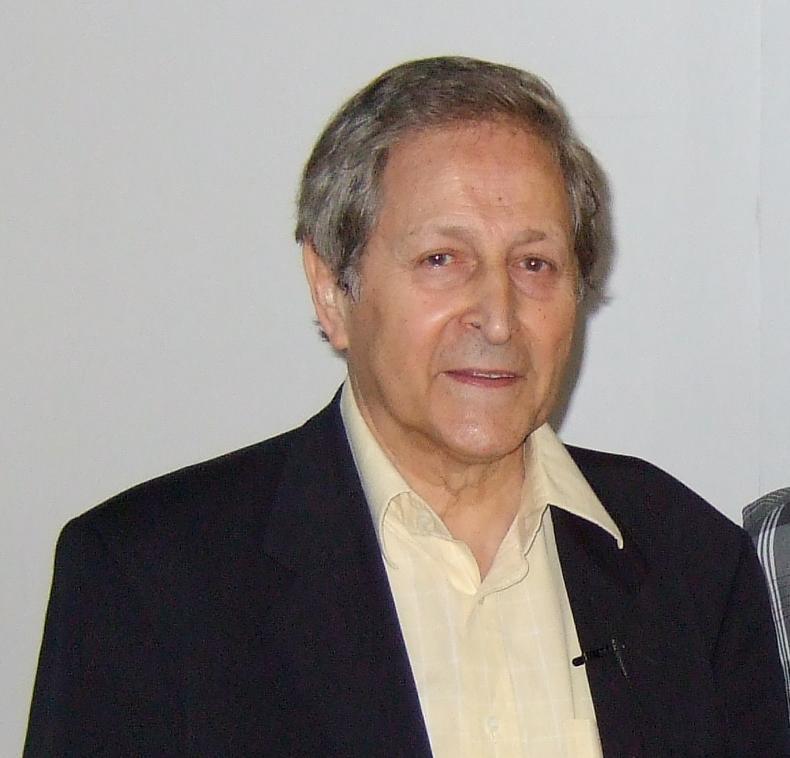

Nobel Prize in Physics · 1997
Claude Cohen-Tannoudji
He explained how laser light can chill atoms to near absolute zero, opening the way to ultra-precise clocks and new quantum physics.
The Nobel citation: “for development of methods to cool and trap atoms with laser light”
- Born
- April 1, 1933, Constantine, French Algeria (now Algeria)
- Shared with
- Steven Chu, William D. Phillips
- Affiliation at the time
- Collège de France, France; École Normale Supérieure, France
Physics prize
1997
Shared with 2 other laureates.
Age that year
64years
Born in 1933.
Sources cited
17
Fact-checked September 24, 2026.
- He saw the first evidence of 'light shifts', an effect he had predicted, on Christmas Eve 1960, using a colleague's apparatus lent to him over the holidays.
- His group cooled helium atoms to 0.18 millionths of a degree above absolute zero, so cold that they crept along at about 2 cm per second.
- His surname means 'the Cohen family from Tangier'. His ancestors fled the Spanish Inquisition and settled in Tunisia and then Algeria in the 16th century.
- His group coined the name 'Sisyphus cooling' in 1986, after the figure of Greek myth doomed to push a stone uphill forever.
- In 2025 PHARAO, a clock using laser-cooled cesium atoms and developed with partners including his Paris laboratory, became the first such clock in orbit.
The breakthrough
Sisyphus cooling and chilling atoms below the 'recoil limit' (1985-1995)
The atoms in the air around us rush about far too fast to study closely. Light can slow them down. Each particle of light, a photon, carries a tiny push, and an atom hit head-on by many photons slows, a bit like a curling stone struck by another stone. In the mid-1980s Steven Chu's group used crossed laser beams to cool atoms this way, and William Phillips's group slowed and trapped them. Theory said there was a floor, the 'Doppler limit', but in 1988 Phillips measured sodium atoms six times colder. Cohen-Tannoudji and Jean Dalibard in Paris, and Chu's group at Stanford, explained why. Real atoms have several internal states, and the crossed beams build a landscape of hills and valleys that differs for each state. A moving atom climbs a hill and slows down. Near the top, the light flips its internal state, so the atom finds itself at the bottom of a new hill and must climb again. Like Sisyphus in Greek myth, forever pushing his stone uphill, the atom keeps losing speed. His group then broke a second barrier, the 'recoil limit' set by the kick of a single photon. Using a quantum interference effect, atoms that were almost standing still were switched into a 'dark' state in which they stopped absorbing light, while moving atoms kept being jostled until they too fell into it. By 1995 helium atoms reached 0.18 millionths of a degree above absolute zero.[2],[3],[4],[6]
“He taught me what I regard as being the fundamental features of the Jewish tradition – studying, learning and sharing knowledge with others.”
What it meant for humanity
Cold, slow atoms can be watched for much longer, and that makes measurements far more precise. The Royal Swedish Academy of Sciences listed atomic clocks, atom interferometers that measure gravity, atom optics and the first Bose-Einstein condensates among the uses of laser cooling. Clocks came first. In a fountain clock, laser-cooled atoms are tossed upward and fall back through a microwave cavity, so each measurement lasts about a second instead of the hundredth of a second possible in older beam clocks. In his 1997 Nobel lecture he noted that one cesium fountain, the BNM-LPTF fountain, was then the most accurate primary time standard. Fountain clocks now serve as national standards for the length of a second: NIST's cesium fountain NIST-F2, launched in 2014, would neither gain nor lose a second in about 300 million years, and NIST says phones, GPS receivers and the power grid rely on accurate atomic clocks. In April 2025 PHARAO, a laser-cooled cesium clock developed with partners including his Paris laboratory, became the first clock of that type in orbit, attached to the International Space Station to test Einstein's theory of gravity. Laser cooling also formed the basis for creating Bose-Einstein condensates in 1995, a new state of matter honoured with the 2001 Nobel Prize, and a 2020 review describes quantum processors built from single atoms held in arrays of light traps. His influence also runs through people and books. His quantum mechanics textbook with Bernard Diu and Franck Laloë, first published in 1973, was translated into several languages and reissued in 2018-2019 with a third volume. Serge Haroche, who shared the 2012 Nobel Prize in Physics, did his thesis work in Cohen-Tannoudji's group.
- Between 1988 and 1995 his group cooled atoms below the 'recoil limit' once thought fundamental. The Nobel committee credits his work with opening the whole area of sub-recoil laser cooling.[4]
- In fountain clocks, laser-cooled atoms are tossed up and fall back, stretching each measurement about 100-fold. NIST's fountain NIST-F2 would neither gain nor lose a second in about 300 million years.[5],[11]
- PHARAO, a laser-cooled cesium clock developed with partners including his Paris laboratory, launched to the International Space Station in April 2025, the first cold-cesium clock in orbit.[12]
- The Nobel committee said laser cooling formed the basis for the discovery of Bose-Einstein condensation in atomic gases, first achieved in 1995 and honoured with the 2001 physics prize.[3],[13]
- His quantum mechanics textbook with Bernard Diu and Franck Laloë, first published in 1973, was widely used and translated into several languages; a third volume appeared in 2019.[6],[7]
- Serge Haroche, winner of the 2012 Nobel Prize in Physics, was one of the students who did thesis work in his group on the 'dressed atom' picture of atoms and light.[2],[17]
Impact in numbers
Cohen-Tannoudji's impact is mostly on understanding and on the tools of precision measurement. His theory helped explain why laser cooling worked far better than expected, and his sub-recoil methods reached temperatures below a limit once thought fundamental. Laser cooling as a whole, built by Chu, Phillips, his Paris group and many others, now underpins fountain clocks that realize the second, the first Bose-Einstein condensates, atom interferometers and neutral-atom quantum processors. His textbooks and lectures have taught quantum physics to many students, and his group trained a future Nobel laureate. We record no quantified claims. NIST runs its fountain clocks for a few weeks at a time to calibrate ensembles of other clocks, and we found no source that isolates their contribution to GPS or other services, so any number would be invented. Quantum computing and quantum sensing have no countable benefits yet. No harm claim is recorded because the risk to encryption is still prospective.
Fundamental scienceTechnology
No number is given here on purpose. Some contributions cannot be counted honestly, and we would rather describe them than invent a figure.
The double edge
No documented harm flows from Cohen-Tannoudji's work, which is basic research, and our sources record no controversy about him. The main risk lies downstream and in the future. Atoms held and controlled by laser light are one of the platforms being developed for quantum computers. NIST warns that such computers could one day break the encryption that protects almost everything done online, reports that some experts expect a code-breaking machine within a decade, and in 2024 issued new encryption standards designed to resist one. His contribution to that technology is foundational and indirect.
- Minor
A future threat to today's encryption
A 2020 review describes quantum processors built from single neutral atoms trapped and controlled by light. NIST says quantum computers could break the encryption that secures online life and that some experts expect such a machine within a decade; in August 2024 it finalized standards designed to resist them. Cohen-Tannoudji's link to this is early and indirect, through the wider science of manipulating atoms with light.[14],[15]
Against the odds
Cohen-Tannoudji grew up Jewish in French Algeria during a violent and frightening time. Algerian Jews had become French citizens in 1870, which set off repeated waves of antisemitism. In August 1934, when he was one year old, rioters in Constantine, his birthplace, killed 25 Jews and wounded dozens while French forces failed to intervene. His family moved to Algiers in 1938, a decision his Paris laboratory's history page links to that violence. In autumn 1940 the Vichy regime stripped Algeria's roughly 117,000 Jews of French citizenship, counted them in a census and imposed quotas in schools. The colonial administration applied these laws with particular severity: Jewish children were pushed out of schools, and the community had to organize its own classes. Our sources do not say how this affected his own schooling. He writes that the American landings of November 1942 saved his family from the Nazi persecution spreading across Europe, but the anti-Jewish measures lasted until October 1943, when citizenship was restored. In 2018 Germany agreed to recognize Algerian Jews of that era as Holocaust survivors. He left for Paris in 1953, before the Algerian war, and later served 28 months in the army, a term lengthened by that war. Our sources document no antisemitic obstacles in his career in France.
1934
Antisemitic attack
In August 1934 rioters in Constantine, his birthplace, killed 25 Jews and wounded dozens. His family left Constantine for Algiers in 1938, following what his Paris laboratory's history page calls bloody antisemitic demonstrations.[6],[10]
1940
Discrimination
From autumn 1940, when he was seven and in elementary school in Algiers, Vichy rule stripped Algerian Jews of French citizenship, counted them in a census and imposed quotas in schools. The measures lasted until October 1943. Our sources do not say whether he was personally excluded.[6],[9]
1957
War
His military service lasted 28 months, longer than usual because of the Algerian war, before he could return to the laboratory in early 1960 to begin his doctorate. Part of it was spent studying the upper atmosphere with rockets.[2]
Jewish background
Cohen-Tannoudji was born in Constantine, Algeria, to Sephardic Jewish parents, Abraham Cohen-Tannoudji and Sarah Sebbah. He writes that his family came from Tangier and, after fleeing Spain during the Inquisition, settled in Tunisia and then Algeria in the 16th century. His self-taught father read biblical and Talmudic texts alongside philosophy and history, and passed on what his son calls the core of Jewish tradition: study, learning and sharing knowledge. Our sources describe no religious practice. He holds honorary doctorates from the Hebrew University of Jerusalem and Bar-Ilan University, and received the Technion's Harvey Prize in 1996.[2],[7],[8],[16]
Key dates
April 1, 1933
Born in Constantine, French Algeria, the eldest of three children in a modest Sephardic Jewish family.[1],[2],[6],[8]
1938
His family moves from Constantine to Algiers, where he attends elementary school.[6]
1940
Vichy laws strip Algeria's Jews of French citizenship and impose quotas in schools; the measures last until October 1943.[6],[9]
1953
Admitted second in the entrance exam, he leaves Algiers for the École Normale Supérieure in Paris.[2],[6]
1955
Drawn from mathematics to physics by Alfred Kastler's lectures, he joins the small optical pumping group of Kastler and Jean Brossel.[2],[6]
December 24, 1960
On Christmas Eve he obtains the first experimental evidence of 'light shifts', an effect his calculations had predicted.[2]
December 1962
Submits his doctoral thesis on the quantum theory of optical pumping.[2],[6]
1973
Becomes professor at the Collège de France, holding the chair of atomic and molecular physics until 2004; his quantum mechanics textbook appears the same year.[6],[7]
1984
Forms a new experimental group on laser cooling and trapping with Alain Aspect and Jean Dalibard; Christophe Salomon joins a year later.[2]
1988
His group helps explain the unexpectedly low temperatures Phillips measured, and first cools helium below the single-photon recoil limit.[2],[4]
1993
His eldest son, Alain, dies at 34 after a long illness; he later dedicates his Nobel lecture to him.[2]
1995
Sub-recoil cooling in three dimensions brings helium atoms to 0.18 millionths of a degree above absolute zero.[3],[4]
October 15, 1997
Awarded one third of the Nobel Prize in Physics, with Steven Chu and William D. Phillips, for methods to cool and trap atoms with laser light.[1],[3]
April 21, 2025
PHARAO, a laser-cooled cesium clock developed with partners including his Paris laboratory, is launched to the International Space Station.[12]
Sources
- 1.Claude Cohen-Tannoudji - Facts · NobelPrize.org (Nobel Prize Outreach)
- 2.Claude Cohen-Tannoudji - Biographical (autobiography) · NobelPrize.org (from Les Prix Nobel, The Nobel Prizes 1997), 1998
- 3.The Nobel Prize in Physics 1997 - Press release · NobelPrize.org (Royal Swedish Academy of Sciences), 1997
- 4.Additional background material on the Nobel Prize in Physics 1997 (Advanced information) · NobelPrize.org (Royal Swedish Academy of Sciences), 1997
- 5.Manipulating Atoms with Photons (Nobel Lecture, 8 December 1997) · NobelPrize.org, 1997
- 6.Claude Cohen-Tannoudji (history of the laboratory) · Laboratoire Kastler Brossel (ENS, Sorbonne Université, CNRS, Collège de France)
- 7.Claude Cohen-Tannoudji (professor's page: career, honours and books) · Collège de France
- 8.Claude Cohen-Tannoudji · Wikipedia
- 9.Algeria Virtual Jewish History Tour (from the Encyclopaedia Judaica) · Jewish Virtual Library (American-Israeli Cooperative Enterprise)
- 10.Constantine (from the Encyclopaedia Judaica) · Jewish Virtual Library (American-Israeli Cooperative Enterprise)
- 11.NIST Launches a New U.S. Time Standard: NIST-F2 Atomic Clock · National Institute of Standards and Technology (US Department of Commerce), 2014
- 12.PHARAO: the cold-atom clock on the International Space Station · CNES (French space agency)
- 13.The Nobel Prize in Physics 2001 - Press release · NobelPrize.org (Royal Swedish Academy of Sciences), 2001
- 14.Quantum computing with neutral atoms, by L. Henriet, L. Beguin, A. Signoles, T. Lahaye, A. Browaeys, G.-O. Reymond and C. Jurczak · arXiv (preprint 2006.12326), 2020
- 15.NIST Releases First 3 Finalized Post-Quantum Encryption Standards · National Institute of Standards and Technology (US Department of Commerce), 2024
- 16.Claude Cohen-Tannoudji - Interview (June 2009) · NobelPrize.org, 2009
- 17.Serge Haroche - Facts · NobelPrize.org (Nobel Prize Outreach)
Fact-checked on September 24, 2026 by a separate AI fact-checking pass that re-opened the sources, with 3 corrections made. How we check
Suggest a correction