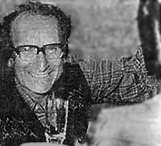

Nobel Prize in Physiology or Medicine · 1984
César Milstein
With Georges Köhler, he found how to make unlimited pure antibodies on demand, the basis of antibody medicines and pregnancy tests.
The Nobel citation: “for theories concerning the specificity in development and control of the immune system and the discovery of the principle for production of monoclonal antibodies”
- Born
- October 8, 1927, Bahia Blanca, Argentina
- Died
- March 24, 2002, Cambridge, United Kingdom
- Shared with
- Niels K. Jerne, Georges J.F. Köhler
- Affiliation at the time
- MRC Laboratory of Molecular Biology, United Kingdom
Medicine prize
1984
Shared with 2 other laureates.
Age that year
57years
Born in 1927.
Headline credited impact
2.3–9million people benefited
People treated with monoclonal antibody medicines worldwide. How it was built
Sources cited
21
Fact-checked September 24, 2026.
- Milstein turned to antibodies only in 1963, at Fred Sanger's suggestion; twelve years later he and Georges Köhler made the first monoclonal antibodies against a chosen target.
- The hybridoma method was never patented. Antibody-based medicines, including related fusion proteins, sold about $217 billion worldwide in 2021 alone.
- In 1962 Argentina's health minister purged Milstein's institute and, Milstein recalled, told its scientists to leave because intellectuals were all communists and Jews.
- More than 200 antibody medicines are now on the market, for conditions from breast cancer and lymphoma to arthritis, migraine and multiple sclerosis.
- On their honeymoon, he and his wife Celia hitchhiked around Europe for a year, including a couple of months working on kibbutzim in Israel.
The breakthrough
Hybridomas: immortal cells that make one chosen antibody (1975)
Antibodies are Y-shaped proteins that the immune system makes to grab germs and other invaders. Each antibody-making white blood cell produces just one kind, which latches onto one particular target. Blood holds millions of kinds mixed together, so scientists who wanted a single pure antibody had a problem: the cells that make antibodies die within days in a lab dish. Cancerous antibody cells, called myeloma cells, can grow forever, but nobody knows what their antibodies stick to. In the early 1970s Milstein's Cambridge lab fused pairs of myeloma cells to study how antibody genes work, and found the fused cells made the antibodies of both parents. Then Milstein and his postdoctoral researcher Georges Köhler tried a twist. They fused a myeloma cell with a normal antibody-making cell from the spleen of a mouse immunized against sheep red blood cells. The hybrid got immortality from the cancer cell and a chosen antibody from the spleen cell. Each line grown from a single hybrid, later called a hybridoma, turned out unlimited amounts of one identical antibody: a monoclonal antibody. Think of a craftsman who can make exactly the part you need but collapses after a day, teamed with a partner who never tires: together they keep the factory running for ever. Milstein then showed how widely the tool worked, from tissue typing and blood-group testing to studying tumour cells and purifying natural substances.[3],[4],[5],[8]
“It resulted from esoteric speculations, for curiosity’s sake, only motivated by a desire to understand nature.”
What it meant for humanity
Before 1975, the antibodies used in labs and clinics came from the blood of immunized animals: messy mixtures that varied from batch to batch. Hybridomas made it possible to produce the same pure antibody, against almost any target, in unlimited amounts. That changed biology first. Researchers could tag and sort particular cell types, map the parts of a flu virus, and purify rare substances such as interferon. Then it changed medicine. Hospital tests that measure hormones and proteins, tests for infections, and home pregnancy tests came to rely on monoclonal antibodies. Doctors use them to tell one kind of tumour from another and to count the immune cells that HIV destroys. The first monoclonal antibody medicine, OKT3, was approved in 1986 to prevent kidney-transplant rejection. Early mouse antibodies often provoked immune reactions in patients, and later engineering, such as Greg Winter's methods for making humanized and fully human antibodies, made them safer. Antibody medicines then took off. By late 2024 more than 200 were on the market. They treat breast cancer, lymphoma, rheumatoid arthritis, psoriasis, Crohn's disease, asthma, migraine and multiple sclerosis, and they protect high-risk babies from the respiratory virus RSV. Antibodies that release the immune system's brakes on cancer, such as Keytruda, became some of the best-selling drugs in the world. In 2021, antibody-based medicines earned about $217 billion, and 15 of the 20 top-selling biotech products were antibody-based. Milstein cared about who got these benefits. He argued that scientists should not seek personal patents or profit from research, and in 2000 he wrote that science would keep its promises only when its benefits were shared fairly with the world's poorest people.
- The first therapeutic monoclonal antibody, OKT3, was approved in 1986 to prevent kidney-transplant rejection; by late 2024 more than 200 antibody medicines were on the market.[12],[15]
- In 2021, antibody-based medicines had global sales of about $217 billion and accounted for 15 of the 20 best-selling biotech products.[14]
- Monoclonal antibodies became everyday tools in hospital labs and home pregnancy tests, and are used to image cancers and to carry drugs or radiation to cancer cells.[6],[21]
- Roche reports that one antibody drug, rituximab, had been used to treat more than 2.7 million people with blood cancers by 2017.[19]
- Working with fellow Argentine Claudio Cuello, Milstein showed how monoclonal antibodies could be used to study the nervous system and its diseases.[3],[21]
Impact in numbers
Monoclonal antibodies are one of the basic tools of modern biology and medicine, so Milstein's influence runs through research labs, hospital diagnostics and pharmacies. We record two modeled claims under the shared outcome for antibody medicines: people treated and cumulative sales. Both credit Milstein with only 15%, because Georges Köhler co-invented the method and turning mouse antibodies into safe drugs took decades of further work by others, from humanized and fully human antibodies to the discovery of drug targets. We make no lives-saved claim: antibody drugs clearly extend and save many lives, but no credible published total exists. Diagnostic uses, from pregnancy tests to blood-group typing and infection tests, reach even more people and are not counted at all. Milstein's later research on how antibodies mutate and improve during an immune response also shaped basic immunology.
HealthEconomyTechnologyFundamental science
Each number is the laureate’s credited share of a real-world outcome, cumulative to 2025. The whole outcome, the share of credit, and the reasoning are shown so you can check the arithmetic. Outcomes shared with other laureates are counted once on the impact page.
- Low confidenceDirectModeledHealth
People treated with monoclonal antibody medicines worldwide
2.3–9
million people benefited, credited share
That is 15% of 15–60 million people benefited since 1986.
How this number was built
No global count exists. Floor: Roche reports rituximab treated over 2.7M people with blood cancers by 2017 and tocilizumab over 1M people by 2019, so 3.7M for two of 200+ marketed antibodies. Assuming those two account for at most a quarter of all patients ever treated gives a low of about 15M. High: rituximab's 2019 sales ($6.54B) were about 4.4% of a roughly $150B market (interpolated between $115.2B in 2018 and $217.3B in 2021); 2.7M / 0.044 = about 61M, rounded to 60M. These are people treated, not cured. Share 0.15: Milstein and Köhler co-invented the hybridoma method (about 0.15 each); the rest belongs to those who humanized antibodies, found drug targets and developed the medicines.[13],[14],[15],[16],[19],[20]
Sources: Roche; Roche; BioDrugs (via PubMed Central); Journal of Biomedical Science (via PubMed Central); Nature Biotechnology (via PubMed Central); mAbs (via PubMed Central)
- Medium confidenceDirectModeledEconomy
Cumulative global sales of monoclonal antibody medicines (a proxy for economic activity)
$300–390
billion in economic value, credited share
That is 15% of $2–2.6 trillion in economic value since 1986.
How this number was built
Sourced annual sales: about $39B (2008) and $75B (2013) (Ecker 2015), $115.2B (2018, Lu 2020), $217.3B (2021, Walsh 2022). Linear interpolation gives about $1.39T for 2008-2021. Low: add 2022-2025 flat at $217B a year ($0.87T), ignore pre-2008 sales, then cut 10% for Fc-fusion drugs such as Enbrel that these totals include but that are not true antibodies: (1.39 + 0.87) x 0.9 = about $2.0T. High: add about $0.18T for 1998-2007 (a linear ramp up to 2008's $39B) and 8% yearly growth for 2022-2025 (Ecker's forecast rate, about $1.06T): about $2.6T. Nominal dollars, which understates the 2024-dollar value. Sales measure spending, not net benefit. Share 0.15, as for the patients claim.[12],[13],[14]
Sources: mAbs (via PubMed Central); Journal of Biomedical Science (via PubMed Central); Nature Biotechnology (via PubMed Central)
The double edge
No weapons or deliberate harms are tied to Milstein's work, but its medical legacy carries real costs. Antibody drugs act powerfully on the immune system, and some carry serious risks. In a 2006 London trial, six healthy volunteers given the experimental antibody TGN1412 became critically ill within hours; all survived after intensive care. Natalizumab, an antibody for multiple sclerosis, had been linked by 2012 to 212 confirmed cases of a rare brain infection, PML, among about 100,000 patients. For much of the world the bigger problem is price. A 2026 study of US Veterans Affairs prices found antibody drugs averaged about $127,000 per year or course of treatment, with 42% priced above $100,000, raising concerns about fairness and access. That sits uneasily with Milstein's own hope that the benefits of science would be shared fairly with the world's poor. The hybridoma method itself was never patented. Prime Minister Margaret Thatcher later criticised the loss, but Milstein had submitted the work for commercial review and blamed officials for the failure.
- Moderate
Powerful immune drugs can cause severe side effects
In 2006 all six healthy young men in the first trial of the antibody TGN1412 developed a cytokine storm within 90 minutes and became critically ill; all survived after intensive care. The multiple sclerosis antibody natalizumab had been linked to 212 confirmed cases of the brain infection PML among 99,571 treated patients by February 2012.[17],[18]
- Moderate
High prices limit who benefits
A 2026 study of 57 monoclonal antibody drugs, using US Veterans Affairs prices, found an average of about US$127,430 per course or year of treatment, with 42% above US$100,000, and warned of serious equity concerns. Milstein himself held that scientists should not profit personally from research and that science must share its benefits with the poor.[9],[16]
- Minor
The patent that was never filed
No patent was sought for the hybridoma method. Margaret Thatcher criticised Milstein and the Medical Research Council for the lost opportunity. Milstein had sent the manuscript for commercial assessment to the state body that then held a monopoly over MRC inventions, considered the criticism unfair, and blamed officials for the failure.[6],[9]
Against the odds
Milstein grew up in a country that had taken in many Jewish families escaping poverty and persecution in the Russian Empire, his father among them. His parents made great sacrifices so that all three sons could go to university. Argentine politics, though, was unstable and often hostile to independent thinkers. As a left-wing student leader in the early 1950s he opposed Juan Perón's education policy, when student activists risked arrest, and his supervisor told him to stay away from research until the political mood eased. After a British fellowship he returned in 1961 to lead a new molecular biology division at the national microbiology institute. In 1962 the military ousted President Arturo Frondizi. The new health minister took over the institute, suspended and then fired its director, and removed eight researchers. Milstein later recalled the minister telling the young protesting scientists that they had no future in Argentina and should leave, because intellectuals were all communists and Jews. The director's lawyer blamed, among other things, a campaign of furious antisemitism, citing insulting posters that had greeted Jewish researchers when they joined. That year was the worst of a wave of antisemitic attacks across Argentina, including the kidnapping of a Jewish student, Graciela Sirota, whose attackers carved a swastika into her chest. When colleagues were dismissed, Milstein resigned, and in 1963 he left for Cambridge, where he spent the rest of his career. He later gave much time to supporting young scientists in developing countries.
1951
Other
A left-wing opponent of Perón's education policy, he was elected president of the chemistry students' association in 1951, when student activists risked arrest. His supervisor, fearing his politics would get him into trouble, told him to pause his research until things calmed down.[8],[11]
1962
Persecution
After President Frondizi was ousted, the new health minister took over the national microbiology institute, fired its director and removed eight researchers. Milstein recalled the minister urging the young scientists to leave the country because intellectuals were all communists and Jews.[8],[9]
1962
Antisemitic attack
Historians describe 1962 as the worst year of a wave of attacks on Argentine Jews and Jewish institutions, including the kidnapping and torture of the Jewish student Graciela Sirota. At the institute, the fired director's lawyer cited, among other causes, a campaign of furious antisemitism.[9],[10]
1963
Exile
Milstein wrote that the political persecution of liberal intellectuals and scientists forced his resignation. He left Argentina in 1963 for the MRC Laboratory of Molecular Biology in Cambridge and never again lived in Argentina.[2],[6],[11]
Jewish background
Milstein was born into a Jewish family in Bahía Blanca. His father, Lázaro, was a Jewish immigrant from Ukraine who reached Argentina in 1913, aged 15. His mother, Máxima, a schoolteacher, was born in Argentina to a poor Jewish immigrant family from Lithuania. The family spoke Yiddish at home and was active in the local Jewish community but not religious. Milstein rarely went to synagogue, yet he was proud of his Argentine Jewish roots. He and his wife worked on Israeli kibbutzim in the early 1950s, and on receiving Israel's Wolf Prize in 1980 he called himself a typical Diaspora Jew who owed his education to his parents' sacrifices.[2],[6],[7],[8],[11]
Key dates
October 8, 1927
Born in Bahía Blanca, Argentina, the middle of three sons of a Jewish immigrant father and a schoolteacher mother.[1],[2],[6]
1952
Graduates in chemistry from the University of Buenos Aires, where he was active in student politics.[2],[8]
1953
Marries fellow chemist Celia Prilleltensky; they spend a year hitchhiking through Europe, including a couple of months on Israeli kibbutzim.[2],[11]
1957
Earns his doctorate in chemistry at the University of Buenos Aires under Andrés Stoppani, a thesis done without paid funding.[2]
1960
Completes a second PhD at Cambridge on a British Council fellowship, then takes a short Medical Research Council post in Fred Sanger's group.[2]
1961
Returns to Buenos Aires to head the new Molecular Biology Division of the National Institute of Microbiology.[2],[9]
1962
After the military ousts President Frondizi, the new health minister takes over the institute and removes its director and eight researchers.[9]
1963
Resigns and moves to the MRC Laboratory of Molecular Biology in Cambridge, where Sanger steers him toward antibodies.[2],[6],[7]
August 7, 1975
With Georges Köhler, publishes in Nature the method for making monoclonal antibodies from fused cells, later called hybridomas.[5]
1980
Receives the Wolf Prize in Medicine from Israel's president at a ceremony in the Knesset.[2],[8]
1984
Shares the Nobel Prize in Physiology or Medicine with Niels Jerne and Georges Köhler.[1],[4]
1988
Becomes Deputy Director of the MRC Laboratory of Molecular Biology, serving until 1995.[6]
1995
Appointed a Companion of Honour; keeps doing research in retirement.[6]
March 24, 2002
Dies in Cambridge, aged 74, after years of heart disease, still working in the lab.[1],[6]
Sources
- 1.César Milstein - Facts · NobelPrize.org (Nobel Prize Outreach)
- 2.César Milstein - Biographical · NobelPrize.org (from Les Prix Nobel, The Nobel Prizes 1984, Nobel Foundation, 1985), 1985
- 3.From the Structure of Antibodies to the Diversification of the Immune Response (Nobel Lecture, 8 December 1984) · NobelPrize.org, 1984
- 4.The Nobel Prize in Physiology or Medicine 1984 - Press release · The Nobel Assembly at the Karolinska Institute / NobelPrize.org, 1984
- 5.Continuous cultures of fused cells secreting antibody of predefined specificity (Köhler G, Milstein C), Nature 256:495-497 · Nature, 1975
- 6.César Milstein, 1927-2002 (tribute by David Secher) · University of Cambridge, 2002
- 7.César Milstein (1927-2002) (obituary by Klaus Rajewsky), Nature 416:806 · Nature, 2002
- 8.César Milstein (1927-2002) and monoclonal antibodies: Father of modern immunology (Bob Weintraub) · The Israel Chemist and Chemical Engineer, Issue 9, 2023
- 9.Representaciones fílmicas de la ciencia. César Milstein y Un fueguito (Zulema Marzorati), Cuadernos de Antropología Social 43:115-128 · Universidad de Buenos Aires (via Redalyc), 2016
- 10.On Hate and Jewish Loyalties across the Americas: The Case of Argentina in the Early 1960s (Adriana Brodsky and Raanan Rein) · AJS Perspectives (Association for Jewish Studies), The Hate Issue
- 11.César Milstein, mal alumno, judío y libertario · Perfil (Buenos Aires), 2024
- 12.The therapeutic monoclonal antibody market (Ecker DM, Jones SD, Levine HL), mAbs 7(1):9-14 · mAbs (via PubMed Central), 2015
- 13.Development of therapeutic antibodies for the treatment of diseases (Lu RM et al.), Journal of Biomedical Science 27:1 · Journal of Biomedical Science (via PubMed Central), 2020
- 14.Biopharmaceutical benchmarks 2022 (Walsh G, Walsh E), Nature Biotechnology 40:1722-1760 · Nature Biotechnology (via PubMed Central), 2022
- 15.Antibodies to watch in 2025 (Crescioli S et al.), mAbs 17(1):2443538 · mAbs (via PubMed Central), 2024
- 16.The Market for Monoclonal Antibodies: Trends, Challenges, and Opportunities (Motta-Santos AS et al.), BioDrugs 40(3):517-537 · BioDrugs (via PubMed Central), 2026
- 17.Cytokine storm in a phase 1 trial of the anti-CD28 monoclonal antibody TGN1412 (Suntharalingam G et al.), N Engl J Med 355:1018-28 · New England Journal of Medicine (via PubMed), 2006
- 18.Risk of natalizumab-associated progressive multifocal leukoencephalopathy (Bloomgren G et al.), N Engl J Med 366:1870-80 · New England Journal of Medicine (via PubMed), 2012
- 19.FDA approves Rituxan Hycela (rituximab and hyaluronidase human) for subcutaneous injection in certain blood cancers · Roche, 2017
- 20.FDA approves Roche's Rituxan (rituximab) in children with two rare blood vessel disorders · Roche, 2019
- 21.IIB Celebrates Hispanic Heritage Month - César Milstein · Duke University, Department of Integrative Immunobiology
Fact-checked on September 24, 2026 by a separate AI fact-checking pass that re-opened the sources, with 12 corrections made. How we check
Suggest a correction