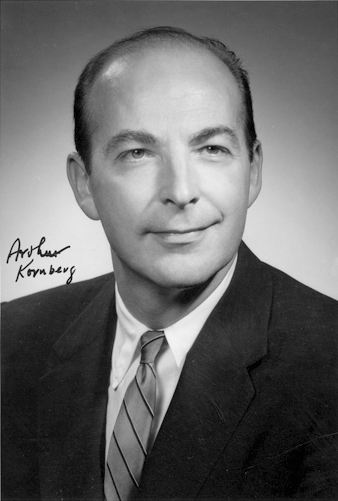

Nobel Prize in Physiology or Medicine · 1959
Arthur Kornberg
He found DNA polymerase, the first known enzyme that copies DNA, and his lab's enzymes became tools of genetic engineering.
The Nobel citation: “for their discovery of the mechanisms in the biological synthesis of ribonucleic acid and deoxyribonucleic acid”
- Born
- March 3, 1918, Brooklyn, NY, USA
- Died
- October 26, 2007, Stanford, CA, USA
- Shared with
- Severo Ochoa
- Affiliation at the time
- Stanford University, USA
Medicine prize
1959
Shared with 1 other laureate.
Age that year
41years
Born in 1918.
Headline credited impact
$30–40billion in economic value
Cumulative global sales of genetically engineered non-antibody protein medicines (a proxy for economic activity). How it was built
Sources cited
24
Fact-checked September 24, 2026.
- By his own account, Rochester's medical school took him in 1937 under a quota of two Jewish students. In 1999 the university named a research building after him.
- His first research paper, in 1942, grew out of a mild jaundice he had himself. It got him moved from a Coast Guard ship to the National Institutes of Health.
- The journal that published his DNA polymerase papers first rejected them. They appeared in 1958, a year before he won the Nobel Prize.
- He and his son Roger both won Nobel Prizes: Arthur in 1959 for how cells copy DNA, Roger in 2006 for how cells read their genes.
- In 1967 his team made infectious virus DNA in a test tube. President Johnson hailed it as creating life, a label Kornberg disliked.
The breakthrough
Finding the enzyme that copies DNA (1953-1967)
Every time a cell divides, it must copy its DNA, the long molecule that stores its genetic instructions, so each new cell gets a full set. In the early 1950s James Watson and Francis Crick showed that DNA is a double helix whose two strands match each other, which hinted at how copying might work. But nobody knew what chemistry actually did the copying. Kornberg was sure the answer lay with enzymes, the proteins that carry out almost every chemical job in a cell. First he studied how cells make the building blocks of DNA and RNA. Then he mixed radioactive building blocks with extracts of crushed E. coli bacteria and looked for any new DNA. At first only a tiny fraction of the radioactivity ended up in DNA, but his team purified the extract step by step until, in 1956, they had isolated the enzyme that was building the new DNA. He named it DNA polymerase. It works like a copyist with an original page in front of it: it reads an existing strand of DNA letter by letter and adds the matching building block (A pairs with T, G with C) to a growing new strand. It needs that template and all four building blocks. His lab later showed that the enzyme also proofreads and repairs DNA. In 1967, using DNA polymerase and a second enzyme, DNA ligase, which seals DNA ends together, his team built the DNA of a small virus that infected bacteria just like the natural one.[1],[3],[8],[9],[12],[14],[15]
“I think it is important to be reminded that, like some virus, anti-Semitism is endemic.”
What it meant for humanity
Kornberg answered a basic question, how life copies its genetic instructions, and in doing so handed scientists a toolkit. DNA polymerase and the other DNA enzymes found or put to use in his Stanford department let researchers copy, fill in, trim and join pieces of DNA in a test tube. In the early 1970s those enzymes were among the reagents in the Stanford experiments, by Paul Berg and by the graduate student Peter Lobban, that introduced recombinant DNA, the joining of genes from different sources. Recombinant DNA soon let microbes make human insulin, which went on sale in 1982, as well as human growth hormone and vaccines. In 2021, brand-name recombinant protein medicines other than antibodies sold about $54 billion worldwide. A DNA polymerase is also the engine of the polymerase chain reaction (PCR), which copies a stretch of DNA millions of times in a few hours and is used to detect HIV and the faulty genes behind inherited diseases. Kornberg argued that research on how cells make the building blocks of DNA and RNA also laid the groundwork for many drugs against cancer, AIDS, herpes and autoimmune disease. Gobind Khorana learned to use the Stanford enzymes to build synthetic DNA, work that helped complete the reading of the genetic code. Kornberg also built a department that shaped biochemistry: its members shared space, grants and equipment, and its students included Randy Schekman, a 2013 Nobel laureate. He co-founded DNAX, a research institute that let its scientists publish freely, and he spent decades arguing that curiosity-driven basic research is what practical medicine depends on.
- In 1956 he isolated DNA polymerase from E. coli, the first enzyme found that assembles DNA, and used it to make DNA in a test tube. He shared the 1959 Nobel Prize with Severo Ochoa.[1],[7],[8]
- Enzymes discovered or applied in his Stanford department, including polymerase to fill gaps and ligase to join DNA ends, were among the reagents in the two experiments that introduced recombinant DNA.[10],[18]
- PCR, the method behind many DNA tests including HIV detection, relies on a DNA polymerase to copy a chosen stretch of DNA millions of times in a few hours.[19]
- In 1967 his team made infectious virus DNA entirely in a test tube, showing that DNA built from ordinary building blocks is enough to carry a working set of genetic instructions.[9],[13],[15]
- Kornberg argued that research on how cells make the building blocks of DNA and RNA underlies the design of many drugs used against cancers, viral infections such as AIDS and herpes, and autoimmune diseases.[6],[11],[12]
- He founded Stanford's biochemistry department, which became a world center for DNA research and trained leading scientists, among them 2013 Nobel laureate Randy Schekman.[7],[20],[23]
Impact in numbers
Kornberg's discovery is foundational: it explained how cells copy DNA and supplied enzymes that genetic engineering and PCR later built on. That makes his impact large but indirect, so we record one conservative ripple claim. Under the shared outcome for recombinant DNA and the biotech industry, we count cumulative sales of recombinant medicines other than antibodies, such as insulin, growth hormone and EPO. Antibody drugs and mRNA vaccines are left out because they have their own outcomes. We use the same total as the Paul Berg profile and credit Kornberg with 2%, because the central inventions of gene splicing and cloning came from others, including Paul Berg, Peter Lobban, Stanley Cohen and Herbert Boyer, and many companies turned them into medicines. We do not count PCR testing or drugs designed around the chemistry of DNA building blocks: both draw in part on what his lab learned, but the causal chain is too long for a credible number.
Fundamental scienceHealthEconomy
Each number is the laureate’s credited share of a real-world outcome, cumulative to 2025. The whole outcome, the share of credit, and the reasoning are shown so you can check the arithmetic. Outcomes shared with other laureates are counted once on the impact page.
- Low confidenceRippleModeledEconomy
Cumulative global sales of genetically engineered non-antibody protein medicines (a proxy for economic activity)
$30–40
billion in economic value, credited share
That is 2% of $1.5–2 trillion in economic value since 1982.
How this number was built
Same outcome and range as the Paul Berg profile: world sales of recombinant medicines other than antibodies and COVID mRNA vaccines (own outcomes), from Humulin insulin in 1982. Inputs: 2013 antibody sales (~$75B) were about half of all biopharma sales, so non-antibody ~$75B (Ecker 2015); 2021 non-antibody originator proteins $53.6B, biosimilars $11.1B (Walsh 2022). Low: quadratic ramp 1982-2013 to $75B ($0.81T) + linear fall to $53.6B over 2014-2021 ($0.50T) + flat 2022-2025 ($0.21T) = ~$1.5T. High: linear ramp 1982-2013 ($1.2T) + the same later years + half of biosimilar sales (~$0.07T) = ~$2.0T. Nominal dollars; sales measure spending, not net benefit. Share 0.02, within the Berg profile's split: his lab's polymerase and ligase were among the reagents of the first recombinant DNA experiments, but splicing, cloning, expression and manufacturing were others' work.[2],[10],[21],[22],[24]
Sources: US National Library of Medicine, Profiles in Science; Nature Biotechnology (via PubMed Central); mAbs (via PubMed Central); J Community Hosp Intern Med Perspect (via PubMed Central); NobelPrize.org (Nobel Prize Outreach)
The double edge
No direct harm is documented from Kornberg's own research, but it fed into debates about the risks of genetic engineering. When his team made infectious virus DNA in 1967, President Johnson announced that Stanford had created life in a test tube, to Kornberg's dismay. Such feats, and the recombinant DNA work his enzymes helped make possible, raised fears that lab-made genes could create new pathogens. Scientists paused some experiments in 1974 and wrote safety rules after the 1975 Asilomar conference; experience later showed the dangers were small. In 1977 Kornberg opposed proposed federal laws to regulate recombinant DNA research, warning that the bigger threat was to scientific inquiry itself. Scientifically, his view that DNA polymerase I copies the bacterial chromosome was challenged when a mutant bacterium lacking it multiplied normally; his son Thomas then found two more polymerases, and the third, polymerase III, turned out to finish building new DNA. There is also a question of credit: his wife Sylvy worked beside him and solved a key problem in the DNA work, but the prize did not recognize her; their son Thomas says her remark that she had been robbed was only a family joke.
- Minor
Fears of lab-made life and new pathogens
The 1967 synthesis of infectious virus DNA was hailed as creating life in a test tube, and such work raised fears that engineered genes could turn harmless microbes into pathogens. A voluntary pause in 1974 and NIH safety guidelines in 1976 followed; within a few years experience showed the dangers were minimal.[9],[18]
- Minor
Opposed laws to regulate gene research
In a February 1977 letter to the NIH director, written as Congress weighed bills to regulate recombinant DNA research, Kornberg warned that attacks on scientific inquiry were a greater danger than biological warfare. He recalled that Senator Edward Kennedy, a bill sponsor, told him lawmakers wanted a say from the start this time.[13]
- Minor
Doubts about which enzyme copies DNA
DNA polymerase I also proved to have major repair roles, and when John Cairns found a mutant bacterium that multiplied normally without it, scientists questioned whether it copies chromosomes. In 1971-72 Thomas Kornberg found two more polymerases; Kornberg's lab later showed that the third, polymerase III, completes new DNA.[9],[10]
- Minor
Credit for Sylvy Kornberg's work
According to lab colleague Robert Lehman, Sylvy Kornberg solved a major problem in the DNA work by finding an enzyme that destroyed one of the four DNA building blocks and stalled the reaction. The prize went to Arthur and Severo Ochoa. Their son Thomas recalls a family joke, stressing it was only a joke, that she said she had been robbed.[12],[17]
Against the odds
Kornberg grew up in Brooklyn in a family of Jewish immigrants from Poland, and he came of age in the Depression, when antisemitism was open and widespread in American higher education. City College of New York took him in at 15, but its graduates hit closed doors afterward. He later recalled that his classmates were turned down by nearly every medical school, and that Columbia had a scholarship for a City College student that went unawarded for about a decade because Columbia accepted none of its graduates. He recalled that the University of Rochester's medical school admitted him in 1937 under a quota that let in only two Jewish students. After his internship he applied for research training grants and won none, which he blamed on antisemitism. His colleague Joshua Lederberg wrote that few jobs in academic or industrial science were open to Jews then; it was the wartime growth of the National Institutes of Health that gave Kornberg his first research post. His wife and lab partner, Sylvy, also faced discrimination as a Jewish scientist. Kornberg was not a refugee and did not face violence; his obstacles were quotas and closed doors. Late in life he said he wanted students who had never met antisemitism to understand how harsh it had been within living memory, and he recalled prejudice against Jewish scientists at universities across the country.
1937
Quota
He recalled that the University of Rochester's medical school capped Jewish admissions at two in his 1937 entering class, and he was one of the two.[13]
1937
Discrimination
He recalled that his City College classmates were turned down by nearly every medical school, and that a Columbia scholarship meant for a City College student went unawarded for about a decade because Columbia accepted none of its graduates.[13]
—
Discrimination
Once his Rochester internship ended, none of his applications for research training grants succeeded, and he later blamed antisemitism.[11]
—
Discrimination
Joshua Lederberg wrote that few opportunities in academic or industrial science were open to Jews when Kornberg graduated; the wartime expansion of the NIH gave him his first chance at research.[13]
—
Discrimination
His wife, the biochemist Sylvy Kornberg, faced discrimination for being Jewish early in her career, in the late 1930s and early 1940s, according to their son Roger.[17]
Jewish background
Kornberg was born in Brooklyn, the youngest of three children of Joseph and Lena Kornberg, Jewish immigrants from Poland who ran a small hardware store. His colleague Joshua Lederberg described his upbringing as typical of New York's second-generation Jewish immigrants, whose parents sacrificed to educate their children. Kornberg spoke openly about the antisemitism he met, including a medical-school quota. He said he was not a Zionist but was very supportive of Israel, and he served on the Weizmann Institute's Board of Governors. No source describes religious practice, so we class his tie to Jewish identity as secular.[4],[7],[11],[13]
Key dates
March 3, 1918
Born in Brooklyn, New York, the youngest of three children of Jewish immigrants from Eastern Europe who ran a small hardware store.[1],[7],[13]
1933
Finishes high school at 15 after skipping several grades and enters the City College of New York.[7],[11]
1937
Earns a B.S. from City College and enters the University of Rochester's medical school, which by his account took only two Jewish students that year.[4],[13]
1941
Earns his M.D. from Rochester and begins a year's internship in internal medicine at Strong Memorial Hospital.[2],[4]
1942
Publishes his first paper, on a mild jaundice he himself had; it gets him moved from ship's doctor on a Coast Guard vessel to the NIH.[7],[16]
1943
Marries the biochemist Sylvy Ruth Levy, who works beside him in the lab for many years.[2],[7],[17]
1946
Trains in enzyme chemistry with Severo Ochoa at NYU, then in 1947 with Carl and Gerty Cori, before setting up an enzyme section at the NIH.[2],[7]
1953
Becomes head of microbiology at Washington University in St. Louis, where his team hunts for the enzyme that makes DNA.[4],[8]
1956
Isolates DNA polymerase from E. coli bacteria and uses it to make DNA in a test tube.[1],[8]
1959
Founds Stanford's Department of Biochemistry and shares the Nobel Prize in Physiology or Medicine with Severo Ochoa.[1],[2],[9]
December 14, 1967
Announces the test-tube synthesis of infectious virus DNA; President Johnson tells an audience that Stanford has created life in a test tube.[9],[15]
1980
Becomes a founding partner, with Paul Berg and Charles Yanofsky, of the DNAX research institute, set up to develop medicines based on recombinant DNA.[10]
2006
Returns to Stockholm to watch his son Roger receive the Nobel Prize in Chemistry, 47 years after his own prize.[5],[12]
October 26, 2007
Dies of respiratory failure at Stanford Hospital, aged 89, having worked in his lab until days before.[1],[11],[12]
Sources
- 1.Arthur Kornberg - Facts · NobelPrize.org (Nobel Prize Outreach)
- 2.Arthur Kornberg - Biographical (provided by the laureate, April 2005) · NobelPrize.org (Nobel Prize Outreach), 2005
- 3.The Biologic Synthesis of Deoxyribonucleic Acid (Nobel Lecture, 11 December 1959) · NobelPrize.org (Nobel Foundation), 1959
- 4.Arthur Kornberg - Curriculum Vitae (provided by the laureate, April 2005) · NobelPrize.org (Nobel Prize Outreach), 2005
- 5.Arthur Kornberg - Interview, December 2006 (with Adam Smith) · NobelPrize.org (Nobel Prize Outreach), 2006
- 6.Basic research, the lifeline of medicine (article by Arthur Kornberg) · NobelPrize.org (Nobel Prize Outreach), 1997
- 7.The Arthur Kornberg Papers: Biographical Overview · US National Library of Medicine, Profiles in Science
- 8.The Arthur Kornberg Papers: The Synthesis of DNA, 1953-1959 · US National Library of Medicine, Profiles in Science
- 9.The Arthur Kornberg Papers: "Creating Life in the Test Tube," 1959-1970 · US National Library of Medicine, Profiles in Science
- 10.The Arthur Kornberg Papers: Astonishing Machines of Replication, Stanford, 1970-Present · US National Library of Medicine, Profiles in Science
- 11.Arthur Kornberg, 89, Dies; Won Nobel for DNA Work (archived copy) · The New York Times, 2007
- 12.Arthur Kornberg obituary (archived copy) · Stanford University School of Medicine, 2007
- 13.Biochemistry at Stanford, Biotechnology at DNAX (oral history with Arthur Kornberg conducted in 1997 by Sally Smith Hughes, introduction by Joshua Lederberg) · Regional Oral History Office, Bancroft Library, University of California, Berkeley (via Internet Archive), 1998
- 14.Arthur Kornberg's Discovery of DNA Polymerase I (JBC Classics, Kresge N, Simoni RD, Hill RL), J Biol Chem 280(49):e46 (archived copy) · Journal of Biological Chemistry, 2005
- 15.Enzymatic synthesis of DNA, XXIV. Synthesis of infectious phage phi-X174 DNA (Goulian M, Kornberg A, Sinsheimer RL), PNAS 58(6):2321-2328 · Proceedings of the National Academy of Sciences (via PubMed Central), 1967
- 16.Latent liver disease in persons recovered from catarrhal jaundice and in otherwise normal medical students as revealed by the bilirubin excretion test (Kornberg A), J Clin Invest 21(3):299-308 · Journal of Clinical Investigation (via PubMed Central), 1942
- 17.Sylvy Kornberg: Biography of a Biochemist, by Diana Kwon (archived copy) · The Scientist, 2017
- 18.The Paul Berg Papers: Recombinant DNA Technologies and Researchers' Responsibilities, 1973-1980 · US National Library of Medicine, Profiles in Science
- 19.Press release: The 1993 Nobel Prize in Chemistry (PCR and site-directed mutagenesis) · NobelPrize.org (Royal Swedish Academy of Sciences), 1993
- 20.Randy W. Schekman - Biographical · NobelPrize.org (Nobel Prize Outreach), 2013
- 21.Biopharmaceutical benchmarks 2022 (Walsh G, Walsh E), Nature Biotechnology 40:1722-1760 · Nature Biotechnology (via PubMed Central), 2022
- 22.The therapeutic monoclonal antibody market (Ecker DM, Jones SD, Levine HL), mAbs 7(1):9-14 · mAbs (via PubMed Central), 2015
- 23.Professor Arthur Kornberg (obituary) · The Independent, 2007
- 24.History of insulin (Quianzon CC, Cheikh I), Journal of Community Hospital Internal Medicine Perspectives 2(2) · J Community Hosp Intern Med Perspect (via PubMed Central), 2012
Fact-checked on September 24, 2026 by a separate AI fact-checking pass that re-opened the sources, with 9 corrections made. How we check
Suggest a correction