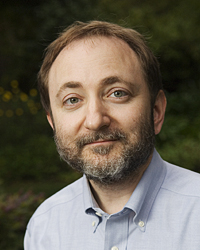

Nobel Prize in Physiology or Medicine · 2006
Andrew Z. Fire
He found that double-stranded RNA can switch off one chosen gene, a tool now used across biology and in new medicines.
The Nobel citation: “for their discovery of RNA interference - gene silencing by double-stranded RNA”
- Born
- April 27, 1959, Stanford, CA, USA
- Shared with
- Craig C. Mello
- Affiliation at the time
- Stanford University School of Medicine, USA
Medicine prize
2006
Shared with 1 other laureate.
Age that year
47years
Born in 1959.
Headline credited impact
40,000–55,000people benefited
Patients treated with approved RNAi (siRNA) medicines, 2018-2025. How it was built
Sources cited
27
Fact-checked September 24, 2026.
- He finished high school at 15 and earned a mathematics degree from UC Berkeley at 19.
- Stanford turned him down as an undergraduate. He later joined its medical school and won his Nobel Prize there.
- The key clue was a twitch: worms injected with double-stranded RNA matching a muscle gene began twitching like worms born without it.
- His Nobel Prize came just eight years after the 1998 paper, unusually fast by Nobel standards.
- His Nobel banquet speech was a comic 'top ten list' of reasons for the 2006 laureates to return to Stockholm in 2036.
The breakthrough
RNA interference: silencing a gene with double-stranded RNA
Your genes are stored as DNA. To use a gene, a cell copies it into a working message called messenger RNA, then reads that message to build a protein. Around 1990, scientists kept getting strange results. Plant scientists who added an extra pigment gene to petunias, hoping for deeper colour, got white petals instead. Worm researchers who used single strands of 'antisense' RNA to block genes saw odd effects that nobody could explain.
Working at the Carnegie Institution in Baltimore, Fire teamed up with Craig Mello to solve the puzzle in a tiny worm, C. elegans. They injected worms with RNA matching a muscle gene. One strand on its own did little. But when they injected both strands paired together, as double-stranded RNA, the worms began to twitch, just like worms born without that gene. The trick worked on gene after gene. A few molecules per cell were enough, the silencing spread through the body, and it even passed to the worms' offspring.
Think of double-stranded RNA as a 'wanted' poster. The cell chops it into short pieces and uses them to find and shred every matching message, so the protein is never made. Fire and Mello called this RNA interference, or RNAi, and published it in Nature in February 1998.[3],[4],[5],[8]
“I get drawn to unsolved questions that don’t make any sense, so, it certainly was a draw.”
What it meant for humanity
RNAi changed how biologists work. Before 1998, finding out what one gene did often meant months of slow, uncertain work to knock it out. RNAi made that quick and cheap. In 2003 a Cambridge team used it to switch off about 86 percent of the worm's 19,427 predicted genes, one at a time, and linked 1,722 genes to visible defects, about two-thirds of them for the first time. After Thomas Tuschl's group showed in 2001 that short, 21-letter double-stranded RNAs could silence genes in human cells, labs everywhere began using the method to hunt for genes involved in disease.
It then became a new kind of medicine. In 2018 patisiran (Onpattro) became the first approved RNAi drug. It treats hereditary transthyretin amyloidosis, an inherited disease in which a faulty liver protein builds up in nerves and the heart. In the trial that led to approval, nerve damage worsened sharply on placebo but improved slightly on patisiran. Other RNAi drugs followed for acute hepatic porphyria, a rare liver disorder, for primary hyperoxaluria type 1, which causes kidney stones and kidney failure, and for hemophilia. Inclisiran (Leqvio) cuts 'bad' LDL cholesterol by about half with an injection every six months. By the end of 2025, Alnylam, the company that led the field, said its six approved medicines had reached about 500,000 patients.
RNAi has also reached farming. In 2023 the US Environmental Protection Agency registered ledprona, the world's first sprayable double-stranded RNA pesticide. It kills the Colorado potato beetle by silencing one of its essential genes.
Fire himself warned that turning RNAi into treatments would take stamina and bring setbacks.
- In 2003 researchers used RNAi to switch off about 86% of the worm's 19,427 predicted genes one by one, and found visible effects for 1,722 genes, two-thirds of them never linked to a trait before.[10]
- In 2001 Thomas Tuschl's group showed that short 21-letter double-stranded RNAs silence genes in cultured human and other mammalian cells, opening RNAi to human biology and drug design.[4],[9]
- Patisiran, approved in 2018 as the first RNAi medicine, was tested on 225 patients with hereditary transthyretin amyloidosis. Nerve damage scores improved on the drug and worsened sharply on placebo.[11],[13]
- In two trials with 3,178 patients, the RNAi drug inclisiran cut LDL cholesterol by about 50% on top of statins, with injections every six months after two starting doses.[12]
- Alnylam reported that its six approved RNAi medicines, including partner drugs Leqvio and Qfitlia, had reached about 500,000 patients by the end of 2025.[13],[14],[27]
- In December 2023 the US EPA registered ledprona, the world's first sprayable double-stranded RNA pesticide, which silences an essential gene in the Colorado potato beetle.[20]
Impact in numbers
Fire's largest gift is a tool. RNAi lets scientists switch off almost any gene in worms, flies, plants or human cells and watch what goes wrong, which sped up the search for gene functions across biology. It also revealed a natural defence system: cells use the same machinery to fight RNA viruses and keep 'jumping genes' quiet. There is no honest way to put a number on a research tool used in countless labs, so this profile does not try. The one benefit claim counts people treated with approved RNAi medicines, where a published total exists. Fire shares that credit with Craig Mello and with the many chemists and companies who spent twenty years learning how to deliver fragile RNA to the right tissue. A small harm claim records the excess deaths in one stopped RNAi drug trial, where the drug's role was not proven but could not be ruled out.
Fundamental scienceHealth
Each number is the laureate’s credited share of a real-world outcome, cumulative to 2025. The whole outcome, the share of credit, and the reasoning are shown so you can check the arithmetic. Outcomes shared with other laureates are counted once on the impact page.
- Medium confidenceRippleSourced totalHealth
Patients treated with approved RNAi (siRNA) medicines, 2018-2025
40,000–55,000
people benefited, credited share
That is 10% of 400,000–550,000 people benefited since 2018.
How this number was built
Alnylam's 2025 annual report says its six approved RNAi medicines (Onpattro, Amvuttra, Givlaari, Oxlumo, and partner drugs Leqvio and Qfitlia) reached about 500,000 patients by end-2025. Its Q4 2023 report counted over 5,000 patients on its own four drugs, so most of the total is inclisiran (Leqvio). Low = 500,000 x 0.8 = 400,000, discounting a rounded company figure. High = 500,000 x 1.1 = 550,000, adding a margin for non-Alnylam siRNA drugs. Share: Fire and Mello co-discovered the mechanism, but siRNA in human cells (Tuschl, 2001), chemical stabilisation and liver delivery were also essential. Because this is a ripple outcome that also needed twenty years of delivery and chemistry work by others, Fire and Mello get 0.1 each and 0.8 goes to later contributors. Fire's credited share: 40,000-55,000 people.[3],[9],[14],[15],[27]
Sources: Alnylam Pharmaceuticals (via US SEC EDGAR); Alnylam Pharmaceuticals (via US SEC EDGAR); Alnylam Pharmaceuticals; Nature (via PubMed); The Nobel Assembly at Karolinska Institutet (NobelPrize.org)
- HarmLow confidenceRippleModeledHealth
Possible excess deaths in the stopped ENDEAVOUR trial of the RNAi drug revusiran
0–1
deaths caused, credited share
That is 10% of 0–14 deaths caused since 2016.
How this number was built
In ENDEAVOUR, 18 of 140 revusiran patients died on treatment versus 2 of 66 (3.0%) on placebo. At the placebo rate, about 140 x 0.030 = 4.2 deaths would be expected, so the excess is 18 - 4.2 = 13.8, rounded to 14 (high). Investigators found no causal mechanism, and patients who died were older with more advanced heart failure, so the true drug-caused figure may be zero (low). Same 0.1 share as the benefit claim, for consistency: Fire's credited share is 0-1.4 deaths.[16]
Sources: Cardiovascular Drugs and Therapy (via PubMed)
The double edge
No harm from Fire's own research is documented. Medicines and methods built on RNAi have had real safety problems, as most new drug classes do. In 2006, researchers found that very high doses of gene-silencing RNA made inside mouse livers could overload the cell's own small-RNA machinery and kill the animals. A late-stage trial of an early RNAi heart drug, revusiran, was stopped after far more patients died on the drug than on placebo. No cause was proven, but a role for the drug could not be ruled out. The hemophilia drug fitusiran works by lowering a natural anti-clotting protein, and it carries the FDA's strongest warning, for dangerous blood clots and gallbladder disease.
- Moderate
Heart drug trial stopped after excess deaths
In the ENDEAVOUR trial of revusiran for amyloid heart disease, 18 of 140 patients (12.9%) on the drug died during treatment, against 2 of 66 (3.0%) on placebo, and the sponsor stopped dosing early. Most deaths were from heart failure. Investigators found no clear mechanism but said a role for revusiran could not be excluded.[16]
- Moderate
Hemophilia RNAi drug carries a boxed warning for clots
The FDA approved fitusiran (Qfitlia) in 2025 with a boxed warning for blood clots and gallbladder disease. The fixed monthly dose tested in trials was not approved because it caused excessive clotting in some patients; dosing must now be guided by blood tests.[17],[18]
- Minor
Overloading the cell's RNA machinery killed mice
A 2006 study gave mice 49 different virus-delivered gene-silencing RNAs. 36 caused liver injury and 23 caused death, because the high doses crowded out the cell's own microRNAs. The finding pushed the field toward careful dosing and design.[19]
Against the odds
Fire's own path shows little sign of the barriers that earlier Jewish scientists faced. He was born in 1959 at Stanford Hospital and grew up in suburban Sunnyvale, where he went to public schools. He finished high school at 15 and earned a mathematics degree at Berkeley at 19. The one rejection in his story, from Stanford's undergraduate admissions, has no known link to his background, and Stanford later made him a professor. No source we found describes antisemitism in his life.
The generations before him met more resistance. In the 1920s Columbia and other Ivy League colleges began limiting how many Jewish students they admitted. Columbia invented 'geographic diversity' partly to cut the number of New York applicants, many of them Jewish, and other Ivy League schools soon copied it. The Library of Congress notes that prejudice and discrimination were a continuing undercurrent in American Jewish life, even though constitutional protections kept persecution from taking deep root. Fire's father studied at MIT around 1951 and led the campus chapter of a Jewish fraternity there.
We record Fire's story honestly as one of opportunity: a public-school student from a Jewish engineering family who reached the top of his field.
Jewish background
Wikipedia and the Jewish Virtual Library say Fire grew up in a Jewish family in Sunnyvale, California. Hebrew Wikipedia, citing the reference book American Men & Women of Science, says his father, the engineer Philip Fire, was president of MIT's chapter of Alpha Epsilon Pi, a Jewish fraternity, in 1951. It names his mother as Janet and her mother as Rose, born Goldstein. No source we found says directly which parent was Jewish; we list his father on the strength of the fraternity detail. We found no public statement by Fire about religion or Jewish identity.[21],[22],[23]
Key dates
April 27, 1959
Born at Stanford University Hospital in California; grows up in nearby Sunnyvale and attends local public schools.[1],[2]
1975
Finishes high school at 15 and enters the University of California, Berkeley, that fall, after Stanford turns him down.[2],[7]
1978
Earns a mathematics degree from Berkeley at 19 and starts a biology PhD at MIT as a National Science Foundation Fellow.[2],[7]
1983
Completes his MIT PhD on adenovirus gene copying under Phillip Sharp, then joins Sydney Brenner's worm group in Cambridge, England.[2],[7],[21],[23]
November 1986
Moves to the Carnegie Institution's Department of Embryology in Baltimore to run his own lab studying gene control in C. elegans.[2]
1989
Becomes a full staff member at Carnegie and an adjunct biology professor at Johns Hopkins University.[2]
February 19, 1998
Publishes the discovery of RNA interference with Craig Mello and colleagues in Nature.[3],[8]
May 24, 2001
Thomas Tuschl's group shows that short double-stranded RNAs silence genes in mammalian cells, opening RNAi to human medicine.[9]
2003
Joins Stanford University School of Medicine as professor of pathology and genetics.[2],[26]
October 2, 2006
Awarded the Nobel Prize in Physiology or Medicine with Craig Mello for the discovery of RNA interference.[1],[3]
December 10, 2006
Receives the prize in Stockholm and gives a banquet speech written as a comic top-ten list of reasons to return in 2036.[6]
2018
Patisiran becomes the first approved RNAi medicine, for hereditary transthyretin amyloidosis.[11],[13]
Sources
- 1.Andrew Z. Fire – Facts – 2006 · NobelPrize.org (Nobel Prize Outreach), 2006
- 2.Andrew Z. Fire – Biographical · NobelPrize.org (Nobel Prize Outreach), 2006
- 3.Press release: The Nobel Prize in Physiology or Medicine 2006 · The Nobel Assembly at Karolinska Institutet (NobelPrize.org), 2006
- 4.Advanced information: RNA interference (scientific background to the 2006 prize) · The Nobel Committee for Physiology or Medicine (NobelPrize.org), 2006
- 5.Andrew Z. Fire – Interview (telephone interview, 2 October 2006) · NobelPrize.org (Nobel Prize Outreach), 2006
- 6.Andrew Z. Fire – Banquet speech · NobelPrize.org (Nobel Prize Outreach), 2006
- 7.Andrew Fire shares Nobel Prize for discovering how double-stranded RNA can switch off genes (Krista Conger; Wayback Machine snapshot) · Stanford University School of Medicine, 2006
- 8.Potent and specific genetic interference by double-stranded RNA in Caenorhabditis elegans (Fire, Xu, Montgomery, Kostas, Driver, Mello), Nature 391:806-811 · Nature (via PubMed), 1998
- 9.Duplexes of 21-nucleotide RNAs mediate RNA interference in cultured mammalian cells (Elbashir et al.), Nature 411:494-498 · Nature (via PubMed), 2001
- 10.Systematic functional analysis of the Caenorhabditis elegans genome using RNAi (Kamath et al.), Nature 421:231-237 · Nature (via PubMed), 2003
- 11.Patisiran, an RNAi Therapeutic, for Hereditary Transthyretin Amyloidosis (Adams et al.), N Engl J Med 379:11-21 · New England Journal of Medicine (via PubMed), 2018
- 12.Two Phase 3 Trials of Inclisiran in Patients with Elevated LDL Cholesterol (Ray et al.), N Engl J Med 382:1507-1519 · New England Journal of Medicine (via PubMed), 2020
- 13.About Alnylam (company history) · Alnylam Pharmaceuticals
- 14.Alnylam Pharmaceuticals 2025 Annual Report to Stockholders (SEC filing ARS) · Alnylam Pharmaceuticals (via US SEC EDGAR), 2026
- 15.Alnylam Pharmaceuticals Reports Fourth Quarter and Full Year 2023 Financial Results (Form 8-K, Exhibit 99.1) · Alnylam Pharmaceuticals (via US SEC EDGAR), 2024
- 16.Phase 3 Multicenter Study of Revusiran in Patients with Hereditary Transthyretin-Mediated (hATTR) Amyloidosis with Cardiomyopathy (ENDEAVOUR) (Judge et al.), Cardiovasc Drugs Ther 34:357-370 · Cardiovascular Drugs and Therapy (via PubMed), 2020
- 17.FDA Approves Novel Treatment for Hemophilia A or B, with or without Factor Inhibitors · US Food and Drug Administration, 2025
- 18.Efficacy and safety of fitusiran prophylaxis in people with haemophilia A or haemophilia B with inhibitors (ATLAS-INH) (Young et al.), Lancet 401:1427-1437 · The Lancet (via PubMed), 2023
- 19.Fatality in mice due to oversaturation of cellular microRNA/short hairpin RNA pathways (Grimm et al.), Nature 441:537-541 · Nature (via PubMed), 2006
- 20.EPA Registers Novel Pesticide Technology for Potato Crops · US Environmental Protection Agency, 2023
- 21.Andrew Fire (1959-) · Jewish Virtual Library (American-Israeli Cooperative Enterprise)
- 22.אנדרו פייר (Andrew Fire) · Hebrew Wikipedia
- 23.Andrew Fire · Wikipedia
- 24.How the Ivy League's Jewish quotas shaped higher education (interview with Mark Oppenheimer) · Inside Higher Ed, 2022
- 25.Challenges (From Haven to Home: 350 Years of Jewish Life in America) · Library of Congress
- 26.Andrew Fire – Stanford Profiles · Stanford University
- 27.Alnylam Pharmaceuticals Reports Second Quarter 2026 Financial Results and Highlights Recent Period Progress · Alnylam Pharmaceuticals, 2026
Fact-checked on September 24, 2026 by a separate AI fact-checking pass that re-opened the sources, with 7 corrections made. How we check
Suggest a correction