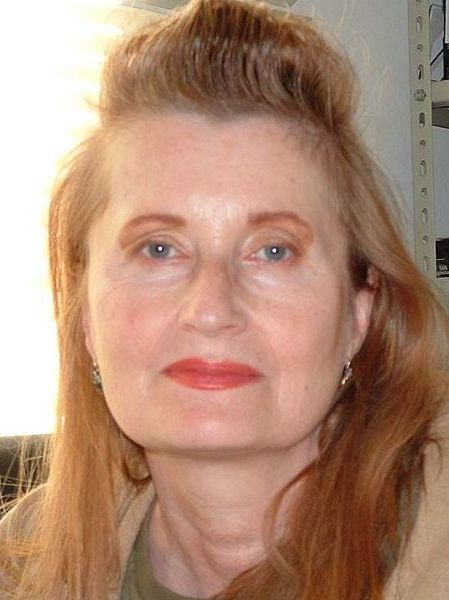

Nobel Prize in Literature · 2004
Elfriede Jelinek
An Austrian writer who turned everyday clichés inside out to expose sexism, violence and her country's buried Nazi past.
The Nobel citation: “for her musical flow of voices and counter-voices in novels and plays that with extraordinary linguistic zeal reveal the absurdity of society's clichés and their subjugating power”
- Born
- October 20, 1946, Mürzzuschlag, Austria
Literature prize
2004
Awarded alone.
Age that year
58years
Born in 1946.
Sources cited
23
Fact-checked September 24, 2026.
- Social phobia kept her away from the 2004 Nobel ceremony in Stockholm. She sent her Nobel lecture, titled Sidelined, as a pre-recorded video instead.
- In the 1995 election campaign, Jörg Haider's far-right party put up posters that set her against 'culture'. She answered by barring Austria's state theatres from staging her plays.
- She trained as a musician first, passing the organist's exam at the Vienna Conservatory in 1971. She says she works with language the way a composer works with sound.
- Her 1983 novel The Piano Teacher became Michael Haneke's 2001 film. In 2004 she became only the tenth woman to win the Nobel Prize in Literature.
- Her 2008 play Rechnitz confronts the March 1945 massacre of almost 200 Jewish forced labourers near the village of Rechnitz in eastern Austria.
The breakthrough
Novels and plays that make everyday clichés reveal their violence
Jelinek writes about power: men over women, the rich over the poor, and a present that would rather forget its past. Her method is unusual. She does not build lifelike characters and let a story unfold. Instead she collects the ready-made language around us, from adverts, soap operas, comics, pulp romances, sports talk and politicians' slogans. Then she runs it through her own text until it gives itself away. She has compared this to a doctor tapping on a patient's chest to hear what is wrong inside. Imagine replaying a cheerful holiday advert again and again, each time a little twisted, until you start to hear the cruelty under the jingle. That is roughly what her sentences do. In novels such as Women as Lovers, Wonderful, Wonderful Times and The Piano Teacher, popular dreams of love, success and the good life trap people in cycles of violence and submission. Her later plays dropped normal dialogue altogether. They are long streams of voices that directors are free to cut and rearrange, and they helped change how German-language theatre is staged. The Swedish Academy praised the musical interplay of voices and counter-voices in her work, and she links it to her years of studying composition.[1],[2],[3],[4],[6],[7],[16]
“I do not fight against men, but against the system that is sexist.”
What it meant for humanity
Jelinek's impact is on how people see things. She did not change what they eat or how they heal. Her first target was the treatment of women. From the 1970s her novels showed women trapped by money, marriage, violent men and the glossy images sold to them. The Swedish Academy named as one of her basic themes the way women are prevented from fully coming to life under stereotyped images. Her 1975 novel Women as Lovers is often counted as her first feminist book.
Her second target was Austria's comfortable myth of its own innocence in the Nazi era. Burgtheater satirised the stars of Vienna's national theatre, which had been part of the Nazi propaganda machine, who carried on their careers after the war as if nothing had happened. In The Children of the Dead, the murdered return to haunt an Alpine holiday idyll. Stick, Staff and Pole grew out of the bomb murder of four Roma and links it to the Nazi murder of Jews and Roma. Rechnitz puts a 1945 massacre of Jewish forced labourers on stage. In each case, she drew attention to crimes and silences many Austrians preferred not to discuss. She paid for it with years of public abuse.
Her third contribution is to theatre itself. By 2016 she had written more than thirty plays. They are open texts that directors can cut and reshape, and they helped shape the style that theatre scholars call post-dramatic. That year the head of her theatre publisher said he suspected she was the most performed German-language author in the world. The Piano Teacher, filmed in 2001, and the 2004 Nobel brought her work to readers far beyond Austria.
- She became only the tenth woman to win the Nobel Prize in Literature. The Swedish Academy highlighted her portrayal of women unable to come fully to life beneath stereotyped images.[3],[11]
- Novels and plays such as Burgtheater, Wonderful, Wonderful Times and The Children of the Dead challenged Austria's myth that it bore no guilt for the Nazi era.[7],[9]
- Rechnitz (The Exterminating Angel), first staged in Munich in 2008, confronts the March 1945 murder of almost 200 Jewish forced labourers in Burgenland. It won the Mülheim Dramatists' Prize in 2009.[17],[18]
- Stick, Staff and Pole took up the bomb murder of four Roma in an Austrian village, which much of the press treated with indifference, and linked it to the Nazi extermination of Jews and Roma.[7]
- By 2016 she had written more than thirty plays. The head of her theatre publisher suspected she was the most performed German-language author in the world, and her open texts shaped a style of directing.[16],[17]
Impact in numbers
Jelinek's impact is on awareness, and it cannot honestly be counted. For half a century she has made readers and audiences hear the violence hidden in ordinary language: in adverts, romance novels, sports talk and political slogans. She showed how that language keeps women small, and how a nation can talk its way out of its past. In Austria, which long clung to a myth of its innocence in the Nazi era, her plays and novels kept the Nazi crimes, the murder of Jews and later racist violence in public view, and she was vilified for it. In German-language theatre, her open, many-voiced texts changed how directors work. Her influence belongs to the shared outcomes of Holocaust remembrance, feminist thought and modern theatre. Her share of those outcomes cannot be separated from that of historians, activists and other artists, and no reliable figures measure it, so we make no numerical claim.
CultureWomen's rights
No number is given here on purpose. Some contributions cannot be counted honestly, and we would rather describe them than invent a figure.
The double edge
No physical harm flows from Jelinek's writing, but her record has real controversies. The gravest is her support, with other writers, for the release of the convicted murderer Jack Unterweger. Once freed, he went on to kill again. Her explicit, violent treatment of sex has been called pornographic by some critics, and in 2005 a member of the Swedish Academy resigned in protest at her prize. She was a Communist Party member for 17 years and defended the socialist experiment even after 1989.
- Moderate
Backing the release of a man who went on to kill
Writers including Jelinek and Günter Grass championed Jack Unterweger, convicted in 1976 of murdering a woman, as a model of rehabilitation through writing. Within six months of his release in 1990 he began killing again, murdering sex workers in Austria, Prague and Los Angeles. A Graz court convicted him of nine murders, and he killed himself the following night.[13]
- Minor
Branded 'violent pornography' by a Nobel juror
In October 2005 Swedish Academy member Knut Ahnlund quit in protest at her prize, calling her work whingeing, violent pornography and claiming it had harmed the award. The academy's secretary replied that Ahnlund had not attended meetings for nearly ten years. Her German editor called the attack absurd.[12]
- Minor
Seventeen years in the Communist Party
She joined the Austrian Communist Party in 1974 and left on 15 March 1991. After the Eastern bloc collapsed, she still defended the socialist countries' attempt at socialism and objected to the media's treatment of former East German leader Erich Honecker. A 2013 University of Vienna study says she went on seeing herself as a Marxist after leaving the party.[19]
Against the odds
Jelinek was born in 1946, a year after the war, so she did not live through the persecution herself. Her father did. When Nazi Germany annexed Austria in 1938, about 192,000 Jews lived there, most of them in Vienna. By late 1942, after mass emigration and deportations to ghettos and killing sites in the east, only about 7,000 remained, mostly people married to non-Jews. Nazi law classed her father, a chemist of Czech-Jewish descent, as half-Jewish. The City of Vienna fired him in 1939. His marriage to a non-Jew and his work at an armaments-linked firm protected him through the war. He later developed dementia and died in a psychiatric hospital in 1969, when Elfriede was 22. Her mother pushed her hard toward a career as a musical prodigy and kept her isolated, and at 18 she suffered a breakdown. Writing became her way out. Post-war Austria then clung to a myth of its own innocence in the Nazi era. When Jelinek wrote about that silence, she was called a traitor, a communist and a pornographer. Newspapers mocked her by rhyming her name with the German word for dirt. In 1995 Jörg Haider's far-right party campaigned against her on posters. Social phobia kept her from receiving the Nobel Prize in person.
1939
Dismissal
Nazi rule cut Austria's Jewish population from about 192,000 in 1938 to about 7,000 by late 1942. Classed as half-Jewish, her father lost his job with the City of Vienna in 1939. His mixed marriage and his work as a chemist at an armaments-linked firm protected him through the war.[3],[8],[21],[23]
1969
Other
Her father developed dementia and died in a psychiatric hospital in 1969, when she was 22. At 18 she suffered a nervous breakdown after years of intense musical training pushed by her mother, and she turned to writing.[8],[10],[23]
1985
Discrimination
After her play Burgtheater exposed the Nazi-era careers of stars of Vienna's national theatre, she was denounced as a traitor, a communist and a pornographer, and was labelled a hater of Austria.[7],[9]
1995
Other
Jörg Haider's far-right party put up campaign posters against her, and the gutter press mocked her name. She withdrew her plays from Austria's state theatres in protest.[7]
Jewish background
Her father, Friedrich Jelinek, a chemist from a working-class family, was of Czech-Jewish descent. Nazi law classed him as half-Jewish. He lost his job with the City of Vienna in 1939 but survived the war, protected by his marriage to a non-Jew and his work at an armaments-linked firm. Her mother, Ilona (née Buchner), was Catholic, and Elfriede attended a Catholic kindergarten and convent school. Her writing keeps returning to the murder of Jews. In 2024 she signed a letter against boycotts of Israeli and Jewish writers. In 2026 she criticised Israeli policy while writing of her love for Israel, which she said had taken in several of her ancestors.[3],[8],[9],[10],[14],[15],[23]
Key dates
October 20, 1946
Born in Mürzzuschlag, Styria, Austria, to a chemist father of Czech-Jewish origin and a mother from a prosperous Vienna family.[1],[3]
1964
Finishes secondary school at the Albertsgymnasium in Vienna and begins studying theatre and art history at the University of Vienna while continuing music studies.[3]
1967
Makes her literary debut with the poetry collection Lisas Schatten.[3]
1969
Her father dies in a psychiatric hospital after years of dementia.[10],[23]
1971
Passes the organist diploma examination at the Vienna Conservatory.[3]
1974
Marries Gottfried Hüngsberg, beginning a marriage split between Vienna and Munich, and joins the Austrian Communist Party.[3],[19],[20]
1983
Publishes the partly autobiographical novel Die Klavierspielerin (The Piano Teacher).[3]
1985
Her play Burgtheater, about Nazi-era stars of Vienna's national theatre, causes a major scandal in Austria.[7]
1995
Publishes The Children of the Dead. Attacked on Freedom Party campaign posters, she bars Austria's state theatres from staging her plays.[3],[7]
1998
2001
Michael Haneke's film of The Piano Teacher brings her work to an international audience.[3],[10]
October 7, 2004
Awarded the Nobel Prize in Literature. Social phobia keeps her away from Stockholm, and her lecture Sidelined is shown on video on 7 December.[1],[2],[5],[6]
November 28, 2008
Rechnitz (The Exterminating Angel), about a 1945 massacre of Jewish forced labourers, premieres at the Munich Kammerspiele.[18]
September 2, 2022
Her husband of 48 years, Gottfried Hüngsberg, a computer scientist and film composer, dies at 77.[20]
Sources
- 1.Elfriede Jelinek – Facts · NobelPrize.org (Nobel Prize Outreach)
- 2.The Nobel Prize in Literature 2004 – Press release · The Swedish Academy / NobelPrize.org, 2004
- 3.The Nobel Prize in Literature 2004 – Bio-bibliography · The Swedish Academy / NobelPrize.org, 2004
- 4.Presentation Speech by Professor Horace Engdahl, 10 December 2004 · NobelPrize.org (Nobel Foundation), 2004
- 5.Elfriede Jelinek – Nobel Lecture: Sidelined · NobelPrize.org (Nobel Foundation), 2004
- 6.Elfriede Jelinek – Interview (Marika Griehsel, November 2004; SVT, 7 October 2004) · NobelPrize.org (Nobel Media), 2004
- 7.Elfriede Jelinek: Provocation as the Breath of Life (Sture Packalén) · NobelPrize.org (Nobel Foundation)
- 8.On Cynicism. Dogs, Hair, Elfriede Jelinek and the Nobel Prize (Leland de la Durantaye, Harvard Review 29) · Harvard Review (author's copy, Claremont McKenna College), 2005
- 9.Jelinek, Elfriede (Encyclopaedia Judaica entry) · Jewish Virtual Library / Encyclopaedia Judaica (Gale, 2007), 2007
- 10.Elfriede Jelinek Biography (Newsmakers) · Notable Biographies (Gale Newsmakers), 2005
- 11.Austrian writer wins Nobel prize · BBC News, 2004
- 12.Nobel winner's work is violent porn, says juror · The Guardian (Luke Harding), 2005
- 13.John Malkovich brings serial killer Jack Unterweger back to life on Vienna stage · The Guardian (Kate Connolly), 2009
- 14.Nobel and Pulitzer winners denounce 'dangerous' Israel cultural boycott · The Guardian (Nadia Khomami), 2024
- 15.Renowned author Jelinek condemns 'land grabbing' in Gaza, West Bank, calls 2-state solution talk 'a lie' · The Times of Israel (liveblog), 2026
- 16.Proper chaos – Elfriede Jelinek's 70th birthday (Wolfgang Höbel), archived copy · Goethe-Institut, 2016
- 17.Elfriede Jelinek (author page) · Rowohlt Theater Verlag
- 18.Rechnitz (Der Würgeengel) – Elfriede Jelineks assoziativer Plappersturm zum Rechnitzer Massenmord (Georg Kasch) · nachtkritik.de, 2008
- 19.Elfriede Jelineks Solidaritätsbekundungen (Britta Kallin) · Forschungsplattform Elfriede Jelinek, University of Vienna (TABU: Bruch portal), 2013
- 20."Ich bin am Boden": Elfriede Jelinek trauert um Ehemann · Kurier, 2022
- 21.Austria (Holocaust Encyclopedia) · United States Holocaust Memorial Museum
- 22.Elfriede Jelinek – Georg-Büchner-Preis 1998 · Deutsche Akademie für Sprache und Dichtung, 1998
- 23.Elfriede Jelinek · Wien Geschichte Wiki (City of Vienna)
Fact-checked on September 24, 2026 by a separate AI fact-checking pass that re-opened the sources, with 11 corrections made. How we check
Suggest a correction