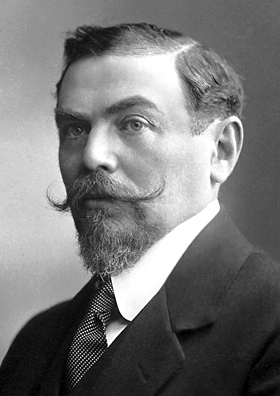

Nobel Peace Prize · 1911
Alfred Fried
A self-taught Viennese bookseller who argued that war would end only when nations built shared rules and institutions to replace anarchy.
The Nobel citation: “for his effort to expose and fight what he considers to be the main cause of war, namely, the anarchy in international relations”
- Born
- November 11, 1864, Vienna, Austria
- Died
- May 4, 1921, Vienna, Austria
- Shared with
- Tobias Asser
Peace prize
1911
Shared with 1 other laureate.
Age that year
47years
Born in 1864.
Sources cited
18
Fact-checked September 24, 2026.
- He left school at 15 to work in a bookshop. Self-taught, he became what the Nobel Committee's chairman called probably the hardest-working pacifist writer of the previous 20 years.
- In 1892 he and Bertha von Suttner founded the German Peace Society in Berlin. Its successor, the DFG-VK, still calls itself Germany's oldest peace organization.
- The peace journal he founded in 1899, Die Friedens-Warte, survived both world wars and a move to Zürich in 1933. Its publisher issued a new volume as recently as 2023.
- During the First World War, Austria accused him of treason for his pacifism. He spent the war in Switzerland and could not go home to Vienna until it ended.
- Bertha von Suttner, the 1905 Peace Prize laureate and his longtime collaborator, was among those who nominated him for the prize in 1911.
The breakthrough
Organized pacifism: fighting war's cause, international anarchy
As a young man, Fried saw pictures of dead soldiers from the Russo-Turkish War, and they turned him from an ardent patriot into a pacifist. Most peace campaigners of his day tried to make people hate war: they described its horrors and called for disarmament. Fried came to see this as treating the symptom, not the disease. In his view war was the symptom of international anarchy: a world of sovereign states with no shared rules, no courts they had to use and no common institutions, so each armed itself against the others. The disappointing first Hague Peace Conference of 1899 sharpened this thinking. The cure, he argued, was organization. International bureaus, treaties and arbitration courts were already appearing, and economic ties between nations were growing. Pacifists should speed that process up and make people aware of it. He set out the theory in a 1908 book on what he called revolutionary pacifism; a 1916 second edition renamed it causal pacifism, stressing its focus on the causes of war. Think of a frontier town with no sheriff and no judge, where every family keeps a rifle. Preaching against violence will not make it safe; building a courthouse might. Fried spent two decades gathering evidence that nations were slowly building such a courthouse, and explaining it in journals, yearbooks and handbooks so that scholars, journalists and politicians would take it seriously.[2],[3],[6],[7],[13],[15]
“War is not in itself a condition so much as the symptom of a condition, that of international anarchy.”
What it meant for humanity
Fried's influence came through print and organization. With Bertha von Suttner he founded the German Peace Society in Berlin in 1892. It grew to about 10,000 members by 1914, and his theory of organized pacifism set its direction until the end of the German Empire. It lives on in a merged successor, the DFG-VK, which calls itself Germany's oldest peace organization. In 1899 he founded Die Friedens-Warte, which he edited until his death. Norman Angell, a later peace laureate, rated it the most effective pacifist periodical in the world, and a new volume appeared as recently as 2023. Fried set out to win German professors of international law and history over to the peace cause, and the Nobel Committee's chairman said in 1911 that he had succeeded. Hans Wehberg, his successor as editor, named the jurists Walther Schücking and Max Huber among those he influenced. His Handbook of the Peace Movement (1905), which the Nobel Committee called his best-known work, gathered the movement's history, conferences and organizations in one place. During the First World War he worked from Switzerland to improve conditions for prisoners of war, and after it he organized international aid for war orphans and widows. He pressed for ideas that later took shape in some form: a league of nations, a union of European states, an effective international court of arbitration and an end to secret diplomacy. The city of Vienna calls him the founder of peace research. In 2011, a century after his prize, it put a memorial plaque on the house where he was living when he won it.
- He and Bertha von Suttner founded the German Peace Society in Berlin on 9 November 1892. It had about 10,000 members by 1914 and lives on in the DFG-VK, which calls itself Germany's oldest peace organization.[3],[7],[11]
- He founded Die Friedens-Warte in 1899 and edited it until his death in 1921. Under his successor it moved to Zürich in 1933, and a new volume appeared as recently as 2023.[2],[4],[18]
- The Nobel Committee's chairman credited him with persuading German professors of international law and history to support and write for the peace cause.[3],[6]
- In Swiss exile during the First World War he worked to improve conditions for prisoners of war. After the war he organized international aid for war orphans and war widows.[2],[8]
- He championed a league of nations, a union of European states, an effective international arbitration court and an end to secret diplomacy, ideas later realized in part.[6],[8],[10],[13]
- The City of Vienna calls him the founder of peace research. In 2011, a century after his prize, it unveiled a plaque on the house where he was living when he won it.[8],[16]
Impact in numbers
Fried's impact was on ideas and institutions, so this profile makes no numerical claims. Counting the people his journalism helped would mean guessing how the world would look without it. What can be documented: he helped found the German Peace Society, which lives on in a successor organization, and a peace journal whose publisher was still issuing new volumes in 2023, more than 120 years after he founded it. He argued that war comes from the lack of international order, and that the fix is shared rules, courts and institutions. Vienna's city history wiki traces his ideas into the founding of the League of Nations and the European Union, though many people shaped those projects and his own share cannot be measured. His hopes were crushed in 1914 and he died poor. His name is little known today, but the question he raised, how to organize a world without war, is still being worked on.
PeaceEducation
No number is given here on purpose. Some contributions cannot be counted honestly, and we would rather describe them than invent a figure.
The double edge
Fried's work caused no documented physical harm, but parts of his record are open to criticism. Before 1914 he publicly defended Kaiser Wilhelm II as a friend of world peace, including in a 1910 book, and during the war he rebutted what he saw as unfair criticism of Germany in the French, British and American press. His central prediction also failed. He believed growing international organization would steadily make war obsolete, and the First World War proved him badly wrong. His successor as editor of Die Friedens-Warte later conceded that he had overestimated the power of international organization. After the war he campaigned against the Versailles and Saint-Germain peace treaties, and he was also critical of the new League of Nations.
- Minor
Defending the Kaiser
Before the First World War Fried portrayed Wilhelm II as committed to peace, including in his 1910 book The Emperor and World Peace, which the Encyclopaedia Judaica calls a defense of the Kaiser's policies. During the war he rebutted criticism of Germany in the Allied press.[2],[10]
- Minor
An optimism that 1914 overturned
Fried held that the world was evolving toward peace as international organization grew. The outbreak of war in 1914 hit him hard, and his biographer Hans Wehberg later conceded that Fried had overestimated what international organization could achieve.[4],[6]
- Minor
Campaign against the peace treaties
After the war he organized a press campaign against the Versailles Treaty and published a collection of protests against it. He also opposed the Treaty of Saint-Germain with Austria and criticized the League of Nations as it was actually set up.[2],[6]
Against the odds
Fried grew up in Vienna as political antisemitism took hold. In 1879, when he was in his teens, the German nationalist Georg von Schönerer brought antisemitism into Austrian politics, and in 1887 Viennese student fraternities began refusing Jewish members. When Fried moved back to Vienna in 1903, the city was run by Karl Lueger, mayor from 1897 to 1910, who had become leader of the antisemitic movement. Fried left school at 15 to work in a bookshop and taught himself the rest. He then built his career in Imperial Germany, where a peace society looked like an attack on a militaristic state. The German Peace Society faced sharp attacks from the moment it was founded, and Suttner wrote that Germany was the least promising soil imaginable for his ideas. The First World War brought censorship: his journal was banned in Germany, German newspapers branded him a traitor, and the Austrian government accused him of treason, so he spent the war in Switzerland. After the war, his criticism of the peace treaties and of right-wing figures forced him to leave Munich in haste. He lost what wealth he had when Austria-Hungary collapsed and died poor in 1921. From 1938, Nazi Germany's lists of banned writing outlawed all of his works. The sources we consulted describe attacks on him as a pacifist; they do not document antisemitic attacks aimed at him personally.
—
Discrimination
Antisemitism became a force in Viennese politics while he was young: Schönerer made it a platform in 1879 and student fraternities barred Jews from 1887. When he moved back in 1903, the antisemitic leader Karl Lueger was mayor (1897-1910).[8],[9]
—
Other
He left school at 15 and trained as a bookseller. The Nobel Committee's chairman called him self-educated and praised how he had taught himself to write at a scholarly level.[2],[3]
1914
Censorship
After war broke out, his journal came under military censorship and was banned in Germany, German newspapers branded him a traitor, and Austria censored pacifist activity. His writings were banned during the war.[2],[4],[8]
1914
Exile
He moved his work to neutral Switzerland. Accused of treason by the Austrian government, he could not return to Vienna until the war was over.[2],[10]
—
Persecution
After the war he tried to settle in Munich, but his criticism of the peace treaties, of German policy and of right-wing figures made that impossible, and he had to leave the city in haste.[8]
1921
Poverty
He lost what wealth he had in the collapse of Austria-Hungary and died in poverty in Vienna.[2],[4]
1938
Censorship
The Nazi regime's lists of harmful and undesirable writing, compiled from 1938 to 1941, banned all of his writings.[12]
Jewish background
Fried was born in Vienna into a Jewish family with roots in Hungary, the eldest of nine children. His father, Samuel, came from Szigetvár in Hungary; his mother, Bertha Engel, was the daughter of a Budapest merchant. The Encyclopaedia Judaica gives him an entry, and a 1972 article called him the forgotten Austrian-Jewish Nobel peace laureate. The sources we found record no Jewish religious or communal involvement in his adult life, and none describe how he saw his own Jewish background. He was a Freemason, and his urn rests at Vienna's Simmering crematorium.[6],[8],[10]
Key dates
November 11, 1864
Born in Vienna into a Jewish family, the eldest of nine children.[1],[8]
1887
After leaving school at 15 and training as a bookseller, opens his own publishing business in Berlin.[2],[7]
1891
Inspired by Bertha von Suttner, he devotes himself to the peace movement.[3],[6],[7]
November 9, 1892
Founds the German Peace Society in Berlin with Suttner; the same year they launch the peace journal Die Waffen nieder! (Lay Down Your Arms).[3],[4],[11]
1899
Founds Die Friedens-Warte. The disappointing first Hague Peace Conference turns his thinking toward international organization.[2],[6]
1903
Returns to Vienna and becomes Suttner's closest collaborator; publishes a textbook of the international language Esperanto.[8]
1905
Publishes his Handbook of the Peace Movement, later expanded into two volumes.[3],[6]
1908
Publishes his theory that pacifists must attack war's cause, international anarchy, in The Foundations of Revolutionary Pacifism.[2],[3]
December 10, 1911
Awarded the Nobel Peace Prize, shared with Tobias Asser of the Netherlands. Suttner was among his nominators.[1],[3],[4],[5],[17]
1913
Receives an honorary doctorate from Leiden University.[6],[7]
1914
War breaks out. He moves his work to Switzerland, where the Austrian government's treason accusation keeps him until the war ends.[2],[14]
1920
Publishes a collection of worldwide protests against the Versailles peace treaty, part of his campaign against it.[2]
May 4, 1921
Dies in poverty in Vienna of a lung infection, aged 56.[1],[2]
1938
Nazi Germany's lists of banned writing, compiled from 1938 to 1941, outlaw all of his works.[12]
Sources
- 1.Alfred Fried – Facts · NobelPrize.org (Nobel Prize Outreach)
- 2.Alfred Fried – Biographical · NobelPrize.org; from Nobel Lectures, Peace 1901-1925 (Elsevier), 1972
- 3.Award ceremony speech, Nobel Peace Prize 1911 (Jørgen Gunnarsson Løvland) · NobelPrize.org, 1911
- 4.Alfred Fried – Speed read · NobelPrize.org (Nobel Prize Outreach)
- 5.The Nobel Peace Prize 1911 – Summary · NobelPrize.org (Nobel Prize Outreach)
- 6.Fried, Alfred Hermann (Hans Wehberg), Neue Deutsche Biographie 5 (1961), pp. 441-442 · Historische Kommission bei der Bayerischen Akademie der Wissenschaften (Deutsche Biographie), 1961
- 7.Fried, Alfred Hermann (1864-1921), Schriftsteller und Publizist · Österreichisches Biographisches Lexikon 1815-1950, Austrian Academy of Sciences, 1956
- 8.Alfred Hermann Fried · Wien Geschichte Wiki (City of Vienna)
- 9.Antisemitismus · Wien Geschichte Wiki (City of Vienna)
- 10.Fried, Alfred Hermann (Josef J. Lador-Lederer) · Encyclopaedia Judaica (via Encyclopedia.com), 2007
- 11.Jahrgang 1892 – Zur Geschichte der ältesten deutschen Friedensorganisation · Deutsche Friedensgesellschaft – Vereinigte KriegsdienstgegnerInnen (DFG-VK)
- 12.Alfred Hermann Fried (entry in the database of publications banned under National Socialism) · Verbrannte und Verbannte (Coding da Vinci project, based on Berlin open data)
- 13.Alfred Hermann Fried: Peace Activist and Nobel Prize Laureate (Petra Schönemann-Behrens), Brill's Specials in Modern History 5 · Brill, 2021
- 14.Fried (Alfred H.) papers, 1914-1921: finding aid · Hoover Institution Library & Archives, via Online Archive of California
- 15.11.11.1864 – Der Geburtstag von Alfred Hermann Fried (ZeitZeichen) · WDR 5 (Westdeutscher Rundfunk), 2014
- 16.Alsergrund: Gedenktafel für Nobelpreisträger Fried · Stadt Wien, Rathauskorrespondenz (press service), 2011
- 17.Alfred Fried – Nominations · NobelPrize.org (Nobel Prize Outreach)
- 18.Die Friedens-Warte: journal page (first published 1899; volume 96, December 2023) · Berliner Wissenschafts-Verlag, via BiblioScout, 2023
Fact-checked on September 24, 2026 by a separate AI fact-checking pass that re-opened the sources, with 8 corrections made. How we check
Suggest a correction